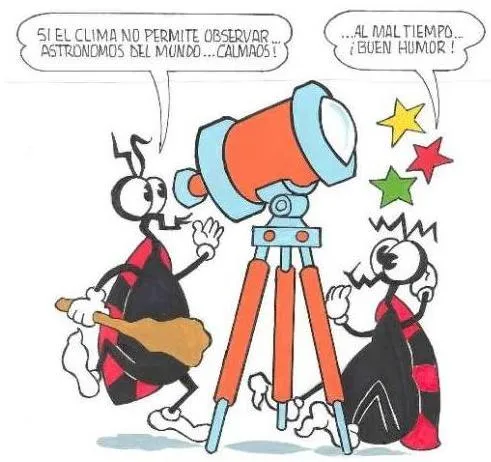
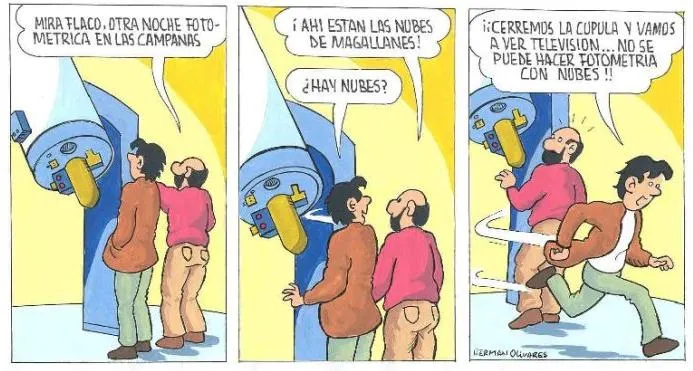
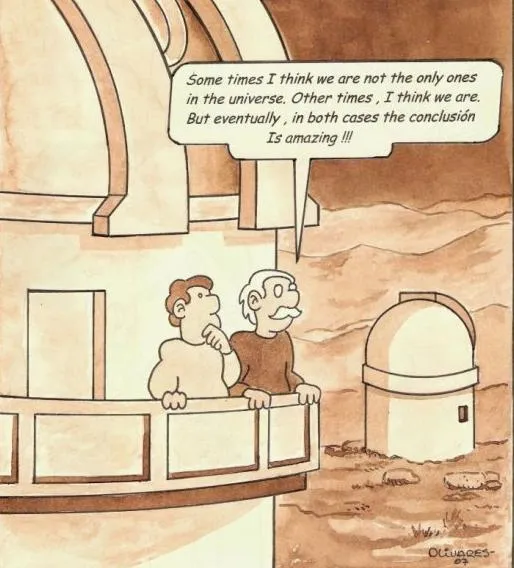
An astronomical observatory is a true community of astronomers, technicians, and various staff. At the Chilean Las Campanas Observatory, professional seriousness is tempered by the humor proposed by one of its operators, through comic strips.
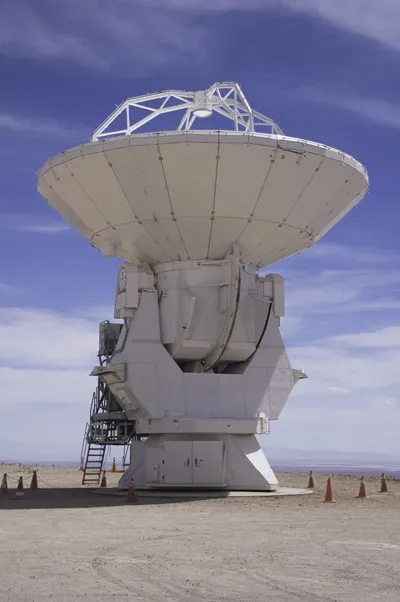
The Las Campanas Observatory (LCO) is an astronomical observatory operated by the Carnegie Institution of Washington. It is located in the Andes Mountains of the Atacama Region, 27 kilometers north of the La Silla Observatory (located in the Coquimbo Region), and the city closest to the observatory is Vallenar, Chile.
It has several instruments:
Magellan Telescopes - 6.5 m twins, named Walter Baade (September 15, 2000) and Landon Clay (September 7, 2002)
Irénée du Pont Telescope (1977) - 2.5 m
Henrietta Swope Telescope (1971) - 1 m
I just saw part of a documentary aired by Canal 7 in its TV Regional cycle, about this observatory where Chileans, Argentines, Poles, and Canadians coexist. I didn't see it from the beginning, so I don't know its name, so if anyone knows it and informs me, I'll be grateful.
What I saw was very instructive and interesting because the documentary allows you to know the life of the observatory community, the activities of the personnel involved, both the research astronomers, the operators and technicians, those in charge of vehicle maintenance and even the chef of the place. The instrumentation they have and the difficulty of its operation and maintenance is impressive. The control room, full of monitors running the programs, amazed me.
And watching the documentary, I learn about Herman Olivares, who has worked as an operator for many years at the site.
It turns out that Herman is a very good cartoonist with a great sense of humor, so he decided to create "El Cahuín Ilustrado", gossipy but well-informed.

Cahuín is a Mapuche word meaning mess or uproar. Cahuín was a meeting of the caciques or loncos (chiefs of the Araucanian tribes or rehues, in times of war and peace, respectively) where the current situation and copuchas [gossip] were discussed. Already in the times of the conquest, when the Mapuches learned about alcohol (and I believe that greatly caused their degradation) a lot was drunk at the cahuines, causing the comments or conversations to be strange or absurd. Hence comes the term cahuín as an unfounded statement, and generally about personal aspects of someone.
In "El Cahuín" the characters of some of the observatory's members are aired out (hence the "copuchento" part), with a good sense of humor.
Carnegie Institution of Washington
The Carnegie Institution of Washington is a private, non-profit institution committed to research in basic science and education, in the areas of astronomy, biology, and Earth sciences. It was founded by Andrew Carnegie in 1902 and incorporated by an act of the United States Congress in 1904. Carnegie, who initially donated US$10 million and later gave several additional millions, conceived the Institution with the purpose of "stimulating, in the broadest and most liberal manner possible, research, discovery, and the application of knowledge for the development of humanity".
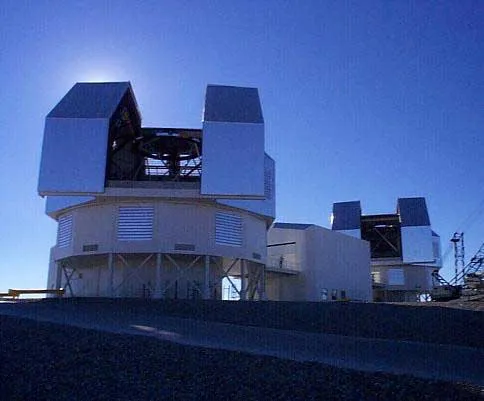
In the first half of the 20th century, the Institution's leadership in astronomy was sustained thanks to its telescopes on Mount Wilson, California. However, due to the increase in the brightness of the night sky as a result of population growth in southern California, the Institution discontinued the use of these telescopes more than a decade ago. A non-profit institution, the Mount Wilson Institute, is today responsible for the operations of that observatory, including the refurbishment of the Hooker telescope, with a 2.5-m diameter reflecting mirror. The observing station for Carnegie astronomers today is the Las Campanas Observatory in Chile, a spectacularly dark site for astronomical observation. At that observatory, Carnegie maintains the 2.5-m diameter Irénée du Pont reflecting telescopes and the 1-m diameter Swope. At the same site, the Carnegie Institution, together with the Universities of Arizona, Michigan, Harvard and the Massachusetts Institute of Technology, is building the so-called Magellan project: two reflecting telescopes with 6.5-m diameter mirrors each.
Some of Carnegie's researchers from the early and mid-20th century are well known:
Edwin Hubble, who revolutionized astronomy with his discovery that the universe is expanding and that there are other galaxies besides the Milky Way;
Charles Richter, creator of the earthquake measurement scale that bears his name;
Barbara McClintock, who won the Nobel Prize for her work on patterns of genetic inheritance;
Alfred Hershey, who won the Nobel Prize for his work on the replication mechanism of viruses and their genetic structure;
Vera Rubin, who received the Presidential Medal of Science for her work confirming the existence of dark matter in the universe;
Andrew Fire, who shared the 2006 Nobel Prize in Physiology or Medicine with Craig C. Mello for the discovery of RNA interference.
Murphy's laws in astronomy
Because Murphy's laws could not be alien to astronomy, below are some with which more than one amateur can identify... :)
- The amount of clouds is directly proportional to the astronomer's desire to observe
- The amount of cloudiness is directly proportional to the astronomer's availability to observe
- The amount of cloud cover is inversely proportional to the illuminated percentage of the Moon
- Corollary: During a drought, the number of lights left on by neighbors will be inversely proportional to the amount of moonlight
- Under partially cloudy skies, the clouds will cover exactly those objects you most want to observe, leaving other areas completely cloud-free
- Out of the ten nights with the best visibility conditions of the year, you will have to attend some indoor evening event for at least eight of them
- As well as during eclipses, transits and the like
- As visibility conditions improve, your spouse's demands for you to return to bed will increase
- In winter, the temperature is always at least 10 degrees lower than what you dressed for
- Corollary: In summer, the number of mosquitoes is directly proportional to the number of stars (also known as the "West Nile Corollary")
- During summer, the number of mosquitoes is always ten percent higher than anticipated -and what you have applied repellent for.
- The quality of the sky (including weather, number of clouds, etc.) will vary inversely proportional to the day of the week; that is, the best viewing period will invariably fall on a work night, limiting the time available to enjoy it
- During the rarest astronomical events, such as transits, asteroid occultations, or a comet passing close by, you will undoubtedly be sent out of town on a business trip, or a major family event will occur. When nothing is happening in your life, nothing new will happen in the Sky. Guaranteed!
- In the event that you were not out of town, or engaged in overwhelmingly banal family activities, and furthermore the sky was clear, the event will occur within one or two degrees of the Full Moon
- In the event that the previous assumptions do not hold, you would be attacked by an ailment whose nature would force you to stay in bed for a period of no less than twelve hours, but less than the next occurrence of the cases described above
- The likelihood of lights, lanterns, headlights, interior lights, or taillights being turned on is directly proportional to the number of open shutters and the number of observers who have begun their adaptation to night vision
- Just when you find the object you've been looking for all night, the neighbor will turn on the house lights, ruining your dark adaptation
- Eyepieces suffer an irresistible magnetic attraction to concrete, unlike small screws and nuts which suffer an irresistible magnetic attraction to tall grass
- All power outages happen on cloudy nights or nights with a Full Moon
- Murphy's Corollary for Observation in the Arctic Zone: "Perfect observing conditions on New Moon nights inevitably lead to the appearance of massive and bright auroras"
- A thermos always falls on the nearest map. Expensive copies or those without lamination have priority. This principle does not apply if the thermos were empty
(Contributed by AAV, Asociación Astronómica Vizcaína)
More astronomical humor at Austrinus
Sources and related links
- Carnegie Institution
- More strips of El Cahuín Ilustrado
- Las Campanas Observatory
- More about Las Campanas at Círculo Astronómico
About the images
Credit: Herman Olivares