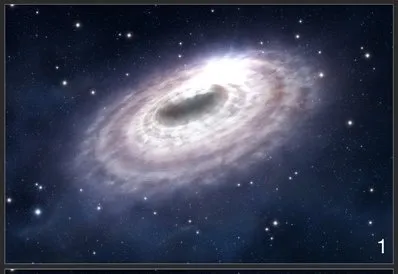
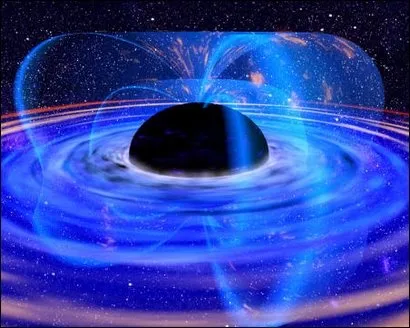
Thanks to natural gravitational lenses, astronomers have scrutinized the inner regions of a disk around a black hole, 10 billion light-years away.
The team of astronomers from Europe and the U.S. studied the so-called "Einstein Cross". This cross-shaped configuration consists of four images of a very distant source. The multiple images are the result of the gravitational lensing effect produced by a foreground galaxy. The light source is a quasar (QSO 2237+0305) 10 billion light-years away, while the foreground galaxy is 10 times closer. The light from the quasar is bent and magnified by the gravitational field of the galaxy acting as a lens.
This effect is known as gravitational lensing or "lensing" in English. When the effect is produced by a large object (like a galaxy) it is called "macrolensing". It consists of observing the light from a very distant object thanks to another large object between Earth and the observed one acting as a lens. Large galaxies and galaxy clusters possess strong gravitational fields that cause the light from a more distant object to curve and magnify, allowing astronomers to study objects that, otherwise, they could not observe. If we also add the use of a large observatory, like the VLT, the result is enticing.
"The combination of this natural magnification with the use of a large telescope provides us with the sharpest details ever obtained," said Frédéric Courbin, leader of the program studying the Einstein Cross (also called "Huchra's lens" in honor of astronomer John Peter Huchra) at ESO.
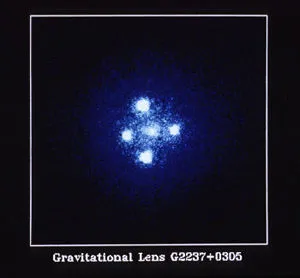
As if that were not enough, the stars in the lensing galaxy act as secondary lenses to produce additional magnification, called "microlensing". Since the stars are moving in the lensing galaxy, the magnification also changes with time. From Earth, the brightness of the quasar images varies by a certain amount. The size of the area magnified by the motion of the stars is a few light-days, comparable to the size of the quasar's accretion disk.
Microlensing affects various emission regions of the disk in different ways, with small regions being more magnified. Since the different regions have different temperatures, the net effect of microlensing is a variation in color in the images, in addition to the brightness variations. By observing these variations in detail over several days, astronomers can measure how matter and energy are distributed around the supermassive black hole hidden in the quasar. The astronomers observed the Einstein Cross three times per month over a period of three years using the VLT, monitoring all the color and brightness changes of the four images.
"Thanks to this unique set of data, we were able to show that the most energetic radiation is emitted in the central light-day from the supermassive black hole and, more importantly, that the energy decreases with distance from the black hole almost exactly in the way theory predicts," explains Alexander Eigenbrod, who completed the data analysis.
The use of gravitational lenses, together with the giant eyes of the VLT, allowed astronomers to investigate regions on scales as small as one millionth of an arcsecond. This corresponds to the size of a coin at a distance of five million kilometers or 13 times the distance to the Moon!!
"This is 1000 times better than what we can achieve using normal techniques with any telescope," adds Courbin.
Measuring the way temperature is distributed around the central black hole is a unique achievement. Several theories exist about the formation of quasars, each with different predictions. Until now, no direct observation has allowed scientists to validate or invalidate the existing theories, particularly for the central regions of a quasar. "This is the first direct and precise measurement of the size of a quasar accretion disk, independent of any model," concluded Georges Meylan, a team member.
Sources and related links
- Astronomers Dissect a Supermassive Black Hole with Natural Magnifying Glasses
ESO press release with more images and videos - Microlensing variability in the gravitationally lensed quasar QSO 2237+0305 = the Einstein Cross
A&A 480, 647-661 (2008)
DOI: 10.1051/0004-6361:20078703
and
A&A 490, 933-943 (2008)
DOI:10.1051/0004-6361:200810729
A. Eigenbrod - F. Courbin - G. Meylan - E. Agol - T. Anguita - R. W. Schmidt - J. Wambsganss - INTEGRAL DISCOVERS AN EMISSION ARC IN THE "EINSTEIN CROSS"
About the images
Credit:ESO/F. Courbin et al.