For astronomers at the European Southern Observatory (ESO), the holidays come in the form of a fantastic new image. It shows the gas around the region known as NGC 2264, an area of the sky that includes the bright blue jewels of the "Christmas Tree" star cluster.
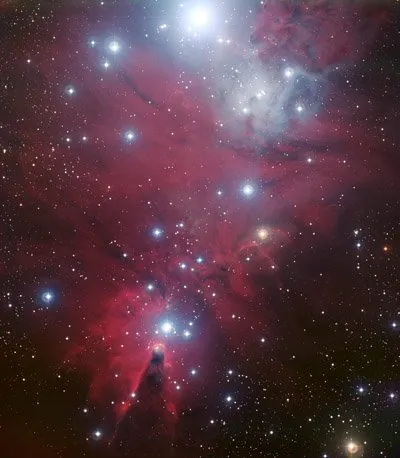
NGC 2264 lies 2,600 light-years from Earth in the constellation Monoceros, the Unicorn, not far from the more familiar figure of Orion, the Hunter. The image shows a region of space about 30 light-years in diameter.
William Herschel discovered this fascinating object during his survey of the skies in the late 18th century. He first noted the bright cluster in January 1784 and the brightest part of the more elusive gas clouds on Christmas two years later. The cluster is very bright and can be easily seen with binoculars. With a small telescope (whose lenses will make the image appear upside down) the stars recall the bright lights on a Christmas tree. The dazzling star at the top is even brighter, enough to be observed with the naked eye. It is a massive multiple star system that emerged from the gas and dust a few million years ago.
In addition to the cluster there are other interesting and curious structures in the gas and dust. At the bottom, the dark triangle is the Cone Nebula, a region of molecular gas flooded with the powerful radiation from the brightest members of the cluster. The region to the right of the brightest star has a texture resembling skin, which is why it has been called the Fox Fur Nebula.
Much of the image appears red because the gigantic gas clouds are glowing under the intense ultraviolet light of the energetic young stars. The stars themselves appear bluish as they are hotter, younger and more massive than our Sun. Some of this bluish light is being scattered by the dust, as seen in the upper part of the image.
This intriguing region is an ideal laboratory for studying star formation. The area shown here is only a small part of a vast cloud of molecular gas that is in the process of forming new stellar generations. In addition to the spectacular visible objects, there are others hidden in the nebula. In the region between the tip of the Cone Nebula and the brightest star at the top of the image there are several areas where stars are being born. There is evidence of intense stellar wind from these young embryos.
The image, including the Christmas Tree cluster, was created from images taken with the WFI camera on the Max-Planck telescope at the La Silla Observatory in Chile.
Sources and related links
- Larger photos and press release:
A Sparkling Spray of Stars - Atlas of the Universe: NGC2264 - The Cone Nebula
- NGC 2264 at SEDS
About the images
Credit: ESO