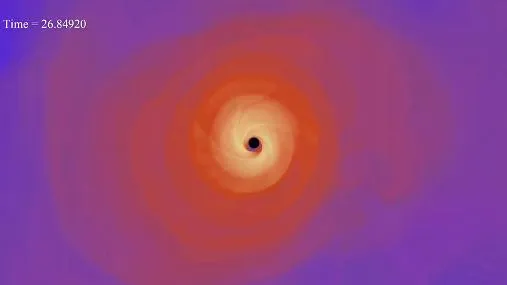
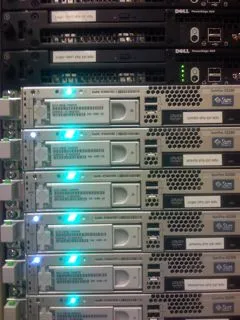
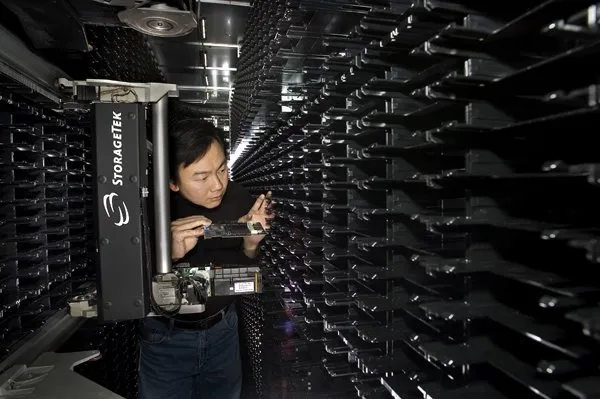
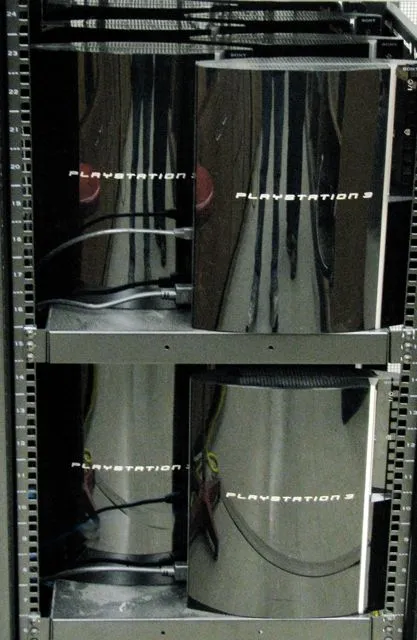
If you are a fan of this console or if you just received it as a gift for the holidays, you should know that you can do more than just kill monsters or race cars. A group of researchers configured 16 PlayStation 3s together to create a type of supercomputer that is helping them estimate the properties of gravitational waves produced by the merger of two black holes.
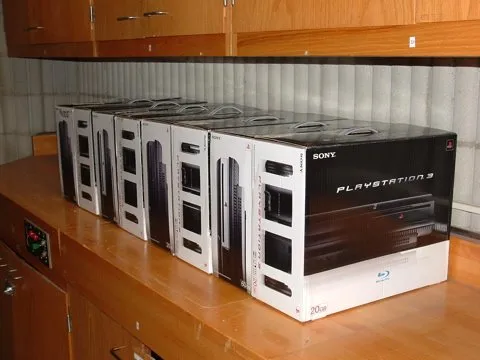
The Sony PlayStation 3 has a number of unique features that make it special for scientific computing. First, as indicated on the researchers' group page, it is an open platform, meaning that different system software can be run on it, for example PowerPC Linux. It has a processor (Cell Processor) developed by Sony, IBM and Toshiba, which has a main CPU and 6 special-purpose cores (SPUs) that perform vector operations. And its cost makes it attractive as a scientific computing node as part of a cluster. According to them, the computational power per dollar is significantly higher than anything else on the market.
Thanks to a donation from Sony, the team was able to form a cluster of 16 PS3s, which they called PS3 Gravity Grid. This cluster or group of interconnected equipment is "stock," with no hardware modifications. They work together using a Netgear switch and for the installation of Linux there are several guides on the internet.
Gaurav Khanna, an astrophysicist at the University of Massachusetts, had been renting time to perform calculations on supercomputers. Renting 30,000 hours (annual average) costs between $20,000 and $30,000.
"For about $4,000 I can have 8 PS3s that can do the same task I do with a supercomputer. For a one-time cost, I have this resource that I can use privately. I can use it indefinitely, over and over again. It's enormously attractive. That's why I considered the project," he told ComputerWorld.
Projects
Merger of binary black holes using Perturbation Theory
The project deals with estimating the properties of gravitational waves produced by the merger of black holes. Gravitational waves are "waves" in spacetime that travel at the speed of light. They were theoretically predicted by Einstein in his general relativity, but have not been directly observed. There is currently an intense search being carried out by LIGO and other observatories. The planned LISA mission by the European and American agencies will also search for these elusive waves.
Performance tests
These tests, called benchmarks, performed on the cluster of 16 PS3s are the ones used by top500.org which lists the world's most powerful supercomputers. PS3 Gravity Grid generates a performance of 40 GFLOPS (40 billion calculations per second). It should be noted that they use double precision for the calculations. If they were single precision, the speed would increase notably.
Sources and related links
- Studying Black Holes Using a PlayStation 3
- PlayStation3 Gravity Grid
- PS3 cluster creates homemade, cheaper supercomputer
About the images
Credit: PS3 Gravity Grid