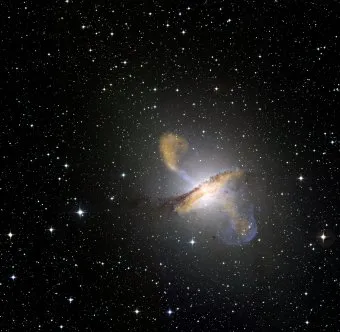
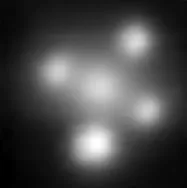
At the heart of MCG-6-30-15, a galaxy 130 million light-years away, there is a hole. It is as big as the orbit of Mars. Stars, gas, and dust are always falling into this hole—a lot of material, equivalent to a hundred million suns. Nothing escapes from this hole, not even light. It is perfectly black, like the mouth of a long tunnel. It is a black hole, rotating. For some years now, it has been speculated that it could release energy. A review of the debate, based on an article from Discover.
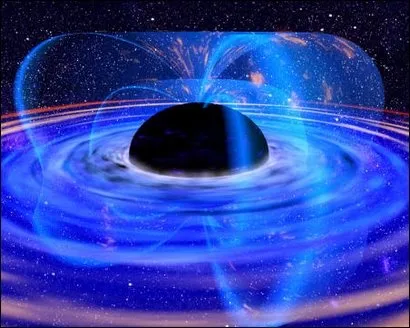
From our planet, MCG-6-30-15 doesn't say much. It is a lenticular galaxy, without the photogenic arms that make spiral galaxies like the Milky Way stand out. "It is very indistinguishable," says Andrew Fabian, an astronomer from Cambridge, who has been studying it for over a decade.
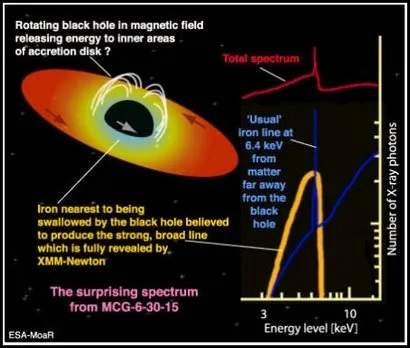
In 2002, a team led by Jörn Wilms from the University of Tübingen in Germany, published the best spectrum to date of the galaxy. It didn't look like much, just a curve of dots with a small peak in the center. It was Figure 1 of their scientific report.
"We couldn't believe what it was," says Wilms. The graph, as he and his colleagues indicate, represents a giant black hole rotating almost at the speed of light, the space-time around it is twisted like a whirlpool and the fluorescent iron atoms that trace that fantastic movement melt like leaves in a whirlpool of water.
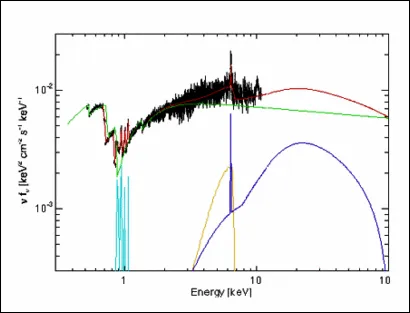
The X-ray glow from those iron atoms is so intense that gravitational heating alone cannot explain it. What that small graph could represent is the detection of a new source of cosmic energy, one predicted a quarter of a century ago but never observed. Some theorists believe that a large part of all the light in the universe, including its most spectacular bursts, could be generated in this way. Its basic principle is familiar, Michael Faraday discovered it in 1831. But this scenario is exotic, to say the least. If Wilms and colleagues are right, there is not just a hole, but an electromagnetic generator at the heart of MCG-6-30-15, one that takes the rotational energy of space-time and converts it into light, almost like a car's alternator generates electricity.
There was a time, before Faraday, when generators would have been more exotic than black holes, since the latter were conceived first. Reverend John Mitchell of Yorkshire, England, a geologist and astronomer, as well as a clergyman, predicted their existence in 1784, using Newton's physics. For Newton, light was made of particles with mass, and gravity was a force exerted by massive objects on each other. The more massive and compact an object was, the greater the speed required to escape its gravity. Michell calculated that a star 500 times larger and more massive than our Sun would have an escape velocity of the speed of light. The light particles would then fall to the surface of the star, like arrows or cannonballs do to Earth. Since light could not leave the star, it would appear totally black.
But this is a somewhat mistaken idea that still remains in many of us, that a black hole is a star so massive that not even light can escape from it.
The reality is a bit more disturbing, because black holes obey Einstein's laws, contained in his General Theory of Relativity. For Newton, gravity was a mysterious force that somehow emanated from mass and acted instantly over great distances. For Einstein, a massive object curves the space-time around it. Thus, it curves the path of anything traveling through space-time, including light, whose particles—photons—have no mass, contrary to what Newton thought.
The gap between Einstein and Newton increases as gravity and the curvature of space become stronger, with black holes being the most extreme case.
Einstein himself refused to believe that these objects could exist. Today it would be difficult to find scientists who disbelieve their existence. It's that when enough mass is concentrated in a space, for example, a large star that has consumed its nuclear fuel, no force can resist the implosive gravity.
That is a black hole: a never-ending implosion. It is not just a dark star, it is an infinitely deep hole in space-time. It forms when a massive object implodes and concentrates into a critical circumference called the event horizon, and so continues until all the mass is concentrated in a singularity.
"Think of a black hole not simply as a place where gravity is extremely strong but as a place where space-time is being continuously pushed into the hole," notes astrophysicist Mitchell Begelman of the University of Colorado, one of the authors of Wilms's paper. "Space is not outside the hole in a stationary form. It is being stretched and pushed into the hole."
Time is also stretched. If we could watch from a distance a clock falling into a black hole, we would see it slow down, and at the event horizon it would stop. If the clock were on the wrist of a person carrying a flashlight and they turned it on towards us, we would see that the light waves would also be stretched. That is called gravitational redshift. A light that started out blue would be shifted towards red, infrared, radio waves and at the event horizon it would be infinitely long and would disappear.
Our friend would not see the same thing. In his frame of reference, his clock and his blue light would behave normally (that's relativity). Of course, his fate is sealed. Once he penetrates the event horizon he will not be able to leave and will be stretched as he approaches the singularity.
That is a black hole: a place where the future leads only inward with unpleasant results. Now let's imagine it rotating very rapidly.
Most black holes must rotate, at least a little. Stars also do and when a large one collapses, the resulting black hole must rotate faster since the same amount of angular momentum will be concentrated in a smaller amount of space. There would be millions of stellar black holes around our galaxy, each between 5 and 10 times the mass of our Sun.
Besides stellar black holes there are supermassive black holes. The latest estimate for MCG-6-30-15 is about 2.6 million suns. No one is sure how these monsters form. Perhaps from the collision of stellar black holes in the crowded galactic nucleus. In any case, a giant black hole would have been born spinning and as it continues to accrete material, angular momentum is added and its speed increases. It is assumed that eventually, its event horizon could move at the speed of light as an upper limit. A black hole with a mass 100 million times that of the Sun, like MCG-6-30-15, would have a circumference of more than 100 million miles and rotate once every one and three-quarters of an hour.
On June 11, 2000, the X-ray photons that left MCG-6-30-15 during the Cretaceous, 130 million years ago, arrived at the XMM-Newton space observatory. The data from millions of photons was what Wilms studied.
MCG-6-30-15 is nothing more than a point in the sky. From previous observations of its spectrum, combined with many theoretical calculations, astronomers formed a picture of intense activity in its nucleus. The central black hole, scientists believe, is surrounded by a disk of gas that spirals inward. Most of this accretion disk is relatively cold, "which means its temperature is in the millions of degrees," notes Wilms. At that temperature it shines mainly in blue and ultraviolet.

The X-rays must come from a hotter source. Theory says they must come from a tenuous cloud or plasma of electrons and protons, called a corona. To be at billions of degrees, the corona must be so close to the black hole that the falling gas has already converted most of its gravitational energy into heat. And since the corona is small, the X-ray emissions from MCG-6-30-15 can change rapidly. "We have seen its brightness double in 100 seconds," says Fabian.
More than a decade ago, Fabian and his colleagues discovered a way to see into this glowing cloud almost at the edge of the black hole. It was this strange and subtle feature of the X-ray spectrum that Wilms's group was looking for. Some of the X-rays from the corona, the Cambridge researchers noted, would excite iron atoms in the accretion disk. Thus, some iron atoms would fluoresce, emitting their own X-rays at a precise line in the energy spectrum: 6.4 kilo-electron volts (keV), which is the energy an electron loses when it falls one level in an iron atom to a lower one.
Since the iron atoms in the galaxy are moving, astronomers do not see the line at 6.4 keV. Instead, it has a shift, to the blue when the disk moves toward Earth and to the red when it moves away. When astronomers record a spectrum of the entire galaxy, the iron line in both directions. At the same time, it also has a gravitational redshift because some iron atoms are very close to the black hole, where time itself and light waves are stretched.
The result is that the emission line is a broad and asymmetric curve, and the broader it is, the faster the iron must be moving and the closer it must be to the black hole. Fabian predicted all this in 1989. In 1994, working with Japanese researchers and the ASCA satellite he found evidence for a broad iron line in MCG-6-30-15. Wilms and his colleagues hoped for more conclusive results with the more sensitive XMM-Newton.
"And what we saw from the beginning was that the iron line was wrong. It was broader than we expected." The initial excitement was followed by concern about whether they understood their own telescope. "Almost monthly we had these panic attacks about some possible calibration problem," recalls Chris Reynolds of the University of Maryland, who worked with Fabian on the previous study and with Wilms on this one. "We had to do the whole analysis again."
The analysis consisted of building a theoretical model of MCG-6-30-15 that could explain the data from the observed galaxy.
The researchers began with a model that included only continuous X-rays from the corona. They found that it produced too many X-rays at low energies and not enough at high energies. They added a cloud of warm fog a few light-years from the black hole to absorb some low-energy X-rays. The fog really seems to exist. Then they added a fluorescent iron line, incredibly bright and redshifted so strongly that it must come from iron atoms shot from the event horizon at the speed of light. Like a bright ring around the black hole.
For the atoms to be so bright so close to the black hole in the galaxy, the hole must be rotating rapidly. By dragging spacetime around it, a rotating black hole allows gas to orbit near the horizon without falling in. And if the iron atoms fluoresce so brightly, something is wrong with the standard model of black hole accretion disks. That view indicates that the disk only lights up from gravitational energy, which is converted to heat and light by friction. But it is difficult to generate a bright ring that way.
"There is no way to produce more energy, for example, by throwing material into the black hole faster. Another mechanism is needed," notes Reynolds.
The new mechanism for extracting energy from a black hole is not actually new. Roger Blandford and Roman Znajek of Cambridge proposed it in 1977.
Magnetic fields can convert rotational energy into electricity. The accretion disk is made of charged particles and as they move, they generate a magnetic field. From there, the field lines and the gas tend to remain and move together. When the gas falls into the black hole, it follows the magnetic field lines. In the theory of these two scientists, these lines stick out of the event horizon like the spines of a porcupine.
"Faraday said that changing the magnetic flux generates an electromotive force, a voltage, if you will," says Blandford. "It's the basis of simple generators. Here it's the same. We have a black hole rotating, moving the magnetic fields and creating voltages. This time, however, the voltages can be prodigiously large."
One can think of magnetic field lines as the wires of a giant electrical circuit, with the black hole as the generator, or as elastic bands that hurl electrically charged particles into distant space.
As matter falls into the black hole, it increases its rotation and stores energy. It releases energy and slows down a bit while the magnetic field lines accelerate the charged particles.
The Blandford and Znajek theory fits with cosmic jets. These are streams of gas that emerge from the nuclei of galaxies, traveling at nearly the speed of light.
But MCG-6-30-15 does not have jets. For an active galaxy, it seems relatively quiet. But it does appear to have a bright ring around the black hole and, until now, according to Wilms and his colleagues, the most plausible source of that light is some type of electromagnetic generator generated by the rotation of the black hole.
The eagerness to truly know what is happening is to continue the investigations. Fabian observed MCG-6-30-15 again with XMM-Newton, with an observation time three times longer than Wilms's, during which it doubled its brightness. They also found a broad iron line. And Fabian together with Jon Miller from the University of Michigan recorded an incredibly similar spectrum from a stellar black hole in our galaxy.
The European and American teams propose a new-generation super X-ray telescope to continue their observations in more detail.
Meanwhile, we can only try to imagine a devouring whirlpool of spacetime that, perhaps, is also a phenomenal cosmic energy generator.
Sources and related links
- Discover: A Lenticular Galaxy Reveals Spinning Black Holes, by Robert Kunzig
- Ciencia@NASA: Energy Escapes from a Black Hole
- Black hole monster in a spin releases energy!
- XMM-EPIC observation of MCG–6-30-15: direct evidence for the
extraction of energy from a spinning black hole?
Joern Wilms, Christopher S. Reynolds, Mitchell C. Begelman, James Reeves, Silvano Molendi, Ruediger Stuabert, Eckhard Kendziorra
arXiv:astro-ph/0110520v1
About the images
Illustration of a black hole. Credit: NASA, Dana Berry
Diagram. Illustration by MoaR
Credit: ESA 2001.
The diagram illustrates the possible origin of the iron line in the spectrum of MCG-6-30-15.
The X-ray spectrum of MCG-6-30-15
Credit: ESA/XMM-Newton
Two lines are present at 6.4 keV: the blue line corresponds to X-rays from iron that is far from the black hole, towards the outer parts of the accretion disk. The broad yellow line is the new mystery revealed by XMM-Newton.
Photo of Andrew Fabian
ScienceWatch