A black hole's accretion disk forms from gas pulled in by the massive object's gravitational tug. Over the last 20 years, astrophysicists have debated whether the swirling motion of the accretion disk periodically reverses direction, a behavior called "flip-flop".
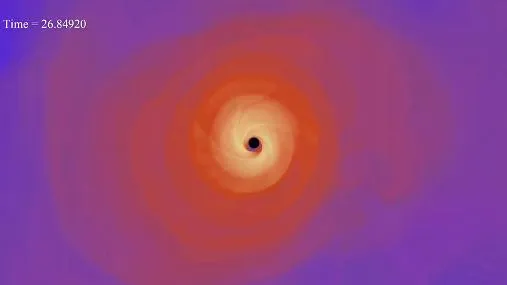
This behavior was first seen in a numerical simulation in 1988 (see Fryxell et al, cited below) and some scientists thought it explained the recurrent X-ray outbursts observed by the European satellite Exosat in 1985. But in subsequent years, some simulations showed this flip-flop and others did not, raising doubts about the phenomenon.
"The initial work was criticized for a wide variety of reasons, but I think the main one was the limited computing power and therefore the precision of the computation," notes John Blondin, a researcher in physics at the University of North Carolina.
Blondin and student T. Chis Pope from the same university wanted to settle the issue once and for all. That meant having greater computing power. To do this, they joined forces with the Texas Advanced Computing Center (TACC) and TeraGrid.
Their simulation found that the accretion disk reversed direction repeatedly, confirming that, at least in this model of a black hole accretion disk, the flip-flop occurs. To better illustrate this phenomenon, Blondin and Pope asked animator Steve Chall (Renaissance Computing Institute) to create a movie from the simulation.
"The problem has been hanging around forever, and what we were able to do with really big computers was to get it right," said Blondin. The most basic form of the equation used in the simulation was originally formulated by Fred Hoyle and Ray Lyttleton in 1939. Blondin added that "it was fun to use supercomputers to solve a problem from 1939".
Sources and related links
- ISGTW:Flip-flopping of black hole accretion disks scrutinized
- Numerical simulation of nonaxisymmetric adiabatic accretion flow
Fryxell, B. A.; Taam, Ronald E.
Astrophysical Journal, Part 1 (ISSN 0004-637X), vol. 335, Dec. 15, 1988, p. 862-880.
DOI: 10.1086/166973 - Revisiting the "Flip-Flop" Instability of Hoyle–Lyttleton Accretion
Blondin, John M.; Pope, T. Chris
The Astrophysical Journal, Volume 700, Issue 1, pp. 95-102 (2009).
DOI: 10.1088/0004-637X/700/1/95
arXiv:0905.2769v1 - EXO 2030+375
Parmar, A. N.; Stella, L.; Ferri, P.; White, N. E.
IAU Circ., 4066, 1 (1985). Edited by Marsden, B. G.
About the images
- Image from the video of the simulation of a black hole accretion disk
Credits: Data: Blondin, John M.; Pope, T. Chris; Animation: Steve Chall (Renaissance Computing Institute)