The largest GRID network passed the most detailed tests to date, ahead of the reactivation of the most powerful particle accelerator. GRID computing for the LHC will have to analyze and handle real data at exorbitant levels.
GRID computing is distributed computing (sometimes called "grid computing" or "mesh computing") that uses a large number of computers organized into "clusters", linked by a network.
Experiments at the Large Hadron Collider (LHC) will produce a whopping 15 petabytes (15 million gigabytes) of data per year, which must be stored, backed up, and made available to the more than 7,000 scientists around the world. To handle this immense computational load, CERN works with groups worldwide to build a computing system for the LHC.
The Worldwide LHC Computing Grid (WLCG) integrates storage and processing power around the world for the use of LHC physicists and is a major step forward in distributed computing technology.
Is this network already prepared for such a workload? This question was attempted to be answered through a series of tests collectively called the "Scale Test of the Experimental Program 2009" (Scale Test of the Experimental Program 2009 or STEP09), which demonstrated WLCG's ability to efficiently navigate the data collected by the intense LHC collisions throughout the entire process that culminates in the world's laboratories and universities.
Although there have been several other data processing tests of the WLCG in the past, STEP09, completed on June 15, was the first to simultaneously test all the key elements of the process.
"Unlike previous challenges, which were dedicated testing periods, STEP09 was a production activity that closely matches the types of workloads expected during LHC data-taking. It was a demonstration not only of the readiness of experiments, sites, and services, but also of the operations and support of procedures and infrastructures," commented Ian Bird, WLCG project leader.
Once LHC data is collected at CERN, dedicated fiber optic networks will distribute the data to 11 centers (called "Tier-1") in Europe, the United States, and Asia. From these, the data is dispatched to more than 140 "Tier-2" centers around the globe. It is at these centers (and at the "Tier-3" ones) that physicists will analyze the data from the experiments -ATLAS, CMS, ALICE and LHCb – to reach (they hope) new discoveries.
"To truly test our readiness for near real-life circumstances, we must perform data replication, reprocessing, analysis, and even event simulation, all at the same time and at the scale expected for data acquisition. That's what makes STEP09 unique," explained Michael Ernst, director of the Brookhaven Laboratory Tier-1 computing center.
The result seems to have been widely satisfactory. A key objective was to test and measure the analysis capabilities of the Tier2 and Tier3 centers. During the tests (which lasted 13 days), seven Tier2 centers for the CMS experiment and four Tier3 centers performed around 225,000 successful job analyses.
"Now we know we are ready for collisions," noted Oliver Gutsche, a Fermilab physicist who led the effort for the CMS experiment.
In the United States there is the Open Science Grid, a key infrastructure in this process, designed for large-scale scientific research. The OSG contributes to the WLCG as the distributed computing facility used by the ATLAS and CMS experiments. OSG is built and operated by a consortium of 90 universities, laboratories, collaborations, and software developers.
Sources and related links
- Data-Taking Dress Rehearsal Proves World’s Largest Computing Grid is Ready for LHC Restart
- US/LHC
- Grids Step-up to a Set of New Records: Scale Testing for the Experiment Programme ’09 (STEP’09)
About the images
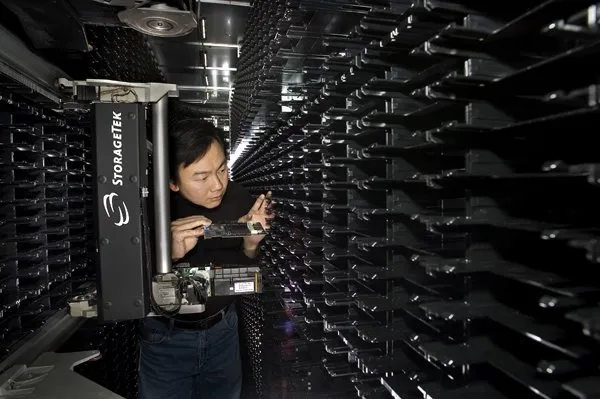
The interior of an automated tape library at Brookhaven.
(Credit: Brookhaven National Laboratory)
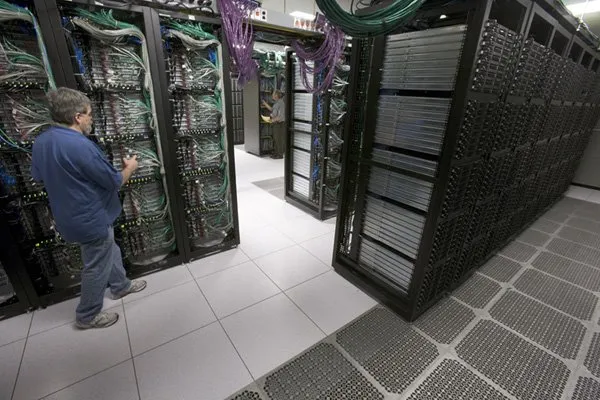
Grid Computing Center (GCC) Fermilab. (Credit: Fermilab)
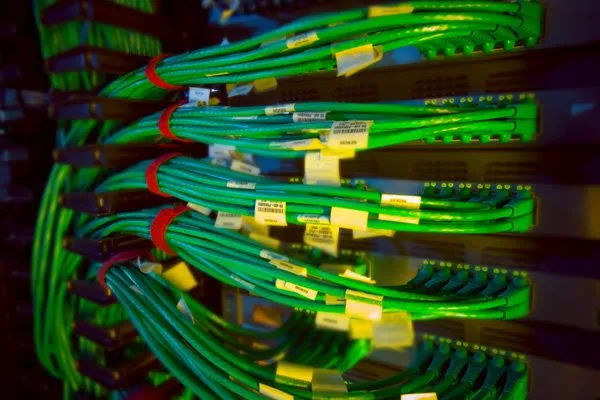
Cables at the Grid Computing Center (GCC) Fermilab. (Credit: Fermilab)