It is one of the finest jewels of the southern sky, as illustrated by one of the latest images from ESO. This globular cluster, located 17,000 light-years from Earth in the constellation Centaurus, contains millions of stars.
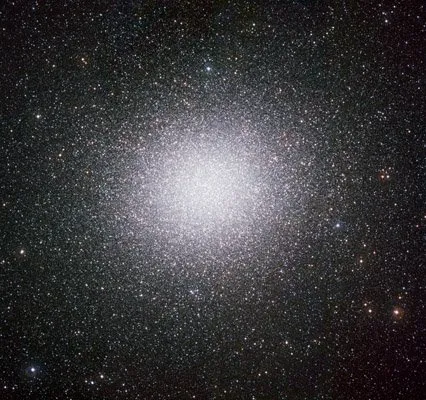
With a magnitude of 3.7, Omega Centauri is visible to the naked eye from a suitable location. It is about 150 light-years in diameter and is the most massive globular cluster in the galaxy.
The new image is based on data collected with the Wide Field Imager (WFI), mounted on the 2.2-meter Max-Planck telescope at the La Silla Observatory.
Omega Centauri (NGC 5139) has been observed throughout history: Ptolemy and Johann Bayer cataloged it as a star. It was not until the 19th century that the Englishman John Frederick William Herschel (the son of the famous Herschel, discoverer of Uranus) realized it was, in fact, a cluster. Globular clusters are one of the oldest groups of stars found in the halos surrounding galaxies like the Milky Way. Omega Centauri is thought to be about 12 billion years old!!
Recent research on this giant suggests there is a medium-sized black hole at its center. Observations with the Hubble Space Telescope and the Gemini Observatory showed that stars at the center are moving at an unusual rate, so astronomers infer it would be a gravitational effect from a massive black hole.
(See: "Black hole in Omega Centauri")
The presence of this black hole raised suspicions about whether Omega Centauri might not, in fact, be a dwarf galaxy. Other evidence points to the several generations of stars present in the cluster, something unexpected in a typical globular cluster, which usually contains stars from the same generation.
(See: "Multiple stellar births in a globular cluster")
Sources and related links
- Omega Centauri — the glittering giant of the southern skies
About the images
Credit: ESO/EIS