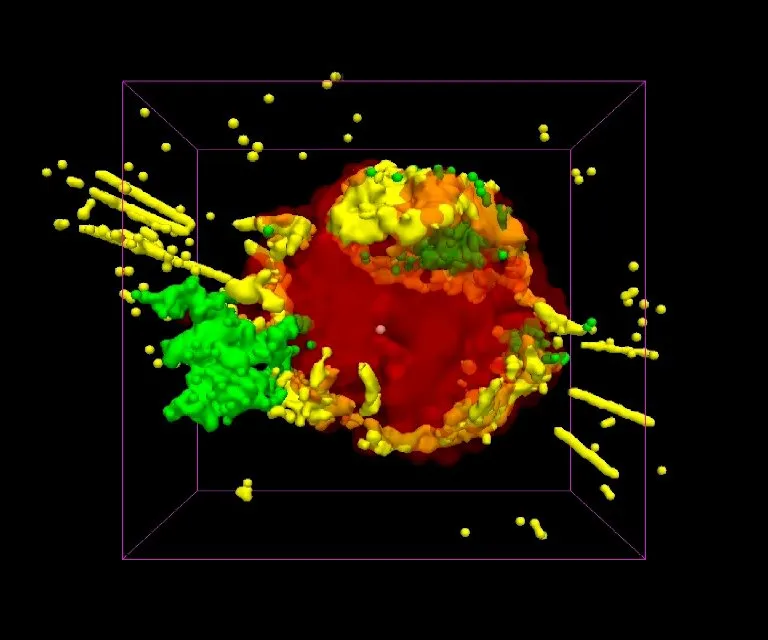
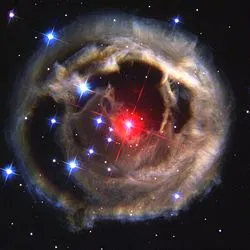
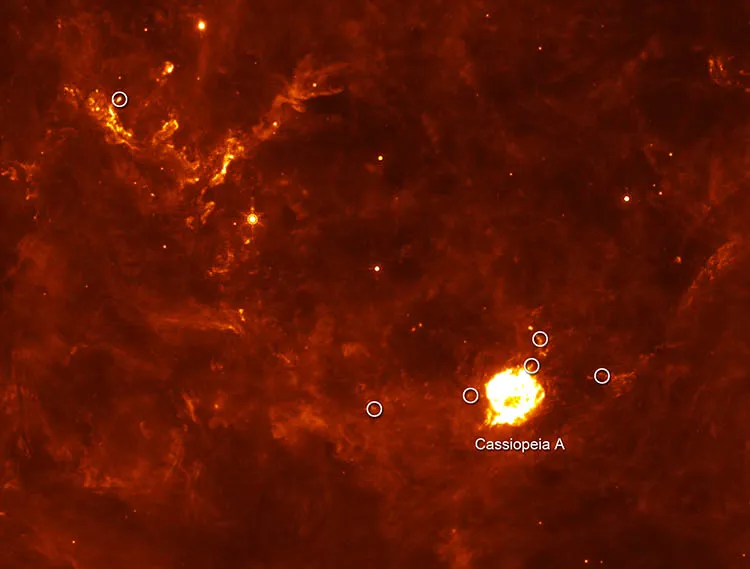
A team of astronomers managed to re-see the explosion of a star that died more than 400 years ago by studying the light echoes from interstellar dust clouds as if they were a time machine.
In November 1572, the Danish astronomer Tycho Brahe saw something strange in the sky. 'I noticed that a new and unusual star, surpassing the others in brilliance, was shining almost directly over my head,' he wrote.
Brahe called the object a 'stella nova' or new star, but it was, in fact, the explosive death of an old star, an event known today as a supernova. Since that moment, the explosion has been fading away, but researchers managed to detect light from that explosion. Their work is published in Nature.
The light that left the astronomer astonished was as bright as Venus and could be seen for two weeks in broad daylight. After 16 months, it disappeared from view.
Working before the invention of the telescope, Brahe accurately documented that, unlike the Moon and the planets, the position of the light did not change relative to the stars. This meant it lay beyond the Moon, which implied a shock to the view of the time that the heavens were perfect and unchanging.
'What we essentially did here is use interstellar dust as a kind of mirror,' says Oliver Krause, an astronomer at the Max Planck Institute in Germany.
When the star explodes, it radiates light in all directions. Brahe and others (like the Spanish scientist Jerónimo Muñoz) saw the light coming directly towards our planet, but the light traveling in other directions is often reflected by dust clouds in space. Since light travels at a very fast, but finite speed, dust clouds hundreds of light-years away from the original supernova create an 'echo' that can still be seen from Earth.
Let's think about throwing a stone into a pond of water. Regular waves will form and move away uniformly. Now suppose those waves now collide with some object. New waves will be generated, moving away from that object. An observer on the shore would see the original waves and, later, the new waves produced by the collision of the first ones with some object.
In this case, the light waves from the original explosion head in all directions. Some waves are seen on Earth in the 16th century. Other waves move away and later 'collide' with dust clouds and are reflected. Thus, more than 400 years after the event, researchers can still detect those light 'echoes.'
It is not the first time astronomers have captured the light echoes of supernovae, but Brahe's is the oldest seen in the Milky Way.
We had reported here in 'Unveiling the mysteries of Cassiopeia A' about the study of the light echoes of Cassiopeia A, by this same scientific team precisely.
Krause and his colleagues observed the echo using the 8.2-meter Subaru telescope atop Mauna Kea in Hawaii. They were able to match the faint glow of the original outburst by searching in the spectrum of light and location in the sky.
Their observations confirm that the supernova is of class Ia. These supernovae are created by the explosion of dense stars, called white dwarfs. The researchers reach this conclusion by performing analysis of the light spectrum, which shows signs of silicon and not hydrogen.
Type Ia supernovae show practically the same intrinsic luminosity and are therefore used as 'cosmic rulers' to measure distances. The observation of this type of supernova in other galaxies led to the discovery of the acceleration of the expansion of the universe, suggesting the existence of a mysterious force, called dark energy.
Despite their importance, many details of this type of supernova remain not fully understood. The most recent supernovae occurred in other galaxies, so being able to study one in the Milky Way is very important. Krause's study not only classifies the explosion as a type Ia but also provides information about this type of event.
Part of the observations for the research were made at Calar Alto (Spain) between August and September of this year. More information and very good material (including videos) on the Observatory's website (see related links).
Sources and related links
- Nature: Astronomers revisit a blast from the past
- Tycho Brahe's 1572 supernova as a standard type Ia as revealed by its light-echo spectrum
Oliver Krause, et al.
Nature 456, 617-619 (December 4, 2008)
DOI:10.1038/nature07608 - Vivid View of Tycho's Supernova Remnant
- Calar Alto: An explosion from the past: astronomy resurrects a 16th-century supernova
About the images
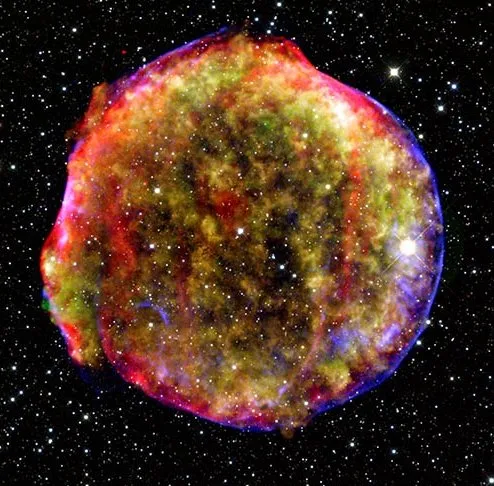
Composite image of the Tycho supernova remnant combining infrared and X-ray observations obtained by the Spitzer and Chandra observatories, respectively, and the Calar Alto observatory.
The explosion left a cloud of hot debris (green and yellow). The location of the shock wave can be seen as a blue sphere of ultra-energetic electrons. The dust in the ejected material radiates at infrared wavelengths (red). Background and foreground stars are seen in white.
Credit: MPIA/NASA