A recent study observed the Bullet Cluster, searching for signs of primordial antimatter.
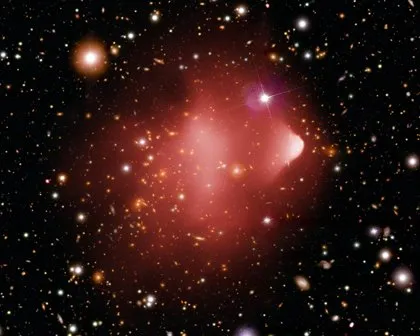
This view of the Bullet Cluster, located 3.8 billion light-years from Earth, combines an image from the Chandra X-ray Observatory with optical data from the Hubble Space Telescope and the Magellan Telescope in Chile.
The cluster, officially known as 1E 0657-56, formed after a violent collision of two large galaxy clusters. It is an object that has become very popular for astrophysical research, including studies of the properties of dark matter and the dynamics of the gas.
(See "Cluster collision provides clues about dark matter")
In a recent investigation, the cluster was used to search for the presence of antimatter from the very early universe. Antimatter is made up of elementary particles that have the same mass as their corresponding matter counterparts—protons, neutrons, and electrons—but with opposite charge and magnetic properties.
According to the Big Bang model, the Universe was bathed in particles of matter and antimatter shortly after "the big bang." Most of this matter was annihilated, but since there would have been a little more matter than antimatter (less than one part in a billion), only matter survived, at least in the local Universe.
Could antimatter from that annihilation have survived?
It is thought that after the Big Bang there was a period called "Inflation," when the Universe expanded exponentially in a fraction of a second.
"If clumps of matter and antimatter existed close to each other before inflation, they could now be separated by more than the scale of the observable universe, so we would never see them come together," notes Gary Steigman of Ohio University, who led the study. "But they could be separated on smaller scales, such as those of superclusters or clusters, which is a more interesting possibility."
In this case, collisions between two galaxy clusters could show evidence of antimatter. X-ray emissions show how much hot gas is involved in those collisions.
The optical image shows the galaxies in the cluster and the X-ray image (in red) reveals how much hot gas has collided. If some of the gas from one of the clusters has antimatter particles, there would be an annihilation between matter and antimatter and the X-rays would be accompanied by gamma rays.
Steigman used data from Chandra and the Compton Gamma Ray Observatory to study the Bullet Cluster. At a relatively close distance and with a favorable orientation as seen from Earth, this cluster provides an excellent test to search for signs of antimatter.
The observed amount of X-rays from Chandra and the non-detection of gamma rays by the Compton Observatory show that the fraction of antimatter in the cluster is less than three parts per million. Furthermore, simulations of the cluster merger show that these results would rule out significant amounts of antimatter on scales of about 65 million light-years, an estimate of the original separation of the two colliding clusters.
"The collision of matter and antimatter is the most efficient process for generating energy in the Universe, but it might not occur on very large scales. But I'm not giving up and I'm planning to search in other colliding galaxy clusters that have been discovered recently," said the scientist.
Finding antimatter in the universe could tell scientists about how long the period of inflation was.
Sources and related links
- The Bullet Cluster: Searching for Primordial Antimatter
- When Clusters Collide: Constraints On Antimatter On The Largest Scales
Gary Steigman
arXiv:0808.1122v1
About the images
Credit: NASA/CXC/CfA/M.Markevitch et al.; Optical: NASA/STScI; Magellan/U.Arizona/D.Clowe et al.