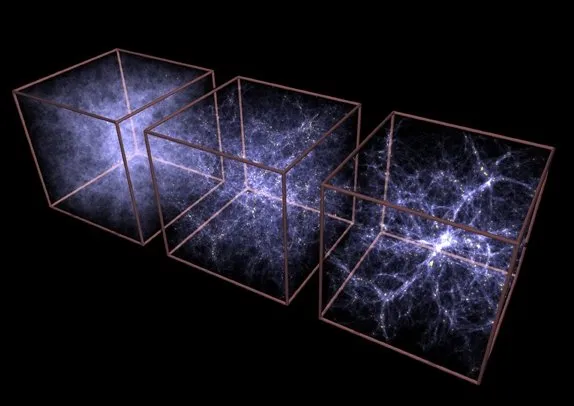
It is thought that the "Big Bang" erased all traces of what came before. But astrophysicists now think it is possible to interpret the imprints of the early stages of the universe in search of some clues.
"It is no longer completely crazy to ask what happened before the Big Bang," notes Marc Kamionkowski of the California Institute of Technology (Caltech).
The scientist, together with Adrienne Erickcek and our friend Sean Carroll, proposes a mathematical model that attempts to explain an anomaly in the universe.
Their research investigates the phenomenon called "Inflation," proposed in the 1980s, which holds that space expanded exponentially in the instant following the Big Bang. This formidable ultra-rapid expansion should produce a very homogeneous universe. However, it seems that the observable universe is not exactly as predicted when taking this inflationary phenomenon into account. Some parts are different from others.
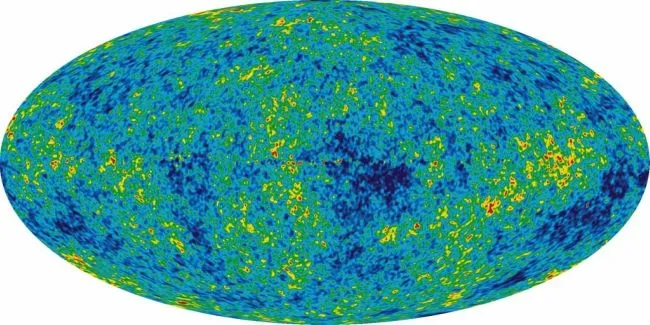
Until now, measurements of the Cosmic Microwave Background (CMB) were consistent with inflation. This CMB is a form of electromagnetic radiation that bathed the universe 400,000 years after the Big Bang. Measurements made of this microwave background found tiny fluctuations that seemed to be the same everywhere. But a few years ago, certain researchers, including a group led by Krzysztof Gorski of JPL, scrutinized the data from the Wilkinson probe (WMAP). WMAP is a probe that made measurements of the cosmic background radiation (more precisely than what the COBE probe did). There they discovered that the amplitude of the fluctuations in the CMB is not the same in all directions.
"If our eyes measured radio frequency, we would see the whole sky glowing. That is what WMAP detects. It is a certified anomaly, but since inflation seems to work so well with everything else, it seems premature to discard the theory," notes Kamionkowski.
What they proposed was to reexamine the theory, taking the anomaly into account. They began testing whether the value of a simple energy field that is supposed to have driven the phenomenon -the inflaton- was different on one side of the universe than on the other. That didn't seem to work. If they changed the value of the inflaton, the temperature and energy amplitude of the variations in space also changed. So they explored a second energy field, called the curvaton, which had been proposed before the detection of the fluctuations in the CMB. They introduced a perturbation in the curvaton field that, apparently, affects only how the temperature varies from one point in space to another, while preserving its average value.
The new model predicts more cold spots than hot spots in the CMB, according to Kamionkowski. This prediction will be put to the test by the Planck satellite, an international mission led by the European Space Agency (ESA) with contributions from NASA, scheduled for April 2009.
For Erickcek, the team's findings hold the key to better understanding inflation. But the perturbation introduced by the researchers could also offer a glimpse of what happened before the Big Bang, since there could be an inherited imprint from the time before inflation. "All of this is hidden behind a veil, observationally. If our model holds, there might be a chance to see beyond that veil."
Sources and related links
- Caltech Researchers Interpret Asymmetry in Early Universe
- First clues to what came before the Big Bang
- A hemispherical power asymmetry from inflation
Adrienne L. Erickcek, Marc Kamionkowski, and Sean M. Carroll
Phys. Rev. D - Volume 78 - Issue 12
DOI:10.1103/PhysRevD.78.123520
About the images
Credit: NASA/WMAP