XMM-Newton captured the glow of a tiny celestial object, revealing for the first time its rotation rate. The new information confirms the object as an extremely rare class of stellar "zombie."
There are only five known so-called Soft Gamma Repeaters or SGRs, four in the Milky Way and one in the Large Magellanic Cloud. Each of these objects is between 10 and 30 km in diameter, yet contains twice the mass of the Sun. They are the collapsed cores of massive stars that exploded: neutron stars.
What differentiates these SGRs from ordinary neutron stars is that they possess magnetic fields 1000 times stronger. This led astronomers to call them "magnetars."
SGR 1627-41 was discovered in 1998 by NASA's Compton Gamma Ray Observatory when it emitted about a hundred short bursts over six weeks. Then it faded before X-ray telescopes could measure its rotation rate. Thus, this rare object was the only magnetar without a known period.
Recently, SGR 1627-41 burst again. But it was located in a region of the sky that ESA's XMM-Newton could not point to, as it had to keep its solar panels facing the Sun to charge its energy. Astronomers waited for Earth to move along its orbit. During that time, the object began to fade rapidly. When it became visible in September 2008, thanks to the EPIC instrument on the satellite, it was still detectable.
A team of astronomers made the necessary observations and revealed that it rotates once every 2.6 seconds. "This makes it the second fastest known magnetar," said Sandro Mereghetti of the Institute of Space Astrophysics and Cosmic Physics in Milan.
Theorists still do not know how these objects can have such powerful magnetic fields. One idea is that they were born rotating very rapidly, at 2-3 milliseconds. Ordinary neutron stars are born with a rotation speed ten times slower. The rapid rotation of these magnetars, combined with convection models in their interior, makes them highly efficient dynamos that generate these enormous fields.
With a rotation rate of 2.6 seconds, this magnetar must be old enough to have slowed down a bit. Another clue to the object's age is that it is still surrounded by a supernova remnant. During the measurement of its rotation, the satellite also detected X-rays coming from the debris of an exploded star, possibly the same one that created the magnetar. "These usually fade after a few tens of thousands of years. The fact that we still see it means it is probably only a few thousand years old," added Mereghetti.
If it produces a burst again, the team plans to measure the rotation rate once more. Any difference will tell them how fast it is slowing down. There is also the possibility that SGR 1627-41 will release a giant burst. Only three such events have been seen in the last 30 years, each from a different SGR, but not from this particular one.
These superbursts can provide as much energy as the Sun, even though they are much, much farther from Earth than our star. "These are intriguing objects; we still have much to learn about them," concluded Mereghetti.
Sources and related links
- XMM-Newton measures speedy spin of rare celestial object
- Possible active magnetar discovered
About the images
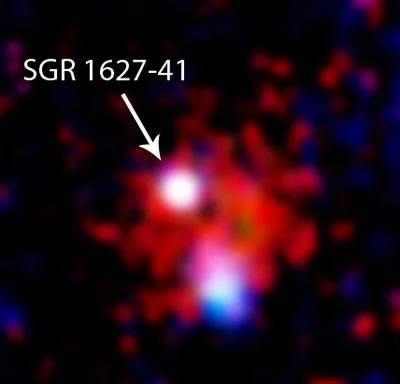
False-color X-ray image of the region around SGR 1627-41 obtained with XMM-Newton. The emission shown in red comes from the debris of a massive star that exploded. It covers a more extensive region than previously deduced from radio observations. This suggests that the exploded star would have been the progenitor of the magnetar.
Credits: ESA/XMM-Newton/EPIC (P. Esposito et al.)