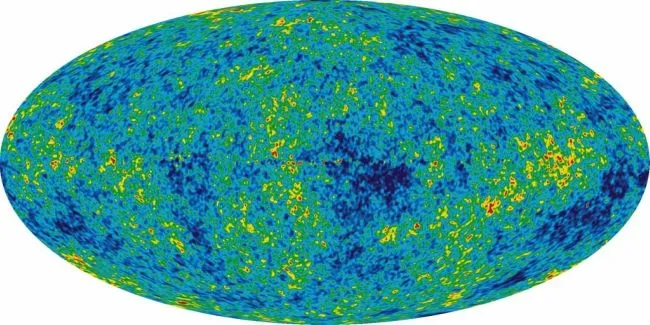
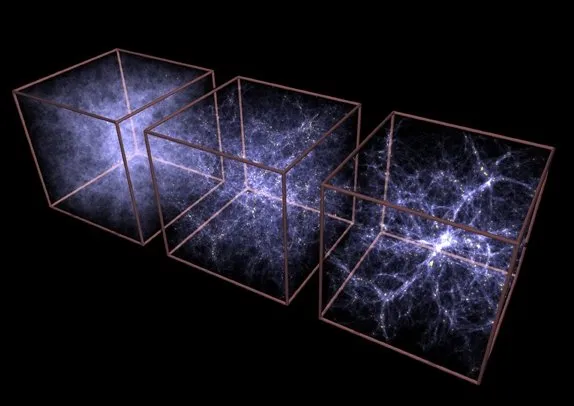
For seven years, the GEO600 experiment has been searching for gravitational waves, generated by dense astronomical objects such as neutron stars and black holes. So far, this German facility has not detected any gravitational waves, but perhaps it could have made an incredible discovery.
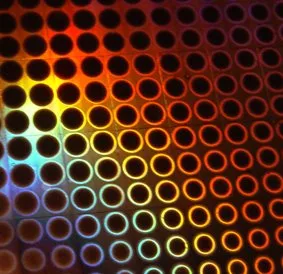
For several months, the members of the GEO600 experiment team were scratching their heads to solve a mystery. An inexplicable noise plagued their giant detector. Now, Craig Hogan, a physicist at Fermilab, says that GEO600 stumbled upon the fundamental limit of space-time, the point at which it ceases to be a "continuum" described by Einstein and dissolves into "grains." Something similar to what happens with images when we enlarge them and begin to notice that they stop appearing as continuous colors and lines to become dots, pixels.
But that's not all. "If the GEO600 result is what I suspect it is, then we all live in a gigantic cosmic hologram," blurted Hogan.

The idea that we live in a hologram sounds absurd, a priori, but allegories and comparisons can be fruitful. The holograms we find on credit cards and other documents are engraved on two-dimensional plastic films. When light is reflected, it recreates the appearance of a 3D image. In the 1990s, Leonard Susskind and Nobel Prize winner Gerard 't Hooft suggested that the same principle could apply to the universe as a whole. Our everyday experience could be a holographic projection of physical processes taking place on a distant 2D surface.
The "holographic principle" challenges our senses. The remarkable idea was motivated by the work on black holes by Jacob Bekenstein and Stephen Hawking. In the 1970s, Hawking showed that black holes are not entirely "black," but can emit radiation, which would cause their evaporation after eons. This statement, however, seems contrary, a priori, to the principle of conservation of information. Hawking radiation would not transmit any information about the interior of the black hole. As it evaporates, the information contained within it would disappear. This is known as the black hole information loss paradox.
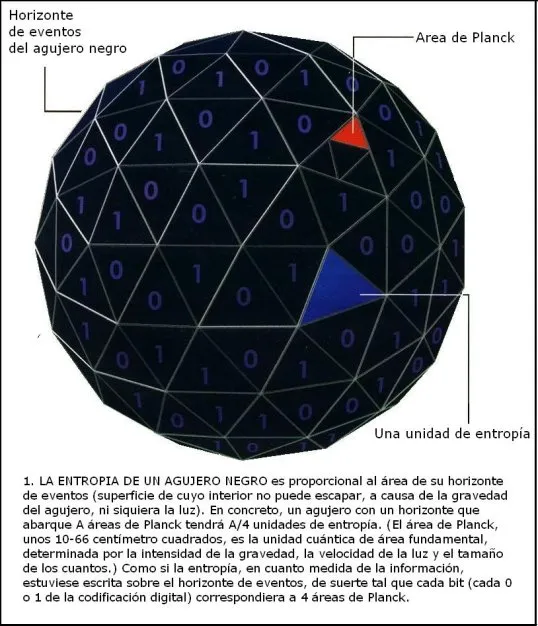
Bekenstein's work produced important clues for solving the paradox. He discovered that the entropy of a black hole—related to its information content—is proportional to the surface area of its event horizon, the point of no return. Theorists have since shown that quantum waves on the event horizon can encode the information inside the black hole, so there is no mysterious loss of information.
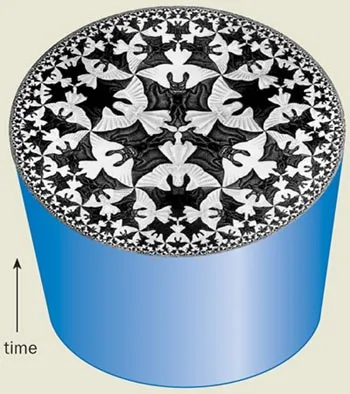
Now, the three-dimensional information of a precursor star can be completely encoded in the two-dimensional horizon of the subsequent black hole, not unlike the 3D image of an object encoded in a 2D hologram. Susskind and 't Hooft extended the concept to the entire universe, based on the idea that the cosmos also has a horizon: the boundary beyond which light has not had time to reach us in the 13,700 million years of the universe's life. Moreover, work by several string theorists, primarily Juan Maldacena, confirmed that the idea is on the right track. He showed that the physics in a hypothetical five-dimensional universe shaped like a potato chip[1] is the same as the physics taking place on a four-dimensional boundary.
According to Hogan, the holographic principle radically changes our picture of space-time. Theoretical physicists have believed that quantum effects would cause space-time to ultimately be tiny units (like the pixels in the previous example) but hundreds of trillions of times smaller than a proton. This distance is known as the Planck length, 10-35 meters. This distance is beyond any conceivable experiment, so discerning this granularity is not even dreamed of.
Until Hogan realized that the holographic principle changed everything. If space-time is a grainy hologram, the universe can be thought of as a sphere whose outer surface is tiled with squares the size of the Planck length, each containing a bit of information. This principle says that the amount of information on the outside must match the number of bits contained within the volume of the universe.
Since the volume of the spherical universe is much larger than its outer surface, how can this be true? Hogan noted that to have the same number of bits in the universe as on the boundary, the world inside must be made of grains larger than the Planck length.
This is good news for anyone wanting to investigate the smallest units of space-time.
"Contrary to expectations, it brings the quantum structure within the reach of current experiments," says Hogan. If the Planck length is far too small to be detected, the holographic "projection" of that granularity could be much larger, about 10-16 meters.
"To put it another way, a holographic universe is blurry. If you live inside a hologram, you can tell by measuring the blurriness," the scientist pointed out.
When Hogan realized this, he wondered if any experiment could be capable of detecting this holographic blurriness of space-time. This is where GEO600 comes into play.
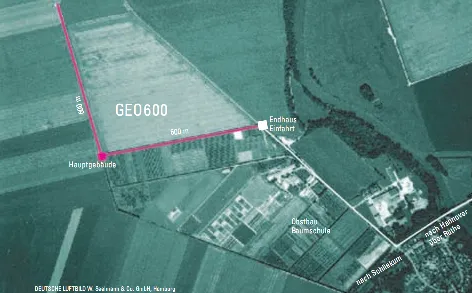
Gravitational wave detectors like GEO600 are essentially incredibly sensitive "rulers." The idea is that if a gravitational wave passes through the experiment, it would alternately stretch space in one direction and compress it in another. To measure this, the team fires a laser at a mirror that splits the light into two beams that travel through the instrument's perpendicular 600-meter arms and bounce back. The beams merge upon returning and create an interference pattern: regions of light and darkness where the light waves canceled or reinforced each other. Any shift in these regions indicates that the relative length of the arms changed.
These experiments are sensitive to changes much smaller than the diameter of a proton. Of the five gravitational wave detectors around the world, Hogan thought GEO600 was the most sensitive for what he had in mind. He predicted that if the beam splitter was shaken by the quantum convulsions of space-time, it would show up in the measurements, and cause noise in the laser signal. (Physical Review D, vol 77, p 104031)
In June, he sent this prediction to the GEO600 team. Karsten Danzmann, from the Max Planck Institute for Gravitational Physics and the University of Hanover, admits the excess noise, at frequencies between 300 and 1500 hertz, which had been bothering the team for a long time. And he sent Hogan a plot of the noise. "It looked exactly like my prediction," notes Hogan.
No one, not even Hogan himself, is claiming to have found evidence for the holographic principle of the universe. It could be a mundane source of noise. Precisely because these instruments are so sensitive, they can detect many types of signals that "contaminate" the results.
The possibility that they were temperature fluctuations in the beam splitter has, for now, been ruled out, as it would only account for one third of the noise.
It would be ironic if an instrument built to detect something as vast as gravitational waves from astronomical sources inadvertently detected the minuscule graininess of space-time.
Much work remains to establish something concrete. Perhaps an instrument dedicated specifically to this search would be ideal. Given these facts, there is a certain motivation in that direction.
What would it mean if holographic noise were confirmed?
"Forget Quantum of Solace, we would have directly observed the quantum of time."
It would be a great help for researchers trying to unite quantum mechanics with the theory of gravity. So far, the most popular approach is string theory. According to Hogan, it would rule out approaches to quantum gravity that do not incorporate the holographic principle and give a boost to those that do. "Ultimately, we might have the first indication of how space-time emerges from quantum theory."
Sources and related links
- Our world may be a giant hologram by Marcus Chown for NewScientist
- Astroseti: The Holographic Principle and M-Theory
- La bella teoría: The holographic theory and gravitation
- Página/12:El universo desnudo: On the occasion of the 10th anniversary of the "Maldacena Conjecture"
- [1]: The author is referring to an Anti-de Sitter (AdS) space, something similar to a hyperbolic space: see Formas del Universo
- Información y Entropía
Guillermo Agudelo Murguía, José Guillermo Alcalá Rivero
About the images
Hologram circles: FastForms
Escher's "Angels and Demons":
Anti-de Sitter space is a solution to Einstein's field equations that is negatively curved. It is analogous to the geometry of Escher's "Angels and Demons", in which the image shows that all the angels and demons are the same size but are distorted due to the negative curvature of space, in the same way that the Mercator projection of the globe distorts the area of continents.
Black Hole:
Taken from Scientific American Latin America. The Information in the Holographic Universe. Jacob D. Bekenstein. Year 2 No. 15 October 2003