Thanks to SkyandTelescope and Google Earth Blog I learned a new and useful way to "adopt" a star, for scientific purposes.
On the web it is possible to find sites that offer "star sales". For a "modest" fee, they give you in return a nice certificate with no value or meaning whatsoever.
However, it is possible to help the Kepler mission, scheduled for launch on March 6, which will search for exoplanets. For $10 it is possible to "adopt" a star. It is a non-profit organization, called White Dwarf Research Corporation that runs the project The Pale Blue Dot and 100% of what is received is used for scientific research on these stars.
In March of this year, NASA will launch the Kepler satellite in search of exoplanets like Earth and distant stars like our Sun. The satellite will monitor the brightness of more than 100,000 stars in the constellation Cygnus with a high-quality digital camera for six years. The Pale Blue Dot Project will provide the support for the analysis of the data that will allow astronomers to determine the size of the planet.
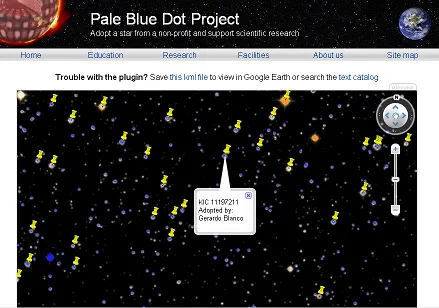
To "adopt" one of these stars it is possible to choose one from the Kepler Catalog which contains the basic data of the stars that the mission targets. Many of these stars have already been selected and it is easy to tell because the name of the person who "adopted" it is indicated. It is possible to navigate the catalog through Google Sky or select a star by its number in the text version (It is a txt file that can be accessed at Pale Blue Dot, where it says "text version" (It's 10 Mb!).
It is also possible to search for a star in Google Sky, through our internet browser, after having installed the Google Earth plug-in.
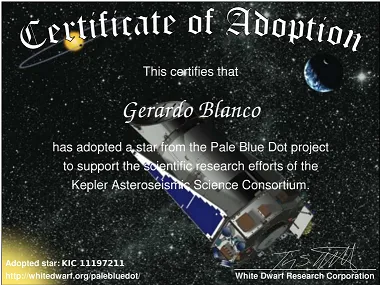
After making the donation, it will be verified, after which a personalized certificate will be sent to the donor and they will be recognized both in the text version catalog and in Google Sky. As seen in the screenshot above, I have already "adopted" star KIC 11197211. Although the number is not exactly a palindrome, at least it starts and ends the same...
Kepler is expected to discover the first planets in 3 to 6 months after the mission begins. If you adopt a star that hosts a planet, they will notify us and we will be part of a special section of the website.
Sources and related links
About the images
Personal screenshot from the Pale Blue Dot Project website.