Astronomers have designed a new method to measure the size and shape of asteroids that are too small or too distant for traditional techniques, thereby increasing the number of asteroids that can be measured by a factor of several hundred.
"Knowledge of the sizes and shapes of asteroids is crucial to understanding how, in the early days of our Solar System, dust could form larger objects and how collisions and re-accumulations have modified them since then," said Marco Delbo, of the Observatoire de la Côte d'Azur, France, leader of the study.
Current methods involve observations with adaptive optics on the largest ground-based telescopes, such as the VLT in Chile, and space-based or radar measurements. However, direct observation, even with adaptive optics, is generally limited to the hundred largest asteroids in the main belt, while radar measurements are mainly limited to near-Earth objects that experience close encounters with our planet.
Delbo and his colleagues designed a new method that uses interferometry to observe asteroids as small as 15 km in diameter, located in the main belt, 200 million kilometers away. This is equivalent to being able to measure the size of a tennis ball at a distance of one hundred kilometers. The technique will not only increase the number of objects that can be measured, but, and this is most important, will allow us to know asteroids that are physically very different from the already well-studied large objects within reach.
The interferometric technique combines light from two or more telescopes. Astronomers tested their method using ESO's VLTI, combining two of its units. "This is equivalent to having vision as sharp as that of a telescope with a diameter equal to the separation between the units used, in this case, 47 meters," explained co-author Sebastiano Ligori, of INAF-Torino, Italy.
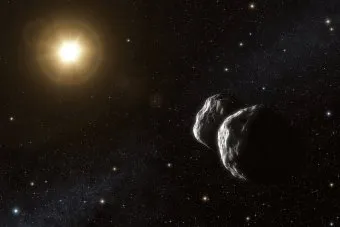
The researchers applied their technique to asteroid (234) Barbara, about which co-author Alberto Cellino found that it has unusual properties. Although it is very distant, the observations revealed that the object has a peculiar shape. The model that best fits is composed of two objects, each the size of a large city—with diameters of 37 and 21 km—separated by at least 24 km.
"The two parts appear to be stacked on top of each other, so the object could be shaped like a giant peanut, or they could be two separate objects orbiting each other," said Delbo.
If (234) Barbara were indeed a double asteroid, it would be even more significant and will be a target for future observations.
Having validated the new and powerful technique, the team can now begin a long observation campaign to study small asteroids.
Sources and related links
- Powerful New Technique to Measure Asteroids' Sizes and Shapes
- First VLTI-MIDI Direct Determinations of Asteroid Sizes
M. Delbo, S. Ligori, A. Matter, A. Cellino, J. Berthier
Submitted to Astrophysical Journal
About the images
Illustration of (234) Barbara. Credit:ESO