A new image of the magnificent planetary nebula was obtained at ESO's La Silla Observatory. The image shows a rich background of distant galaxies, usually not seen in other images of this object.
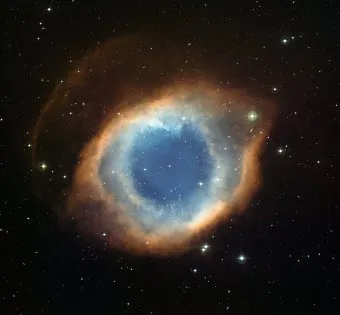
The Helix Nebula, NGC 7293, lies 700 light-years away, in the constellation of Aquarius. It is one of the closest and most spectacular examples of a planetary nebula. These exotic objects have nothing to do with planets, but are stars like the Sun in their final stages before retiring as white dwarfs. Shells of gas are expelled from the star's surface, often in intricate and very beautiful designs and glow under the powerful ultraviolet radiation of the very hot central star. The main ring of the Helix Nebula is two light-years in diameter.
Although it is a very photogenic object, Helix is difficult to see visually. The history of its discovery is quite obscure. It appeared in a list of new objects compiled by the German astronomer Karl Ludwig Harding in 1824. The name Helix, the helix, comes from the shape seen in earlier photographs.
Although it looks like a doughnut, studies have shown that it possibly consists of at least two separate disks with outer rings and filaments. The bright inner disk appears to be expanding at about 100,000 km/h and to have taken about 12,000 years to form.
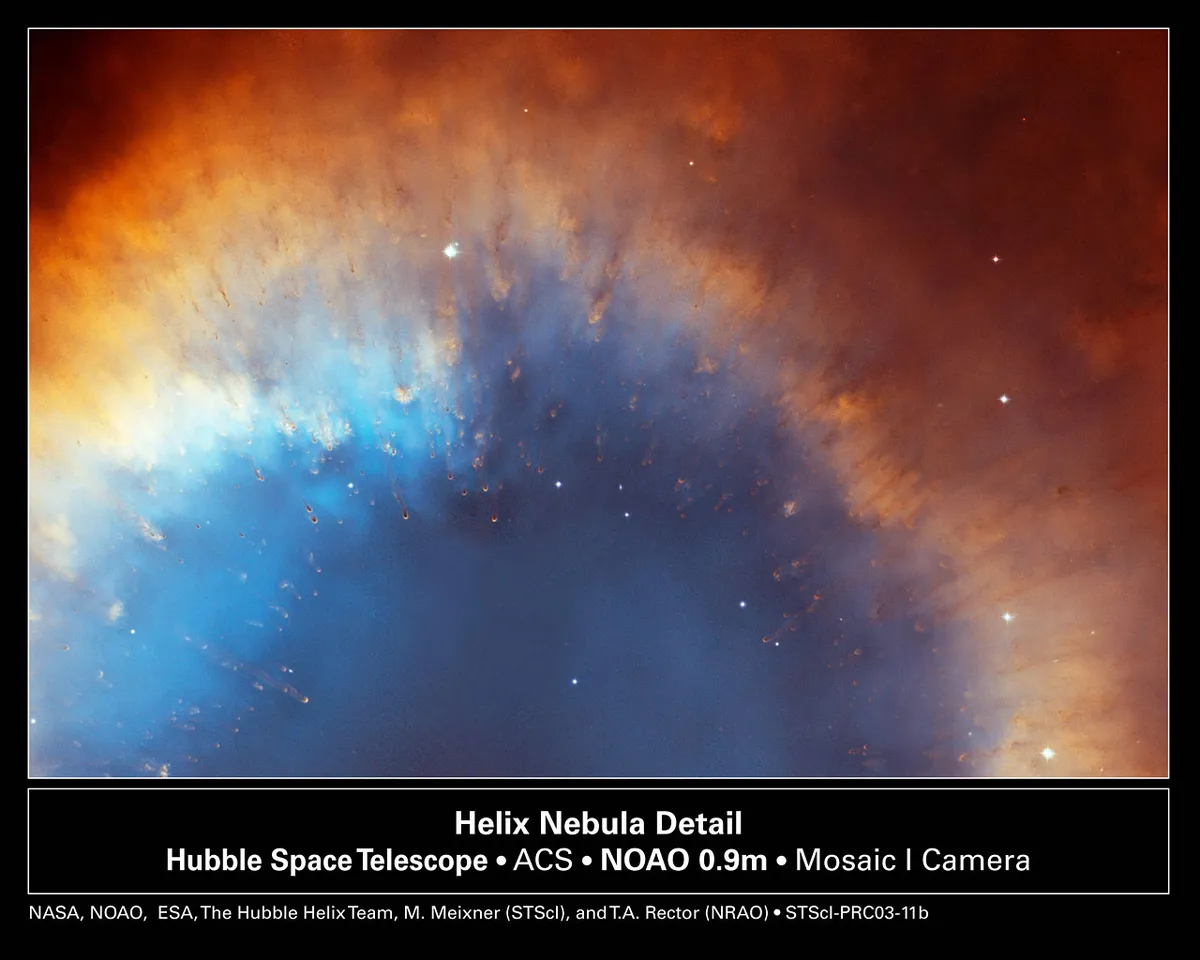
As it is relatively close -it covers an area of the sky a quarter of the full Moon- it can be studied in great detail, more than other planetary nebulae, and it was found to have an unexpected and complex structure. Around the ring there are small "blobs", known as "cometary knots", with faint tails extending from the central star. Although they seem small, each knot is almost as large as our Solar System. They have been extensively studied, both by ESO's Very Large Telescope and by Hubble, but remain only partially understood.
A careful look at the central part of the object reveals not only the knots, but also many remote galaxies seen through the bright gas.
Sources and related links
- Into the Eye of the Helix
- More photos of the Helix Nebula on SpaceTelescope
About the images
This color composite of NGC 7293 was created from images obtained using the Wide Field Imager (WFI) instrument, on a camera on the 2.2-meter Max-Planck telescope of ESO at the La Silla Observatory, in Chile. The blue-green glow in the center comes from oxygen atoms shining under the effects of the intense ultraviolet radiation from the 120,000 degrees Celsius central star and the hot gas. Farther from the star and beyond the rings of knots, the red color of hydrogen and nitrogen is more prominent. A detailed view of the central part reveals not only the knots, but several distant galaxies through the gas.
Credit:ESO
Detail seen by the Hubble Space Telescope
Helix Nebula Detail
Credit:NASA, NOAO, ESA, the Hubble Helix Nebula Team, M. Meixner (STScI), and T.A. Rector (NRAO).