The planetary nebula NGC 2818 nests in the open cluster NGC 2818A. Both reside more than 10,000 light-years away, in the constellation Pyxis (the Compass).
The image was taken with Hubble's Wide Field Planetary Camera 2.
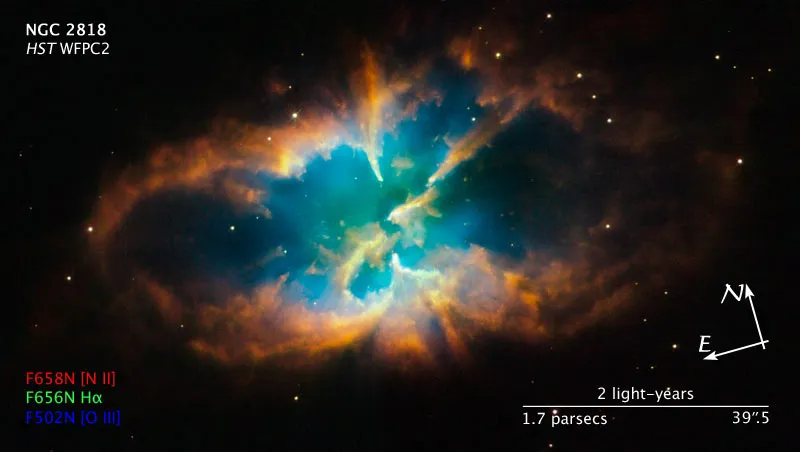
The colors in the image represent a range of emissions from the nebula's clouds: red represents nitrogen, green hydrogen, and blue, oxygen.
NGC 2818 is one of the few planetary nebulae in our galaxy located within an open cluster. Open clusters, in general, are loosely bound and disperse over time (hundreds of millions of years). The stars that form planetary nebulae typically live for billions of years. Thus, it is rare for an open cluster to survive long enough for one of its members to form a planetary nebula. This cluster is very old, estimated at nearly one billion years.
The spectacular structure of 2818 (also known as PLN 261+8.1) contains the outer layers of a star like the Sun that were expelled into interstellar space during the final stages of the star's life. These bright gaseous shrouds were expelled by the star before it exhausted its stellar fuel to sustain the nuclear reactions in its core.
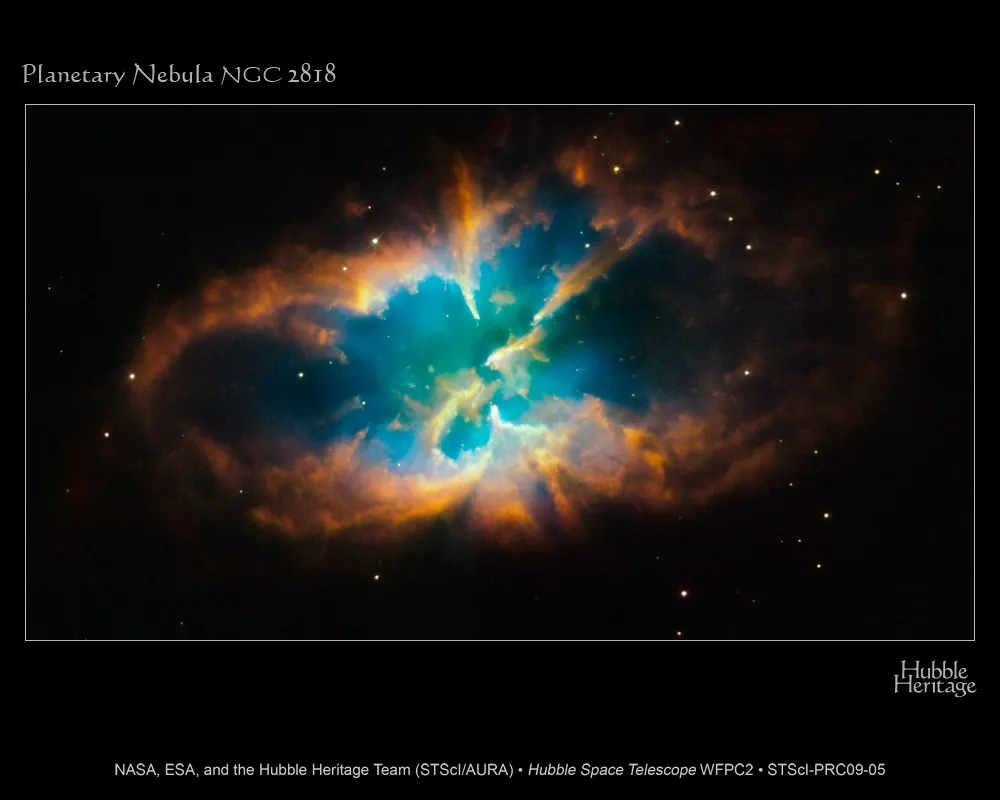
Planetary nebulae are some of the most spectacular structures in the cosmos and can vary extremely. NGC 2818 has a complex shape. However, given its location in the cluster, astronomers have access to information about the nebula, such as its age and distance, that they might otherwise not have.
Sources and related links
About the images
Credit: NASA, ESA, and the Hubble Heritage Team (STScI/AURA)