While waiting for high-energy bursts and cosmic explosions, NASA's Swift satellite is monitoring comet Lulin as it approaches Earth. For the first time, astronomers are seeing simultaneous ultraviolet and X-ray images of a comet.
"We couldn't send a space probe to Comet Lulin, but Swift is giving us the information we would get from such a mission," said Jenny Carter, study leader from the University of Leicester.
A comet is a jumble of gas and dust. Comet Lulin, known as C/2007 N3, was discovered last year by astronomers at the Lulin Observatory in Taiwan. The comet will have its closest approach to our planet on February 24, at 38 million miles, equivalent to 160 times the distance to the Moon.
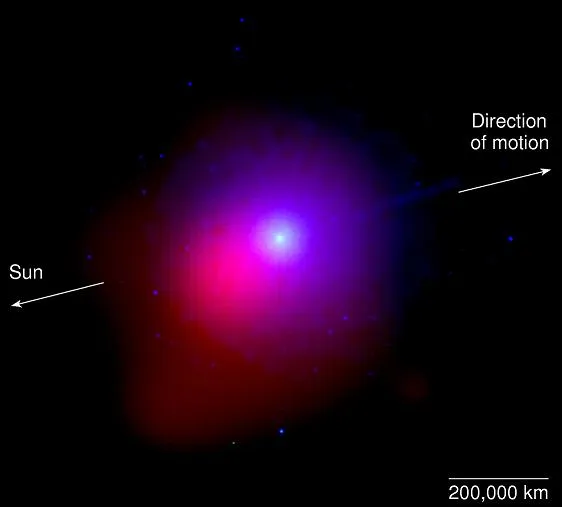
On January 28, Swift focused its instruments (UVOT and XRT, ultraviolet/optical and X-ray instruments) on the comet. Swift can detect water directly. But the Sun's ultraviolet light quickly breaks those molecules into hydrogen atoms and hydroxyl (OH) molecules. The UVOT instrument detects the OH and its images reveal a cloud of these molecules extending about 250,000 miles.
In addition, the instrument includes a device called a "grism", a hybrid of a prism and a diffraction grating, which separates light by wavelength. The range includes wavelengths at which hydroxyl molecules are most active. "This gives us a unique view of the types and amounts of gas a comet produces, which gives us clues about the origin of comets and the solar system," explained Dennis Bodewits of the Goddard Space Flight Center.
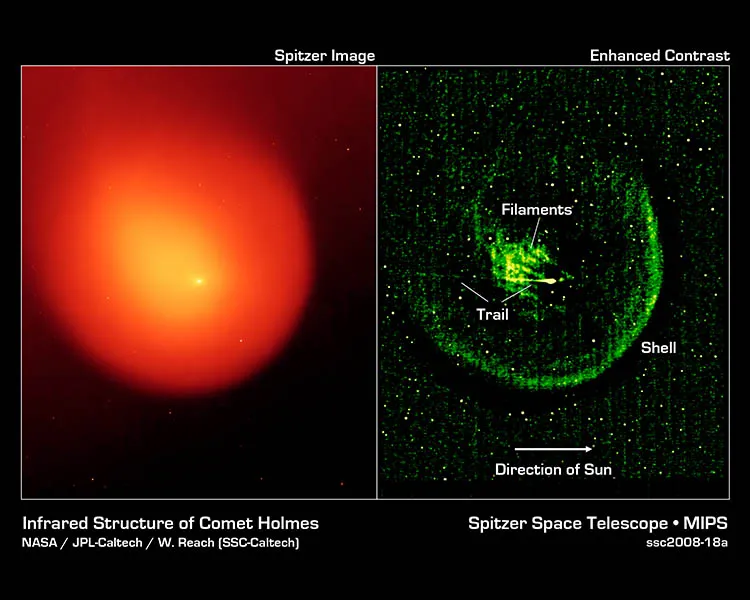
In Swift's images, the comet's tail extends to the right. Solar radiation pushes the comet's dust grains. As the grains gradually evaporate, they create a thin tail of hydroxyl.
Farther from the comet, even those molecules succumb to solar radiation and break into their constituent oxygen and hydrogen. "The solar wind - a stream of particles from the sun - interacts with the comet's cloud of atoms. This causes the solar wind to generate X-rays and that's what the XRT instrument sees," explained Stefan Immler, part of the team.
This interaction, called charge exchange, results in X-rays from most comets as they pass near the Sun (about three times the Earth-Sun distance). Since Lulin is very active, its atomic cloud is especially dense.
The team hopes to continue its observations of the comet and obtain better data to determine its composition, which could allow creating a 3D model of it during its flight through the solar system.
Questions and answers about Lulin
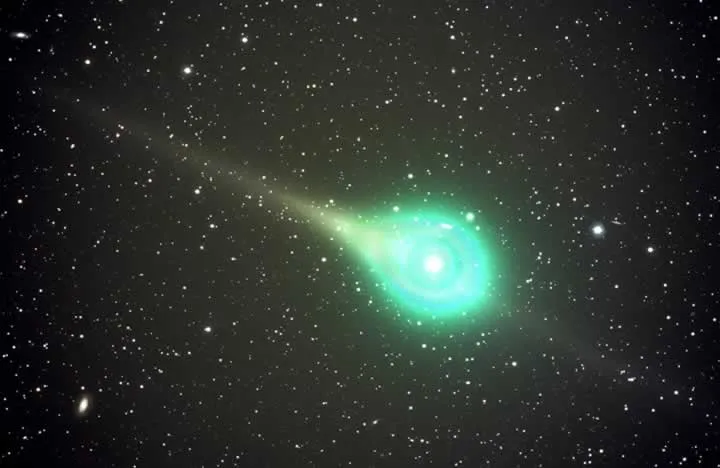
Why is it green?
The green color arises when ionized cyanogen and carbon gases in the comet's atmosphere emit radiation at green wavelengths. These gases evaporate when the ices in the comet's nucleus get close enough to the Sun.
What other unusual features does the comet have?
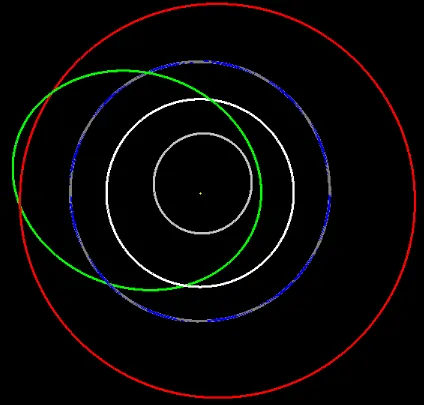
Comet Lulin is moving almost in the same orbital plane around the sun as the planets, but in the opposite direction (retrograde). It is probably the first time it has entered the inner solar system, so some of its original volatile ices in its nucleus might still be present and could be identifiable during observations.
Will we be able to see the comet and its greenish color? When, where and how?
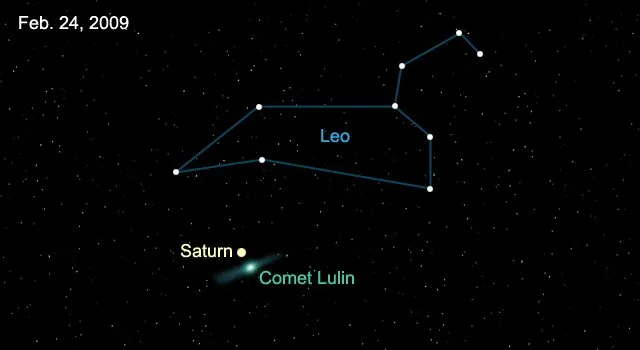
The comet should be observable in dark skies with binoculars. The best time for observation would be near its closest approach to Earth, on February 24, when the planet appears just below Saturn in the constellation Leo. At that time, the comet is expected to have a magnitude of 6.
Will NASA astronomers follow the comet?
A small "army" of professional and amateur astronomers will follow the comet at various wavelengths. It is not so common for a relatively bright comet to be seen in the inner solar system and astronomers will take advantage of this opportunity.
Where can I get maps and more information?
Sur Astronómico, by Enzo Bernardini, is a specialized, accurate and highly recommended site for obtaining information. There is a note specifically created about Comet C/2007 N3 Lulin. Also the site EspacioProfundo and in particular its forums contain a lot of helpful data for locating the comet.
I use a program to view the sky but it doesn't bring comet data, what do I do?
The Minor Planet Center has a page with comet data for use in computer programs:
http://www.cfa.harvard.edu/iau/Ephemerides/Comets/SoftwareComets.html
Sources and related links
- EurekAlert:NASA's Swift spies Comet Lulin and NASA:Lulin
- Comet Lulin (Comet Lulin) on Flickr
- Q and A: A Green Comet
- Ciencia@NASA:A Green Comet Approaches Earth
About the images
Image of Comet Lulin taken on January 28 combining UVOT (blue and green) and XRT (red) data.
Credit:NASA/Swift/Univ. of Leicester/Bodewits et al.
Photograph of comet Lulin. Credit: Jack Newton