The latest image from ESO reveals incredible details in the intricate structures of one of the largest and brightest nebulae in the sky, the Carina Nebula (NGC 3372), where strong winds and powerful radiation from massive stars are wreaking havoc on the great cloud of gas and dust from which the stars were born.
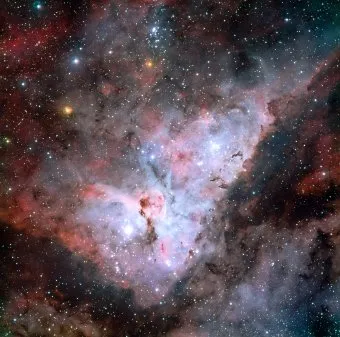
The image shows the variety of this cosmic panorama, with clusters of young stars, pillars of dust, and binary stars. It was produced by combining exposures through six filters with the Wide Field Imager (WFI) on the 2.2-meter ESO telescope at the La Silla Observatory, Chile.
The Carina Nebula is located 7,500 light-years away in the constellation of the same name (Carina, the Keel). Spanning 100 light-years, it is four times larger than the famous Orion Nebula and much brighter. It is an intense region of star formation with dark lanes of dust and many star clusters.
The glow of the nebula comes mainly from hydrogen in the strong radiation from young massive stars. The interaction between hydrogen and ultraviolet light results in its characteristic red and purple color. The immense nebula contains more than a dozen stars with at least 50 or 100 times the mass of our Sun.
One of the best-known stars in the universe, Eta Carinae, is found in the nebula. It is one of the most massive in our galaxy, more than 100 times the mass of the Sun and about 4 million times brighter. It is a very unstable star, with violent outbursts, to the point of being mistaken for a supernova event. It is thought to have a companion that orbits it. Both stars have powerful winds that collide. In mid-January of this year, the companion was at its closest distance to Eta Carinae. The event, which could provide interesting data to better understand the structure of massive star winds, has been followed by a flotilla of instruments on several ESO telescopes.
Sources and related links
- ESO: Strong Winds over the Keel
Through the ESO press release it is possible to access videos and even a high-resolution image of the nebula (134MB!!!)
About the images
Image composite of the Carina Nebula. Several known objects can be seen: at the bottom left, Eta Carinae, with the famous Keyhole Nebula. The collection of very bright, young stars, to the upper right of Eta Carinae is the open cluster Trumpler 14. A second open cluster, Collinder 228, is located just below Eta Carinae.
Credit: ESO