The La Silla observatory, which is celebrating its 40th anniversary, has become the largest astronomical observatory of its time. It brought Europe to the frontiers of astronomical research, and it is still the most scientifically productive in ground-based astronomy.
With about 300 refereed scientific publications, attributable to the observatory's work per year, La Silla is one of the cutting-edge facilities in astronomy. Thanks to its instruments, many discoveries were made. The HARPS spectrograph, one of the greatest planet hunters, detected the Gliese 581 system, which contains what could be the first rocky planet in a habitable zone, outside the solar system.
Several telescopes at La Silla played a crucial role in discovering that the expansion of the universe is accelerating and in linking gamma-ray bursts -the most energetic explosions in the universe- with supernovae. Since 1987, the La Silla Observatory played an important role in the study and monitoring of the nearest supernova, SN 1987A.
"The La Silla Observatory continues to offer the astronomical community exceptional capabilities", noted the Director General of ESO, Tim de Zeeuw. "It was ESO's first presence in Chile and thus, triggered a very long and fruitful collaboration with this country and its scientific community".
The observatory is located on the edge of the Atacama Desert, Chile, one of the driest and loneliest places in the world. Like other observatories in that region of the planet, La Silla is far from sources of light pollution and, like the Paranal Observatory that hosts the Very Large Telescope (VLT), it has one of the darkest and cleanest night skies on Earth.
La Silla was home to no less than 15 telescopes, among them the first -and for a long time, the only- telescope working in submillimeter waves (the 15-meter SEST) in the southern hemisphere, which paved the way for APEX and ALMA and the 1-meter Schmidt telescope, which completed the first photographic mapping of the southern sky. The telescopes at La Silla have supported countless space missions, for example, by obtaining the last images of comet Shoemaker Levy 9 before it crashed into Jupiter, and thus, helping to predict the exact moment when the Galileo spacecraft had to observe to capture images of the cosmic commission.
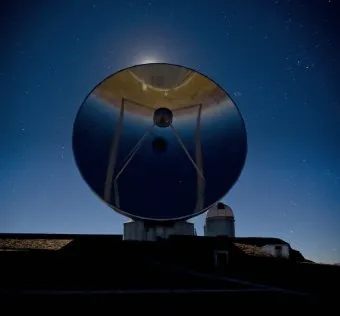
At the center of the image is the 15-meter antenna of SEST (Swedish-ESO Submillimetre Telescope), backlit by the Moon. To the left, farther away, is the dome of the 3.6-meter telescope, at the highest point of the mountain. The reddish star at the top right of the image is Aldebaran, in the Constellation of Taurus. The star cluster Pleiades is seen just to the right (2 o'clock position) of SEST.
There is a reversed reflection of the sky and the horizon behind the photographer in the highly polished antenna.
"Many of the astronomers of the current generation were trained at La Silla where they had their first experience with what were later considered great telescopes", indicated Bruno Leibundgut, Director of Science at ESO.
While some of the smaller telescopes have been closed for years, cutting-edge observations continue with the large telescopes, aided by new and innovative astronomical instruments. La Silla currently hosts two of the most productive telescopes of the 4-meter class in the world, the 3.5-meter New Technology Telescope (NTT) and the ESO 3.6-meter Telescope.
"The NTT opened a new path for telescope engineering and design", commented Andreas Kaufer, director of the La Silla Paranal Observatory. The NTT was the first in the world to have a computer-controlled primary mirror (active optics), a technology developed by ESO and now applied by the VLT and the largest current telescopes in the world. The ESO 3.6-meter telescope, which was for many years one of the largest European telescopes in operation, is now home to the extrasolar planet hunter, HARPS (High Accuracy Radial velocity Planet Searcher), a spectrograph with unrivaled precision.
La Silla's infrastructure is used by many ESO member states for specific projects such as the Swiss 1.2-meter Euler Telescope, the Italian Rapid-Eye Mount (REM) and the French gamma-ray burst hunters TAROT, as well as more commonly used facilities, like the 2.2-meter telescope of the German Max Planck Society and the Danish 1.5-meter telescopes. The 67-million-pixel Wide Field Imager, on the 2.2-meter telescope has taken many incredible images of celestial objects, some of which have now become icons of their kind.
The La Silla Observatory, north of the city of La Serena, has been a bastion of the organization's capabilities since the 1960s. The site was chosen after an initial prospecting expedition -partially on horseback- to the Chilean Andes, during 1963 and 1964, by the first Director General of ESO, Otto Heckmann, and several senior astronomers. This was done with the help of AURA, which had chosen to install an observatory on the nearby Cerro Tololo. In the following years, the site was developed and the first small and medium-sized telescopes were erected, followed by the 3.6-meter telescope in 1977 and the NTT in 1989. On March 25, 1969, an audience of more than 300 people, including the Chilean president, Eduardo Frei and the Swedish Minister of Education, Olof Palme, celebrated the completion of the first phase of the construction program.
"The construction of the La Silla Observatory is not only of vast importance for the future of astronomical research, but also a remarkable example of what can be achieved through efficiency and true long-range international cooperation", expressed Olof Palme at that time.
The future of the La Silla Observatory remains bright. In 2007 the ESO Council supported a plan that maintains an important role for La Silla, in addition to the other major ESO facilities, the VLT, ALMA and the E-ELT.
La Silla also plans to host new national telescope projects and visitor instruments - an option that has already received a strong positive response from the astronomical community.
To learn more about La Silla:
http://www.eso.org/public/astronomy/teles-instr/lasilla.html
More images of La Silla:
http://www.eso.org/gallery/v/ESOPIA/LaSilla/
ESO timeline:
http://www.eso.org/public/about-eso/timeline.html
ESO
The European Organization for Astronomical Research in the Southern Hemisphere (ESO) is a European body for cutting-edge science and technology in the field of astrophysics. The countries that make up ESO are Germany, Belgium, Denmark, Spain, Finland, France, the Netherlands, Italy, Portugal, the United Kingdom, the Czech Republic, Sweden, and Switzerland.
The idea of establishing a large common observatory for European astronomers emerged in the spring of 1953, in the mind of the German astronomer Walter Baade. A few months later, in January 1954, twelve distinguished astronomers from Belgium, France, Germany, England, the Netherlands, and Sweden met at Leiden University to discuss this new idea of a common observatory for Europe.
The result of this meeting was a historic declaration, expressing their desire that the scientific organizations of their respective countries recommend the establishment of a European observatory in the southern hemisphere.
In 1962, the Convention that gave rise to ESO was signed, with the main mission of building and operating state-of-the-art astronomical facilities, enabling first-class research in the southern hemisphere.
This ambitious goal has made ESO a leading organization in world astronomy, with facilities and projects that go beyond the individual capabilities of its member countries.
The ESO headquarters is located in Garching (Germany).
To learn more about ESO and La Silla, in Spanish, visit the Chilean site:
http://www.eso.cl/
Sources and related links
- ESO’s First Observatory Celebrates 40th Anniversary
About the images
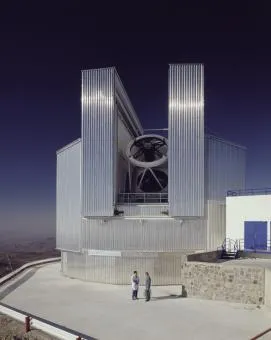
NTT: ESO's 3.6-m New Technology Telescope (NTT), in its octagonal enclosure.
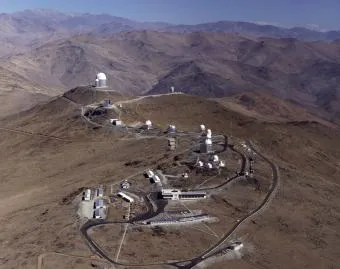
Aerial view of La Silla.
All images belong to ESO. Larger images and videos can be obtained from the press release cited above.