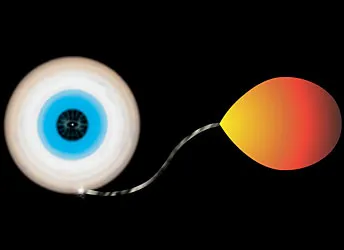
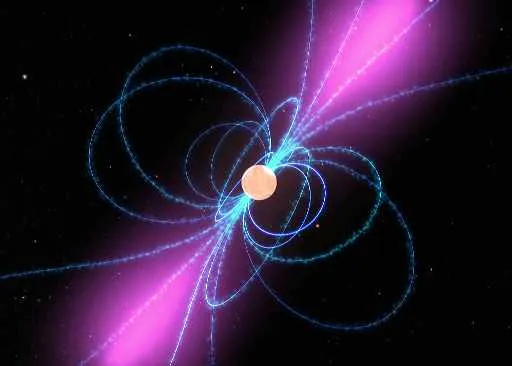
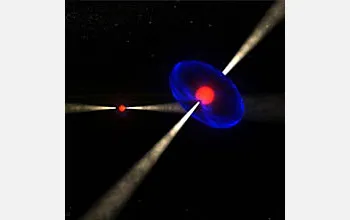
The collaborative project Einstein@Home will process and analyze data from the Arecibo Observatory in search of pulsars orbiting neutron stars or black holes.
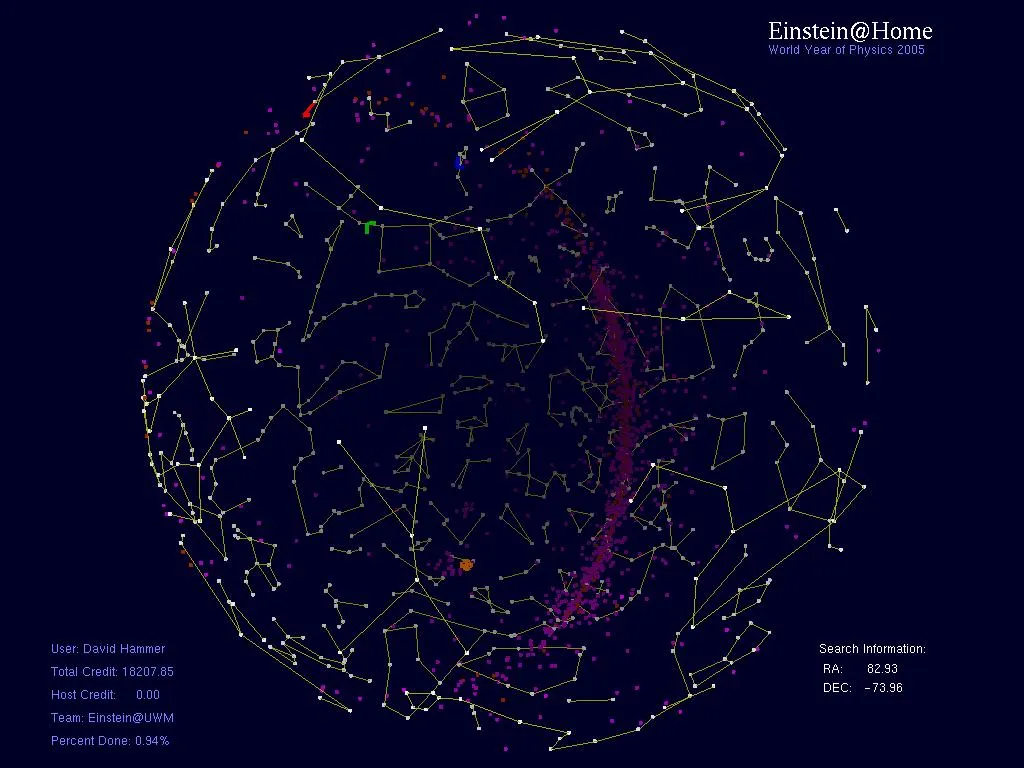
Einstein@Home is one of the largest distributed volunteer computing projects in the world. More than 200,000 people have joined the project, based at the University of Wisconsin-Milwaukee (UWM) and the Albert Einstein Institute (AEI), and have donated time from their computers to search for pulsars using data from LIGO and the GEO600 gravitational wave detectors.
The project is supported by the American Physical Society (APS) and a number of international organizations.
On March 24, Professor Bruce Allen, Director of the project, and Professor Jim Cordes, of Cornell University and Head of the Arecibo PALFA Consortium, announced that the project will analyze data taken by PALFA (Pulsar ALFA Survey Project) at the Arecibo Observatory in Puerto Rico. This observatory, famous for its appearance in some films like Contact and Goldeneye, is the largest single-aperture radio telescope on the planet and is used to study pulsars, galaxies, solar system objects and Earth's atmosphere. Using new methods developed at the Albert Einstein Institute, the project will search the Observatory's data to find binary systems of the most extreme objects in the universe: a rotating neutron star orbiting another neutron star or a black hole. Current searches of radio data lose sensitivity for orbital periods shorter than 50 minutes. But the enormous computational capabilities of Einstein@Home, equivalent to tens of thousands of computers, make it possible to detect pulsars in binary systems with orbital periods as short as 11 minutes.
"Discovering a pulsar orbiting a neutron star or a black hole, with an orbital period of less than an hour, would generate tremendous opportunities to test General Relativity and to estimate the merger frequency of binaries," Cordes said. The mergers of these systems are among the rarest and most spectacular events in the cosmos. They emit bursts of gravitational waves that current detectors might be able to detect and are also thought to emit bursts of gamma rays just before the collapsing stars merge to form a black hole.
"While our long-term goal is to detect gravitational waves, in the short term we hope to discover at least a few new radio pulsars per year," Allen commented.
The large datasets from the Arecibo surveys are archived and initially processed at Cornell and other PALFA institutions. For this project, the data are sent to the Albert Einstein Institute in Hannover via broadband, pre-processed and then distributed to computers around the world. The results are returned to AEI, Cornell and UWM for further investigation.
How to collaborate

Basically, users who wish to use the idle time of their computers can subscribe to the many distributed volunteer computing projects of BOINC.
Use your computer's idle time (Windows, Mac, or Linux) to cure diseases, study global warming, discover pulsars, and do many other kinds of scientific research. It's safe, stable, and easy:
1. Choose projects
2. Download and run the BOINC program
3. Enter an email address and a password.
To join Einstein@home, visit the page:
http://einstein.phys.uwm.edu/
The process is very simple. You download the BOINC program, install it and from that moment we can start adding projects. For the latter, we can use the program's menu, add a project from those listed there and enter our email address and password, if we have already subscribed to a project. Otherwise, at that time we can create a user and password for the project we have chosen. When adding a project, the program will receive data via the internet connection from a central server. The users' computers process the data when the user indicates (it can be set to be used only when the user is not using the computer, but there are also other variants that can be configured for CPU, RAM and disk usage). Then the program will send the processed data to the server and will receive, if available, more data to process.
Sources and related links
- New EINSTEIN@HOME effort launched: home computers to search Arecibo data for new pulsars
- Einstein at Home
- Arecibo PALFA
- Astroseti:La Esfera del Salva Pantallas de Einstein@Homeli>
About the images
Einstein@Home screensaver
PALFA logo
BOINC logo