An online catalog of confirmed discovered worlds orbiting other stars, from The Planetary Society, allows you to learn detailed information about each of these exoplanets.
Since the first exoplanet was discovered in the mid-1990s, the number has not stopped increasing.
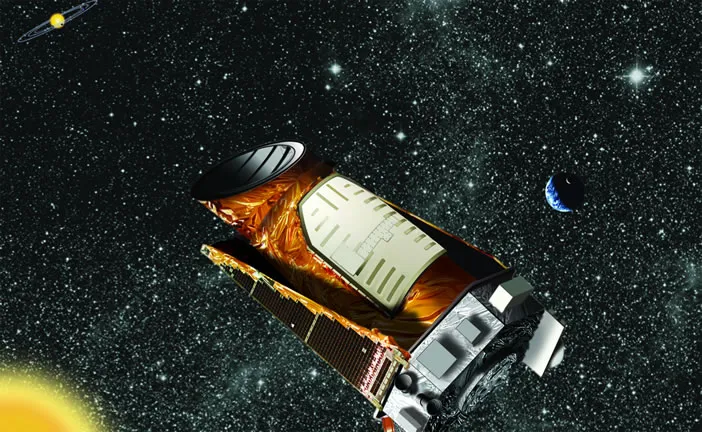
According to this new online catalog, the discovered worlds currently amount to 335. With the recent launch of the Kepler mission, the Corot mission and current and future ground-based telescopes, that number will increase notably in the coming years.
Most of the discovered exoplanets are gas giants, hundreds of times the mass of Earth and many of them, orbiting very close to their star. But, just as detection methods and instrument sensitivity have improved, the discovered worlds have also varied. Planetary systems composed of up to five worlds have been discovered, some with characteristics similar to our solar system.
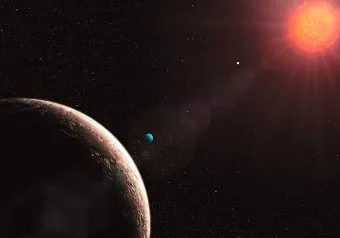
A few candidates for an "alien Earth" have also been detected, that is, worlds similar to ours orbiting another star. However, the great candidate is still being sought, that world that shares many of the characteristics of our pale blue world.
The Planetary Society's catalog (Planetary Society) presents an update of the list of known exoplanets, along with essential information about each one:
Location and host star
Mass
Orbital period
Method by which it was detected
Date of discovery
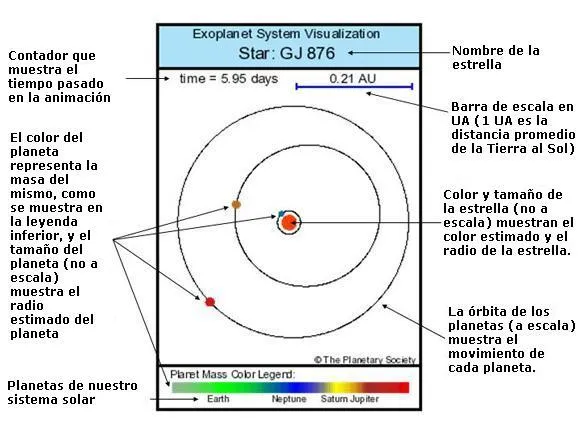
An animated graphic of each exoplanet shows its precise orbit and that of other planets in the system. Star types and planet sizes are indicated with colors.
The catalog also includes articles on detection methods and there is a page dedicated to "notable exoplanets," those that stand out from the rest and tell us something unique about distant worlds. When a new exoplanet is detected it will be included in the catalog.
The funds to produce and maintain the Exoplanet Catalog were provided by donations from members of The Planetary Society.
The animations
Visualization system: Each star in the catalog has an animation that illustrates a variety of information. The star's name appears at the very top. On the right, at the top, a counter shows the amount of real time elapsed in the animation. On the left, the scale bar, which changes from system to system. The colors and sizes of the planets give an immediate indication of the mass and size of the exoplanets by using a color legend below. The color and size of the star varies according to the star type.
Star color and size
This legend shows the meaning of the colors and sizes of the stars in the animations. A variety of stars are shown, including the Sun, to show how the color and size scale progresses. The spectral type of these stars and the surface temperature in degrees Kelvin are also shown.

In the astronomical community, stars are categorized according to a spectral type, which is useful for distinguishing between large blue O and B stars, stars like our Sun F, G and K and smaller red M stars. The legend shows a variety of spectral types and how they are represented in the animations. The color follows the true colors of these stars, determined by their temperature (except when the type is unknown, shown in black). While most planets are found around small "main sequence" stars, like our Sun, some have been found around giants, like K0III.
Note that the sizes of the stars are not exactly to scale compared to each other: a B0 star is about 20 times larger than the Sun and an M5 is about 5 times smaller. Also, the sizes are not to scale with the orbits either.
Planet colors and sizes
Except in some cases, it is generally impossible to measure the actual color of the planet. The planets in the animations are colored according to their mass.
Some planets like Earth, Neptune, Saturn and Jupiter are shown and the mass of the planets in Earth Masses (1=6 x 1024 kg) and Jupiter Masses (1.9 x 1027 kg).

The radius of the planets is also shown in "Jupiter Radii" (71,500 km).
The colors with which they are represented are arbitrary but help to quickly identify the mass of the planets. Those that are like Earth are green; those that are like Neptune, blue; those with a mass similar to Saturn are yellow; those with a mass like Jupiter, red.
Below the animations there is a color bar to remember this scale, with the position of the aforementioned planets of our system.

Most planets were discovered with the "radial velocity" technique, which only determines the minimum mass of the planet. The catalog illustrates the minimum mass (in italics in the catalog) if the actual mass is not known.
Unless the planet transits its star, the size cannot be measured and the sizes are estimated based on assumed densities.
As in the case of star sizes, planet sizes are not to scale with each other.
Orbital path
The orbital path of each planet is shown as a thin black line. This is how the system would look seen from above the orbital plane (The animations do not show the system as seen from Earth).
Johannes Kepler showed that the orbits of planets are ellipses (Kepler's First Law). The eccentricity of an orbit describes how much an orbit varies from a circle. An eccentricity of 0 is a circular orbit.
Scale bar
Each ellipse has a semi-major axis, defined as half of the longest diameter. In circular orbits (when eccentricity is 0), the semi-major axis is the radius of the circle. In the catalog, the semi-major axis of the most distant planet was used as the scale for the animations, for example, "0.8 AU" means that the semi-major axis of the planet with the largest orbit is 0.8 AU (Astronomical Units).
Time elapsed
The same variety in size scales is seen in the time scale, with some planets completing a revolution in less than a day and others with orbital periods greater than hundreds of years. Each animation has a different speed and the total time is shown in the upper corner when the animation runs.
Help the Planetary Society
There are various ways to help this organization. Through donations, memberships, corporate donations, giving a membership to another person, shopping in their online store, and other ways.
Why join the Planetary Society?
The Planetary Society carries out several exciting projects, including SETI@home, exoplanet discovery and much more. Only with the support of its members is it possible to make advances in humanity's search for knowledge of the cosmos. By being a member you will have access to the magazine (also available online), opportunities to participate through contests, projects and more. Member-only access to certain parts of the website, alerts about what's happening in the space community and the pleasure of being part of an organization that seeks to increase our knowledge of the universe.
The Planetary Society, founded in 1980 by Carl Sagan, Bruce Murray and Louis Friedman, inspires and involves the public worldwide in space exploration. Dedicated to the exploration and search for life beyond Earth, it is a non-governmental and non-profit organization, supported by its members.
To learn more:http://www.planetary.org/home/
Sources and related links
- How Many Planets Are There?
- Exoplanet catalog from The Planetary Society
About the images
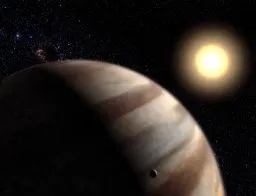
Artist's conception of the gas giant orbiting a Sun-like star, HD 209458, 150 light-years from Earth. Credit: G. Bacon (STScI/AVL)
The explanatory images for the animations are from The Planetary Society.