The Hubble Space Telescope identified, in its archives, a star that is a million times brighter than our Sun, before exploding as a supernova in 2005. According to current theories of stellar evolution, the star should not have exploded so early in its life.
"This could mean we are fundamentally wrong about the evolution of massive stars and that the theories need to be revised," said Avishay Gal-Yam of the Weizmann Institute of Science in Israel.
The exploded star, estimated at 100 solar masses, was not mature enough, according to theory, to have evolved and have an iron core, a prerequisite for the implosion that triggers supernovae.
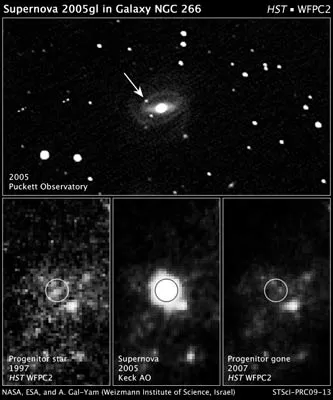
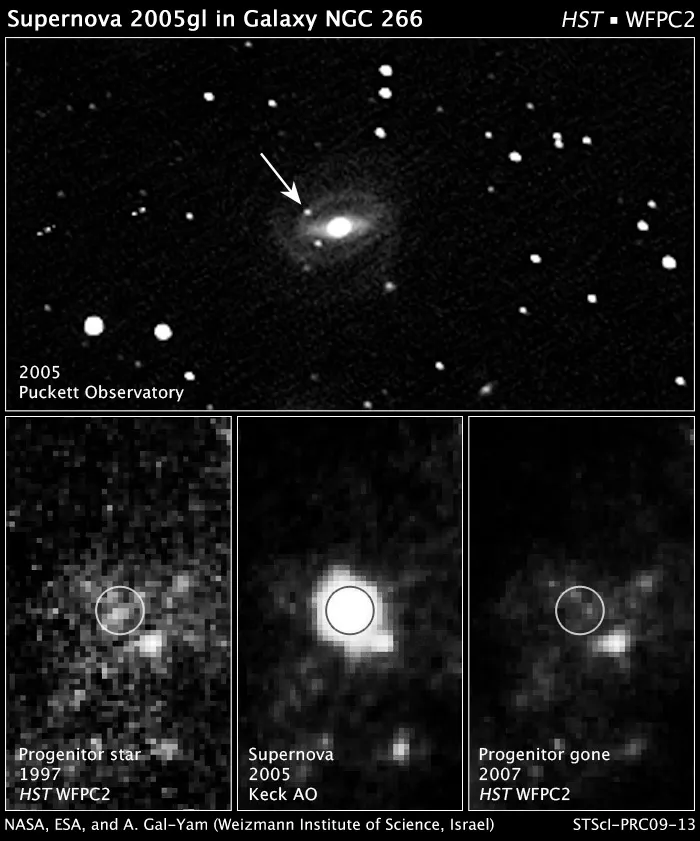
The explosion, called SN 2005gl, was seen in the barred spiral galaxy NGC 266 on October 5, 2005. Pre-explosion images from Hubble's archives, taken in 1997, reveal the progenitor star as a point source with an absolute visual magnitude of -10.3.
The progenitor was so bright that it probably belonged to the class called Luminous Blue Variables (LBV), since no other type of star is intrinsically so bright, according to Gal-Yam. As this type of star evolves, it expels much of its mass through a strong stellar wind. Only at that point does it develop a large iron core and finally explode as a supernova.
Massive and luminous stars of up to 100 solar masses, like Eta Carinae in our galaxy, should lose their hydrogen envelopes entirely before the supernova explosion. "These observations demonstrate that many details in the evolution and fate of LBVs remain a mystery. We must continue to watch Eta Carinae, it could surprise us again," said Mario Livio of the Space Telescope Science Institute.
The co-author of the report sent to Nature, Douglas Leonard of San Diego University, further explained that: "The identification of the progenitor shows that, at least in some cases, massive stars explode before losing most of their hydrogen envelopes, suggesting that core evolution and envelope evolution are less related than previously thought, a discovery that could require a revision of stellar evolution theory."
One possibility is that the progenitor was a pair of stars, a binary system that merged. This would have fueled the nuclear reactions and made the star shine enormously, making it appear more luminous and less evolved than it really was. "This also leaves open the question of whether there could be other mechanisms for triggering supernova explosions. Perhaps we are missing something very basic in understanding how a superluminous star loses mass," said Gal-Yam.
The scientist reported that the observation revealed that only a small part of the star's mass was ejected in the explosion. Most of the material, says Gal-Yam, was drawn into the collapsing core which likely became a black hole estimated at at least 10 to 15 solar masses.
Gal-Yam and Leonard located the progenitor in archive images of NGC 266 in 1997. The team used the Keck telescope to precisely locate the supernova in the outer arm of the galaxy. A follow-up with Hubble in 2007 showed that the superluminous star was no longer there. To ensure that the new observation was consistent with the 1997 archive image, the astronomers used the same camera used in 1997, the Wide Field Planetary Camera 2.
The luminous source, NGC266 LBV 1, which scientists had previously identified as spatially coincident with SN 2005gl, is no longer visible in 2007. The proposal that this source was the progenitor of this supernova has two problems, as the authors indicate in their report. First, the old Hubble images cannot rule out the possibility that the point source detected in 1997 was a compact cluster of many stars. Second, the spatial coincidence of the single star alone does not provide conclusive evidence that the supernova is related to the luminous star. The explosion could have been the result of a lower luminosity star, projected near the source, but undetectable in the 1997 images. The new, deeper 2007 observations attempt to address these caveats. The new data indicate that the source is a single star and that it disappeared after the SN 2005gl supernova explosion.
But there is another possibility, which the scientists indicate would be very difficult in virtue of the many coincidences it implies, which is that the source is an unrelated LBV but spatially coincident with SN 2005gl, which had an eruption in 1997 and then declined below the detection threshold in 2007.
Finding archive images of stars before they explode as supernovae is not a simple task. Many other supernova progenitor candidates have been reported. The only other undisputed progenitor, however, was the blue supergiant progenitor of SN 1987A. In that case, the progenitor star was thought to have been a red supergiant and at a later period evolved to blue supergiant status. This led to a revision of supernova theory. The progenitor star observed by Gal-Yam is too massive to have undergone such a swing, so another explanation is needed, according to the scientist.
Sources and related links
- Hubble Uncovers an Unusual Stellar Progenitor to a Supernova
- A massive hypergiant star as the progenitor of the supernova SN 2005gl
A. Gal-Yam & D. C. Leonard
Nature, Published online March 22, 2009
DOI:10.1038/nature07934; - On the progenitor of SN 2005gl and the nature of Type IIn supernovae
Avishay Gal-Yam et al.
ApJ 656 372-381
arXiv:astro-ph/0608029v1
DOI:10.1086/510523
About the images
Archive images:
The top image is a ground-based image of the supernova in galaxy NGC 266, in the constellation Pisces, in 2005.
Credit: Puckett Observatory.
Below, left:
1997 Hubble visible-light image of the galaxy region where the supernova occurred. The circle marks the star that Hubble measured with an absolute magnitude of -10.3. This corresponds to a brightness of a million suns (at the galaxy's distance of 215 million light-years)
NASA, ESA, and A. Gal-Yam (Weizmann Institute of Science, Israel)
Below, center: Near-infrared image of the explosion taken on November 11, 2005, with the Keck telescope, using adaptive optics.
NASA, ESA, and A. Gal-Yam (Weizmann Institute of Science, Israel), D. Leonard (San Diego State University), and D. Fox (Penn State University)
Bottom, right: A follow-up visible-light image from Hubble taken on September 26, 2007. Note that the bright source near the supernova site can be seen in all three panels, but the progenitor star is no longer there.
NASA, ESA, and A. Gal-Yam (Weizmann Institute of Science, Israel)