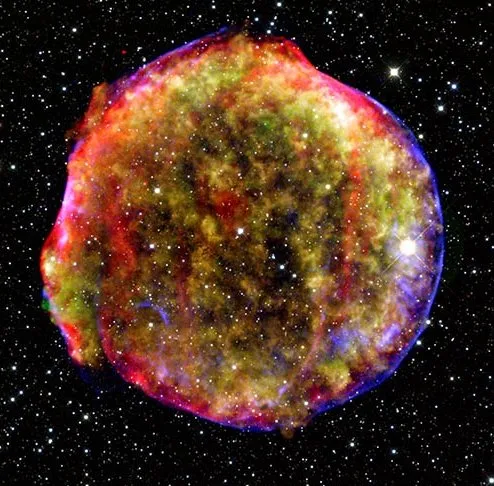
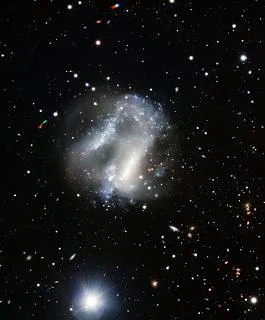
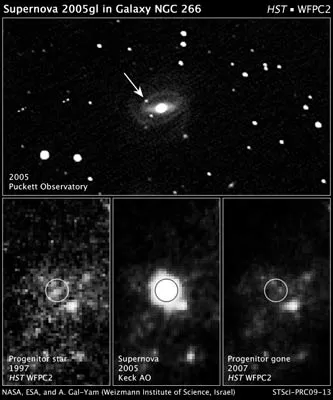
Two new efforts have taken the supernova remnant from static to dynamic. A new film with data from the Chandra Observatory shows changes over time never before seen in this type of object. And an unprecedented three-dimensional visualization of the same remnant, by an independent team, is being presented.
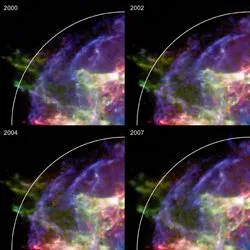
Almost ten years ago, the "first light" of the Chandra X-ray Observatory of Cassiopeia A (Cas A) revealed structures and details until then unknown. Now, after eight years of observation, scientists were able to build an animation of Cas A that tracks the expansion and changes over time of the remnant.
"With Chandra, we have seen Cas A over a relatively small amount of time of its life, but so far the show has been incredible. And we can use this to learn more about what happens after a star explodes," notes Daniel Patnaude of the Smithsonian Astrophysical Observatory in Cambridge.
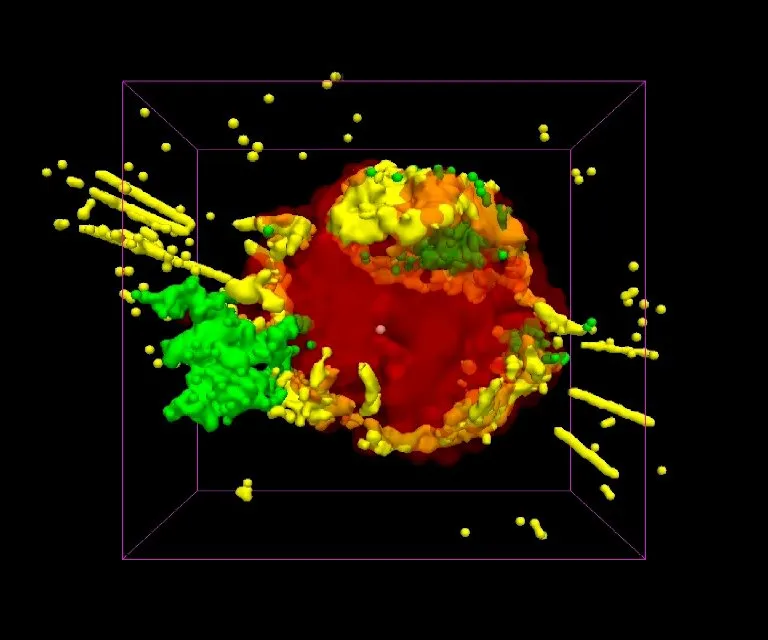
An independent 3-D visualization of Cas A was presented along with the results of Patnaude's team at a press conference of the Meeting of the American Astronomical Society in California. Based on data from Chandra, Spitzer and ground observatories, Tracey Delaney and colleagues created the first three-dimensional image of the remnant.
"We have always wanted to know how the pieces we see in two dimensions fit together in real life. Now we can see it in this 'hologram' of the supernova debris," indicates Delaney of the Massachusetts Institute of Technology.
This visualization was possible through a collaboration with the Harvard Medical Astronomy project.
We already talked here about the project (in Gas Clouds in 3D) that not only seeks to offer a new data visualization tool, but also for study and analysis.
Patnaude and his team measured the expansion velocity in Cas A and found that it is slower than expected based on current models.
Using estimates of the properties of the supernova explosion, including its energy and dynamics, the group showed that 30% of the energy in the supernova went into accelerating cosmic rays. The flickering in the film provides valuable information about where this particle acceleration occurs.
Similarly, the new 3-D model provides researchers with a new ability to study the remnant. With this tool, Delaney and colleagues found two components of the explosion: a spherical component from the star's outer layers and a flattened one from the inner layers.
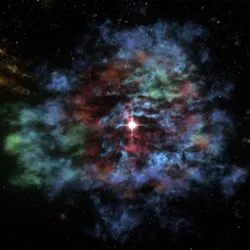
Notable features of the model are the hyper-velocity jets of internal material expelled from the explosion. The silicon jets appear in the northwest and southwest, while the iron jets are seen in the southeast and north.
The implication of the work is that astronomers who model supernovas must now consider that the star's outer layers come out in a spherical shape and the inner ones more in a disk shape with hyper-velocity jets in multiple directions.
About the 3-D visualization
In the visualization, the green region is mostly iron observed in X-rays. The region in yellow is a combination of argon and silicon seen in X-rays, optical and infrared. The red region is cold debris seen in infrared. The blue reveals the outer shock wave, in X-rays.
About the Animation
The X-ray data film of Cas A was made with data from observations taken in January 2000, February 2002, February 2004 and December 2007. In the images, the lower energy X-rays are shown in red, the intermediate ones in green and the higher ones in blue.
Cas A is the remnant of a star that exploded about 330 years ago and is one of the youngest remnants in the galaxy.
Sources and related links
About the images
Credits:
Animation:NASA/CXC/SAO/D.Patnaude et al.
3-D Animation:NASA/CXC/D.Berry