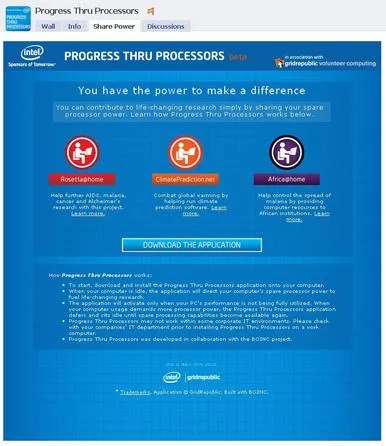
In recent years, technology has made it possible for users of increasingly powerful computers and faster internet connections to collaborate in different scientific programs. But there are also other ways to help.
The possibilities of helping different projects or institutions linked to science can be classified into: Donations, Distributed computing, Online collaboration, Dissemination, Active volunteering, among others.
Donations
Donations are a way to collaborate with scientific institutions or work teams and are generally subdivided into: Financial donations (individual or group/corporate) and equipment/supplies donations.
Distributed computing
Distributed computing allows us to use the free resources of our computers to analyze data from different projects. It only requires downloading and installing free software, joining the projects we like, and that's it. The default options can be easily changed so that the analysis is performed when we really want it. Usually the applications will use our hardware resources (processor, disk and memory) when we are not using the computer. But if we have a powerful PC we can let the applications run permanently. Some of the applications also allow the use of powerful graphics card processors.
Dissemination
If we have our own website or a space on the internet that we can use, we will have a resource to disseminate the concept of solidarity and collaboration, tell which projects to join and how to do it. Social networks have opened up possibilities for all of us to have a small space on the web. Users of Facebook, Twitter and other networks can occasionally send messages to their users about these topics and thus encourage other people to join or at least become interested in these alternatives.
Active volunteering
In some institutions it is possible to do more active volunteering such as giving courses, repairing equipment or helping with fundraising.
Below we list some of the possibilities for helping science. Needless to say, these are not the only institutions that may merit our collaboration. The idea is to nominate some with the aim of raising awareness of the value of solidarity. Towards the end we will also comment on the need that other types of organizations, not scientific ones, have for our help.
ARTICLES AND ONLINE HELP
WIKIPEDIA

An example is Wikipedia, with which we can collaborate in the "Online collaboration" section. The online encyclopedia is free and very visited every day, but to carry out the initiative, funds and equipment are required. To collaborate with Wikipedia we can write articles, translate articles already written in other languages, donate money or equipment. There is a variety of related projects such as Wiktionary, Wikibooks, Wikiquote, and more.
In addition to the very famous online encyclopedia, there are also other similar spaces:
http://www.wikilearning.com/
ar.answers.yahoo.com/
And also the forums, which we constantly consult on different topics, from online dictionary forums to computer assistance forums that have gotten us out of trouble so many times.
GALAXY ZOO
The Galaxy Zoo projects provide the possibility of carrying out an activity that, if it is of interest to us, will be entertaining and valued. For the scientific community it is also important. On the one hand, observatories collect a huge amount of data to analyze. Part of the analysis can always be done through complex automatic programs, but in many cases, an evaluation is needed that no computer can perform. At least, for now. On the other hand, those powerful algorithms are not generated by spontaneous generation. Open source programs allow users to collaborate with code improvements, resulting in a benefit for all users. Recently, Jill Tarter, the director of the SETI program, announced that she would offer the possibility to engineers around the world to improve their algorithms. And to expand her extraterrestrial intelligence search program so that users can not only collaborate through the donation of time and resources from their computers, but also through intellectual contribution.
Related notes:
Supernova hunters wanted
To classify lunar craters
Help wanted to classify never-before-seen galaxies
PALE BLUE DOT PROJECT
Just like Carl Sagan's book, the homonymous project "Pale Blue Dot" offers the possibility of collaborating with a scientific investigation to search for exoplanets, by adopting a star.
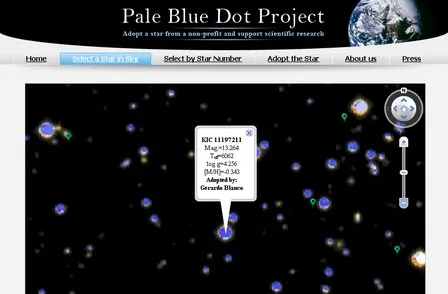
The recent Kepler mission will study the brightness of more than 100 thousand stars. This project will enable the analysis of that data to search for planets. What the user gets in return for their donation is the designation of the star they chose, keeping in mind that this designation is not official, but we will see our name in the online catalog and in Google Sky. They will also send us a certificate and if the chosen star has a planet we will appear in a special section of the site.
Pale Blue Dot:
http://whitedwarf.org/palebluedot/
CITIZEN SKY
Epsilon Aurigae is a star that varies in brightness. To discover the reason, a site called Citizen Sky was created that will recruit, train, and coordinate public participation in this project.
The initiative is aimed at those in which the user not only collects data, but can participate more actively in the scientific methodology.
More information at the Copernicus Institute: "Reaching the citizen sky".
Astronomy associations in Argentina
There are several associations distributed throughout the country. Perhaps it is convenient to make the necessary inquiries or search the web, to approach and collaborate with the groups near our home.
In the Federal Capital, the Argentine Association "Amigos de la Astronomía" is a non-profit public welfare entity, founded in 1929, whose objective is to disseminate and cultivate Astronomy. Its headquarters is located at Av. Patricias Argentinas 550 (C1405BWS) Ciudad Autónoma de Buenos Aires, Argentina.
To learn about the benefits and requirements to become a member, visit the association's page.
http://www.amigosdelaastronomia.org/
LIADA
The Ibero-American League of Astronomy LIADA attempts to organize, enhance, lead and facilitate the efforts of amateur and semi-professional astronomers from Ibero-America. Professional astronomers participate in it, thus crystallizing the collaboration between the two groups that nourish our beloved activity: Astronomy.
The objectives agreed upon by the members of LIADA are:
Promote the study of Astronomy and the observation of the sky in those areas that are most significant.
Unite all observers on planet Earth who speak Spanish and Portuguese.
Promote communication between professionals and amateurs.
Disseminate and expand respect and appreciation for Earth as a planet.
Publish the work of members.
LIADA is the heir of the old Latin American League of Astronomy, founded by inspiration of Víctor Estremadoiro Robles on October 18, 1958. It was created on December 12, 1982, as part of the reorganization of the former LLADA.
Social and Administrative Headquarters
Observatorio CODE, Centro Observadores del Espacio, Avda. Almirante Brown 5100 (Costanera), 3000 Santa Fe, Argentina [email protected]
To become a member, consult the LIADA membership page.
More associations and groups
Precisely in LIADA we can find a link to other groups throughout the country.
DONATIONS (ARGENTINA)
Some institutions linked to science that require financial help from the public are:
Fundación Ciencias Exactas y Naturales
The central objective of the Foundation is to collaborate with the Faculty of Exact and Natural Sciences of the University of Buenos Aires. It supports scientific research by primarily granting scholarships to undergraduate students who show economic difficulties in pursuing their degree. It promotes technology transfer through agreements with companies. It administers subsidies granted by other institutions in the country and abroad to researchers of the Faculty. It cooperates with scientific institutions in the country and abroad in financing meetings and scientific congresses held in the country. It participates with the Faculty in the management of the Business Incubator, INCUBACEN.
Did you study at UBA and wish to help your university?
http://www.fundcse.fcen.uba.ar/donaciones/
Instituto Leloir

The Fundación Instituto Leloir conducts research on cancer, Alzheimer's, heart attack, Parkinson's and dengue, among other diseases.
For more than 60 years it has generated excellent knowledge, which will allow us to have more and more tools to diagnose and treat diseases that deeply damage the lives of people and entire families.
To achieve this, they depend on very costly supplies: reagents, instruments and high-tech equipment.
We can join as Friends of Instituto Leloir with a monthly donation.
https://www.leloir.org.ar/es/Colabore_Ahora.html
Fundación Favaloro
Fundación Favaloro receives solidarity donations from individuals and companies. These are allocated to the care of patients without resources, the expansion of facilities and the purchase of new equipment so that diagnoses are more precise and patient hospitalization is shorter.
Currently, more than 15,000 people make up an important network of donors. With their effort they support the Foundation and make it possible to continue the work begun by Dr. René G. Favaloro.
http://www.fundacionfavaloro.org/home/index.htm
INFANT
The Foundation for Research in Pediatric Infectology (INFANT) is a non-profit organization created in 2003 for the development of scientific initiatives that translate laboratory findings into interventions with a direct impact on children's well-being.
http://www.infant.org.ar/acerca.php
La Fundación Evolución
Fundación Evolución is a non-governmental, non-profit organization. Its main objective is to contribute to the educational use of Information and Communication Technologies (ICT) to promote contact between young people and teachers in local and global communities.
http://www.fevolucion.org/sobre_nosotros_2.asp
BOINC
BOINC projects allow the use of the "dead" time and resources of our computers to process the enormous amount of data in the databases of different projects. The idea is simple and powerful and users have several options when running the application. There is a great variety of projects we can use related to medicine, astronomy and physics, etc.
We have already commented on this here in other posts we cite below:
BOINC goes social with Facebook
A decade of SETI@home
Einstein@Home will search for radio pulsars in Arecibo data
What can we expect from the LHC?
Voluntariado universitario

The Ministry of Education and the Secretariat of University Policies have been carrying out the University Volunteer Program. Projects can be presented on the initiative of students, teachers, and researchers, but in all cases the work teams of a project must be composed of at least 10 students and 1 teacher. The 2009 call has already closed and they are in the process of evaluation and selection, after which the selected initiatives are funded.
GREENPEACE
What can be said about the best-known ecological organization? That we can collaborate in many ways. Spreading their campaigns, collecting signatures, putting a banner on our website or making a financial donation are some of the possibilities.
http://www.greenpeace.org/argentina/
Other ecological organizations
The Argentine Association of Sanitary and Environmental Engineering (AIDIS ARGENTINA) is a Non-Governmental Organization, non-profit, with legal status established in 1948, as a member of the Inter-American Association of Sanitary and Environmental Engineering, which it represents in the country.
http://www.aidisar.org.ar/
A listing of environmental NGOs in Argentina on Taringa
SOCIAL ORGANIZATIONS
There are countless foundations and NGOs linked to various human activities, in support of the situation of arts and culture, the heritage of nations and humanity, the rights of those who have less. In this space we wanted to compile some options related to science because this is a blog of astronomy news. However, we do not live in a bubble and social reality demands our solidarity. The world being better also depends on us. In part, we are what we do. Are we supportive?
Many of the options mentioned before do not require much effort on our part. Distributed computing, as said, is a way to help analyze scientific data that will ultimately result in a benefit for society and that does not require active participation on our part.
Spreading the activity of these organizations, communicating their campaigns and helping to expand awareness about the issues these institutions address will not take much of our time either.
That is why, perhaps, it is good to help each one according to our needs. Of course we will tend to be more supportive of some initiatives than others, but not limiting ourselves to collaboration with scientific organizations is also necessary, useful and possible.
A list of social organizations would be too extensive. As an example we cite only a few, but we urge the reader to look for others and be attentive to the requests disseminated in the media.
UNICEF
UNICEF Argentina works to promote the protection of the rights of children and adolescents, help meet their most important needs and increase the opportunities offered to them, so that they reach the full development of their capacities.
http://www.unicef.org/argentina/spanish/support.html
Fundación Leer
Any person, company or organization, both from Argentina and abroad, can give their support to Fundación Leer, contributing to promote reading and literacy of children and young people in Argentina.
http://www.leer.org.ar/
ORGANIZACIONES NEXO
The organizations I call Nexus are those that establish links between the community and other organizations, helping those who need help and those who wish to provide it to find each other.
HELP Argentina

HelpArgentina is a foundation that promotes philanthropy by connecting individuals, companies, and foundations from around the world with civil society organizations in Argentina. By working with organizations that meet transparency and good practice requirements, HelpArgentina seeks to promote donor trust in the sector.
There are several possibilities: financial donations to one of the social organizations; Social volunteering; as an ambassador and other options.
http://www.helpargentina.org/es
Red Solidaria
It is an organization in which we volunteers try to save lives or improve the quality of life of other people. We establish a link between those in need and those who can cover each of these needs. We believe in our society's capacity to generate more and more supportive responses every day.
http://www.redsolidaria.presencia.net/
IDEALISTAS.ORG

The idea behind this initiative is to create links between those who can and want to help and those who need our collaboration. It is a social network, but also much more. It is a push for more than 80,000 social organizations and more than 500,000 people to be part of positive change in their communities.
The possibilities are multiple:
Find: people, organizations, groups, job offers, volunteer opportunities, events and more.
Register: to receive email alerts with new opportunities that match your interests, and create a personal profile to connect with other idealists.
Share: invite friends and family to join.
Follow this story: read our blog, subscribe to RSS feeds from any search result on our site.
Publish: create a profile for your organization on Idealistas.org and publish opportunities, programs, events and more.
Join: find or create a Group to connect with others.
Spread: include content from Idealistas.org on your website.
Explore: learn about community action, social organizations and more in our resource centers.
Attend: nonprofit career fairs and public service fairs for graduates.
Donate: make a contribution to support this work.
To learn more:
http://www.idealist.org/if/idealist/es/Donate/default