A Mathematics professor at Duke University has discovered, together with a student, a universal principle that links the curious interrelation of light and shadow on the surface of a simple cup of coffee, with the way gravity magnifies and distorts light coming from distant galaxies.
They are convinced that scientists will be able to use violations of this principle to locate invisible accumulations of dark matter in the Universe.

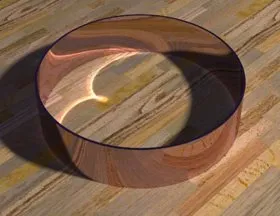
Light rays naturally describe a refraction curve similar to that offered by the curvature of the inner surface of a cup of coffee, like an ivy leaf that points to the center and presents its brightest part along its edge.
Mathematicians and physicists call that shape a cusp curve, and the bright edge a "caustic", explains Arlie Petters, a Mathematics professor at Duke and responsible for the curious finding. "It happens because a bunch of light rays can stack up on those curves," he explains.
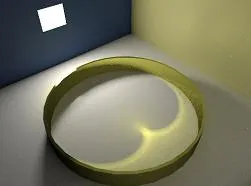
Described by Leonardo Da Vinci in the 16th century, caustics can be seen everywhere in daily life, for example in the reflection of the sun's rays on the surface of a swimming pool or on the hull of a boat.
But caustics also manifest in the Universe, specifically in the arrangement as a gravitational lens, caused because galaxies are so massive that their gravity bends and distorts light from more distant galaxies. "This means their gravity is so powerful that some light rays stack up on those curvatures," explained Petters.
"Nature has created these things," the scientist pointed out. And he added: "It's amazing that we can see in a cup of coffee the extension of a mathematical theorem with effects in the cosmos."
From Earth's point of view, the entire cosmos seems a vast interaction of gravity and light that can extend back in spacetime. "As in many lighting patterns, some areas will be brighter than others. And the brightest parts will be along these caustic curves."
Interpreting data from telescope surveys correctly requires understanding the distortions inherent to gravitational lenses, which sometimes bend a more distant point of light into multiple and magnified copies of itself.
Petters and other researchers have previously found that, if that light source appears to be juxtaposed on the confines of a caustic arc, two duplicate images will appear to be positioned abnormally close to each other and will seem equally bright. And since these clones are apparently equal in brightness, subtracting the luminosity of one from the other results in a difference of zero.
In an article appearing in Journal of Mathematical Physics, Petters and his student Amir Aazami extend those relatively simple examples to include what Petters called "higher-order caustics". In those situations the interaction of light and gravity could extend further in space and perform forms of "caustic metamorphosis" in the process.
Aazami was informally testing a special case of his evolutionary caustic theorem called an "elliptic umbilic", using a computer program called Mathematica, when he noticed a pattern.
"I kept getting zero over and over," the student recounted, no matter the scenario he tried with the software. So he thought he was making a mistake, until he realized that perhaps it was the opposite. It was the "Aha!" moment, as he commented.
Petters realized that his student had found a universal mathematical principle so dominant that it can impose balance on the most complicated illusions of gravitational lenses. And they hope that higher-order caustics can be observed in the Large Synoptic Survey Telescope (LSST), under construction in Chile.
Another scenario it predicts is that "for one of the higher-order caustics, if there are two pairs of lensed images that are close to each other but are not equally bright, the theorem is violated. The reason would be some substructure in the galaxy," such as dark matter near one of the images causing it to be less magnified.
A magnified castle
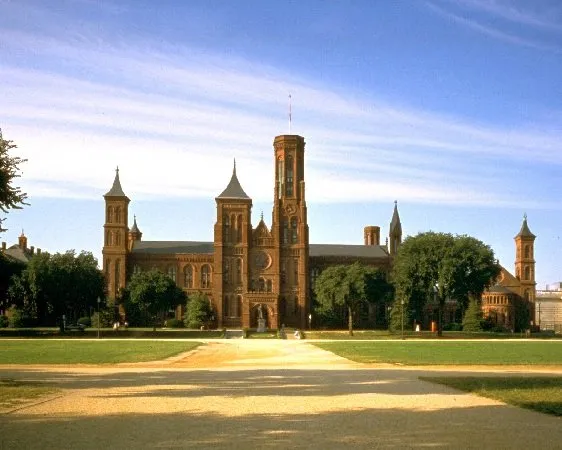
The castle on the Mall in Washington D.C, seen from the natural history museum.
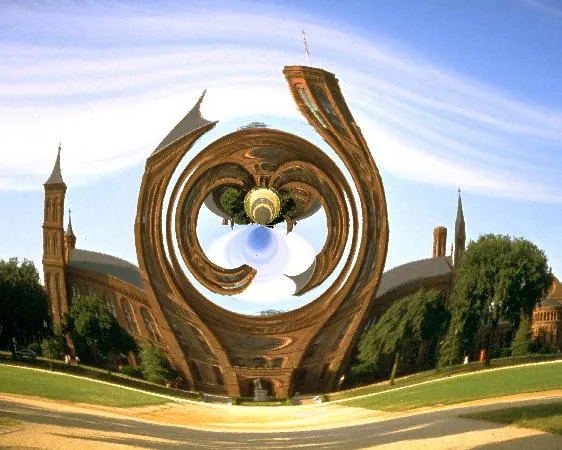
Now we put a black hole with the mass of Saturn in the middle of the Mall, and we see the castle through the resulting gravitational lens.
Note that there are two images of each of the middle towers, one inside the ring and one outside. The interior image is flipped.
These images form the logo of the CfA Arizona Space Telescope Lens Survey, or CASTLeS survey (CfA-Arizona Space Telescope Lens Survey)
Sources and related links
- EurekAlert:Duke physicists see the cosmos in a coffee cup
- Duke:Physicists See The Cosmos In A Coffee Cup
- The coffeecup caustic
- A universal magnification theorem for higher-order caustic singularities
A. B. Aazami and A. O. Petters
J. Math. Phys. 50, 032501 (2009); DOI:10.1063/1.3081055
About the images
Ivy leaf:Cepolina photo
Light reflected on the sides of a metal ring produces the cusp curve effect as in the coffee cup.
Credit:Henrik Wann Jensen, University of California, San Diego
Caustic image in coffee cup:Alejandro Uribe
Castle photo:
Smithsonian. Credit: Eric Long.