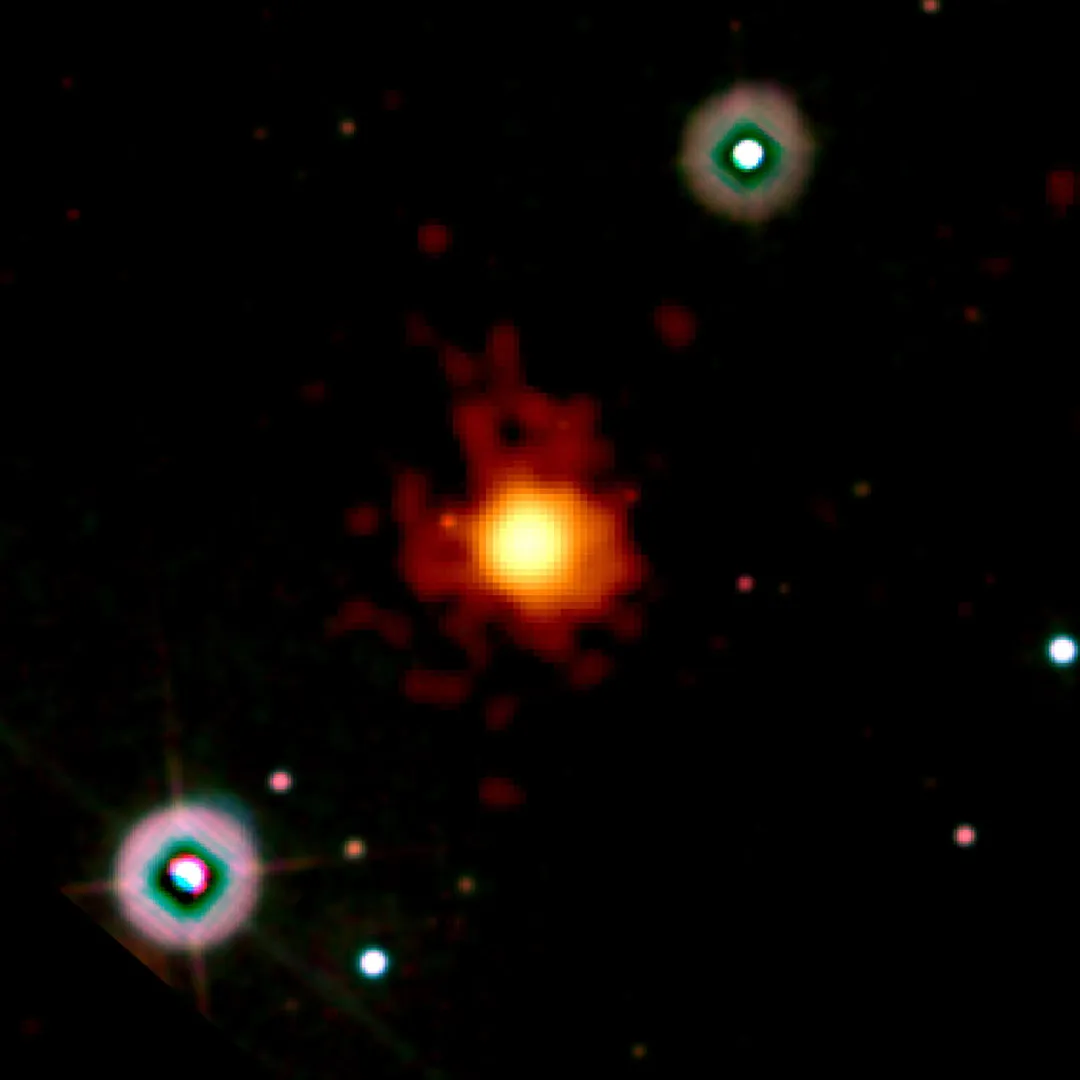
Using information from a set of telescopes, astronomers discovered a mysterious giant object that existed when the universe was only 800 million years old. Objects like this are enormous bodies of gas that could be the precursors of galaxies. They named it Himiko, after a legendary Japanese queen.
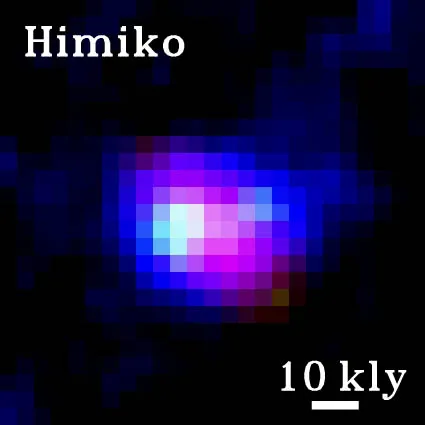
The object is almost half the size of the Milky Way. It extends for 55,000 light-years, a record for an early object. Researchers are puzzled about what it exactly is. As it is one of the most distant objects found so far, its faintness does not allow scientists to understand its physical origins. It could be ionized gas generated by a supermassive black hole; a primordial galaxy with a large gas disk; a collision of two large galaxies; superwinds from intense star formation, or a giant galaxy with a mass of about 40 billion suns.
"The farther we look into space, the farther we go back in time," explained the study's author Masami Ouchi, of the Carnegie Observatories. "I am very surprised by this discovery. I never imagined that such an object could exist at this early stage of the universe's history. According to the big bang cosmology model, smaller objects formed first and then merged to produce larger systems. This object has the size of present-day galaxies, but when the universe was 800 million years old, only 6% of the age of the current universe!".
These extensive objects, called Lyman-Alpha blobs, had already been found at a great distance, when the universe was about 2 billion years old, much less than where they found Himiko. The object is located at a transition point in the evolution of the universe called the "reionization epoch" (z = 6.595). That chapter in the universe's history was the dawn of the cosmos. During that period, neutral hydrogen began to form quasars, stars and the first galaxies.
The team initially identified Himiko among 207 candidate distant galaxies seen at optical wavelengths using the Subaru telescope. And they performed spectroscopic observations to measure the distance with different instruments. Himiko was an extraordinarily bright and large candidate for a distant galaxy. "We hesitated to spend our precious telescope time taking spectra of this rare candidate. We never believed that this bright and large source was a real distant object," noted Ouchi. They assumed it was a closer object "contaminating" their sample. But they tried anyway and the spectrum showed characteristic hydrogen signs that clearly indicate a remarkable distance: 12.9 billion years!.
"Using infrared data from NASA's Spitzer space telescope and the United Kingdom Infrared Telescope, radio data from the VLA and X-ray data from XMM-Newton, we were able to estimate the star formation rate and stellar mass of this galaxy and investigate whether it contained an active nucleus generated by a supermassive black hole," explained James Dunlop, a team member. "We found that the stellar mass in Himiko is an order of magnitude greater than other known objects from a similar epoch, but we still cannot say if the center hosts an active black hole," he commented.
The fact that the object is so exceptional makes it attractive to study. "If this was the discovery of a class of objects that are the ancestors of today's galaxies, there should be more smaller objects already found, a continuous distribution. Since this object is, at this point, unique in its class, it makes it difficult to fit into the prevailing model of how normal galaxies formed. On the other hand, that's what makes it interesting!" indicated Alan Dressler, a member of the international team of astronomers that conducted the study.
Sources and related links
- Carnegie: Mysterious Space Blob Discovered at Cosmic Dawn
- Discovery of a Giant Lyα Emitter Near the Reionization Epoch
Masami Ouchi, et al
2009 ApJ 696 1164-1175
DOI: 10.1088/0004-637X/696/2/1164 - The last monolith: A faint radio signal from the depth of intergalactic space. Part one.
About the images
The image of the object Himiko is a composite and in false color. Credit: M. Ouchi et al.