The most crowded collision of galaxy clusters has been identified by combining information from three different telescopes. The result gives scientists a chance to learn what happens when some of the largest objects in the universe collide in a cosmic free-for-all.
Using data from the Chandra X-ray Observatory, the Hubble Space Telescope and the Keck Observatory in Hawaii, astronomers were able to determine the three-dimensional geometry and motion in the system MACSJ0717.5+3745 located 5.4 billion light-years from Earth.
The researchers found that four distinct galaxy clusters are involved in a triple merger, the first time such a phenomenon has been documented.
In MACSJ0717.5+3745, a 13-million-light-year-long filament (a stream of galaxies, gas and dark matter) is falling into a region that is already full of matter, causing collision after collision.
"Besides this enormous pile-up, MACSJ0717 is remarkable for its temperature," said Cheng-Jiun Ma of the University of Hawaii and lead author of the study. "Since each of these collisions releases energy in the form of heat, MACS0717 has one of the highest temperatures ever seen in such a system," he noted.
While the filament in MACJ0717 had been previously discovered, these results show for the first time that it is the source of this galactic beating. The evidence has two parts. First, by comparing the position of the gas and galaxy clusters, the researchers traced the direction of motion of the clusters, which agreed with the orientation of the filament in most cases. Second, that the hottest region in MACSJ0717 is where the filament intersects the cluster, suggesting that impacts are occurring.
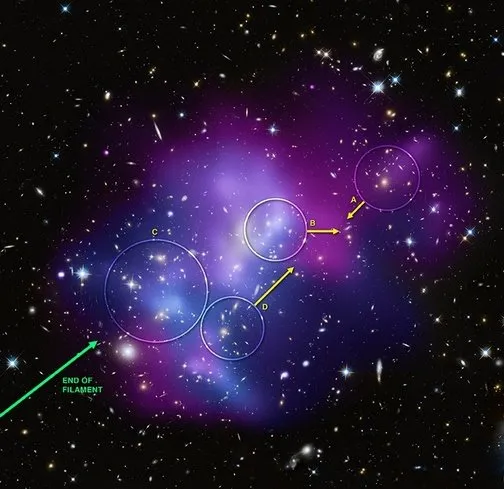
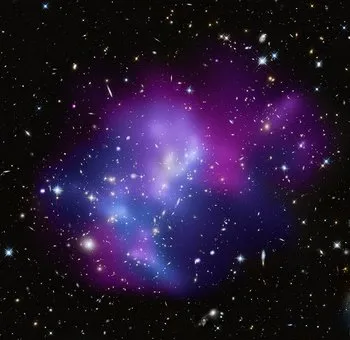
The composite image (top) shows the massive galaxy cluster MACSJ0717.5+3745. The color of the hot gas is color-coded to show its temperature. The coolest gas is shown as a reddish purple, the hottest gas in blue and the intermediate temperatures in purple.
The repeated collisions in the cluster are caused by a 13-million-light-year-long stream of galaxies, dust and dark matter - known as a filament.
The labeled version shows the galaxies in the four different clusters, identified by the letters A, B, C and D, involved in the collision, plus the direction of motion of the three fastest-moving clusters.
The coolest (reddest) region of gas toward the lower left of the cluster identified as D has likely survived from before the collision. Cluster A appears to be falling into the main cluster after having passed through in the opposite direction. Cluster B has a much higher velocity than the others along the line of sight.
"MACSJ0717 shows how giant galaxy clusters interact with their environment on scales of millions of light-years. It is a beautiful system to study how clusters grow as material falls into them along filaments," explained Harald Ebeling of the University of Hawaii.
Computer simulations show that the most massive galaxy clusters must grow in regions where large-scale filaments of intergalactic gas, galaxies, and dark matter intersect.
"It is exciting that the data we obtain from MACSJ0717 seem to beautifully match the scenario described in the simulations," added the study author.
Data at various wavelengths were crucial for this work. Optical data from Hubble and Keck provided information about the motion and density of galaxies along the line of sight, but not about their course perpendicular to that direction. By combining X-ray data with optical data, scientists were able to determine the three-dimensional geometry and motions in the system.
In the future, Ma and his team hope to use deeper X-ray data to measure the temperature of the gas along the 13-million-light-year extent of the filament. Much remains to be learned about the properties of the hot gas in filaments.
"It is the most spectacular and most disturbed cluster I have ever seen and we think we can learn a lot from it about how structures in our universe grow and evolve."
Sources and related links
- Chandra:Cosmic Heavyweights in Free-for-all
- HubbleSite:Galaxy Cluster MACS J0717
- An X-Ray/Optical Study of the Complex Dynamics of the Core of the Massive Intermediate-Redshift Cluster MACSJ0717.5+3745
Cheng-Jiun Ma, Harald Ebeling, Elizabeth Barrett
ApJ 693 L56-L60
DOI: 10.1088/0004-637X/693/2/L56
About the images
Credits:X-ray (NASA/CXC/IfA/C. Ma et al.); Optical: (NASA/STScI/IfA/C. Ma et al.)