To commemorate the 19 years of success of the Hubble Space Telescope, the observatory has photographed a peculiar system of galaxies known as Arp 194. This interacting group contains several galaxies along with a "cosmic fountain" of stars, gas and dust that extends 100 thousand light-years.
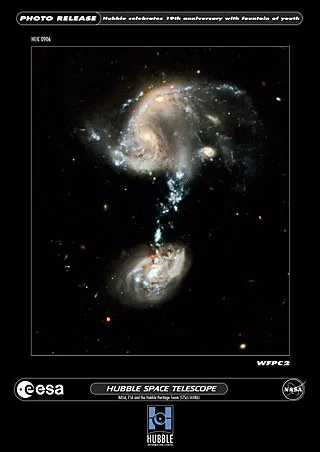
Over the last 19 years, Hubble has taken dozens of exotic photographs of galaxies interacting and creating very rare shapes and structures. The trio of galaxies Arp 194 is, in this sense, a notable case. We can see in these structures a shape of a closing question mark("?"), a genie emerging from Aladdin's lamp, a water fountain and even a pair of owl eyes in the upper galaxies.
The rare blue "bridge" of material extending in the northern component looks as if it connects to a third galaxy but in reality that galaxy is in the background and not connected at all.
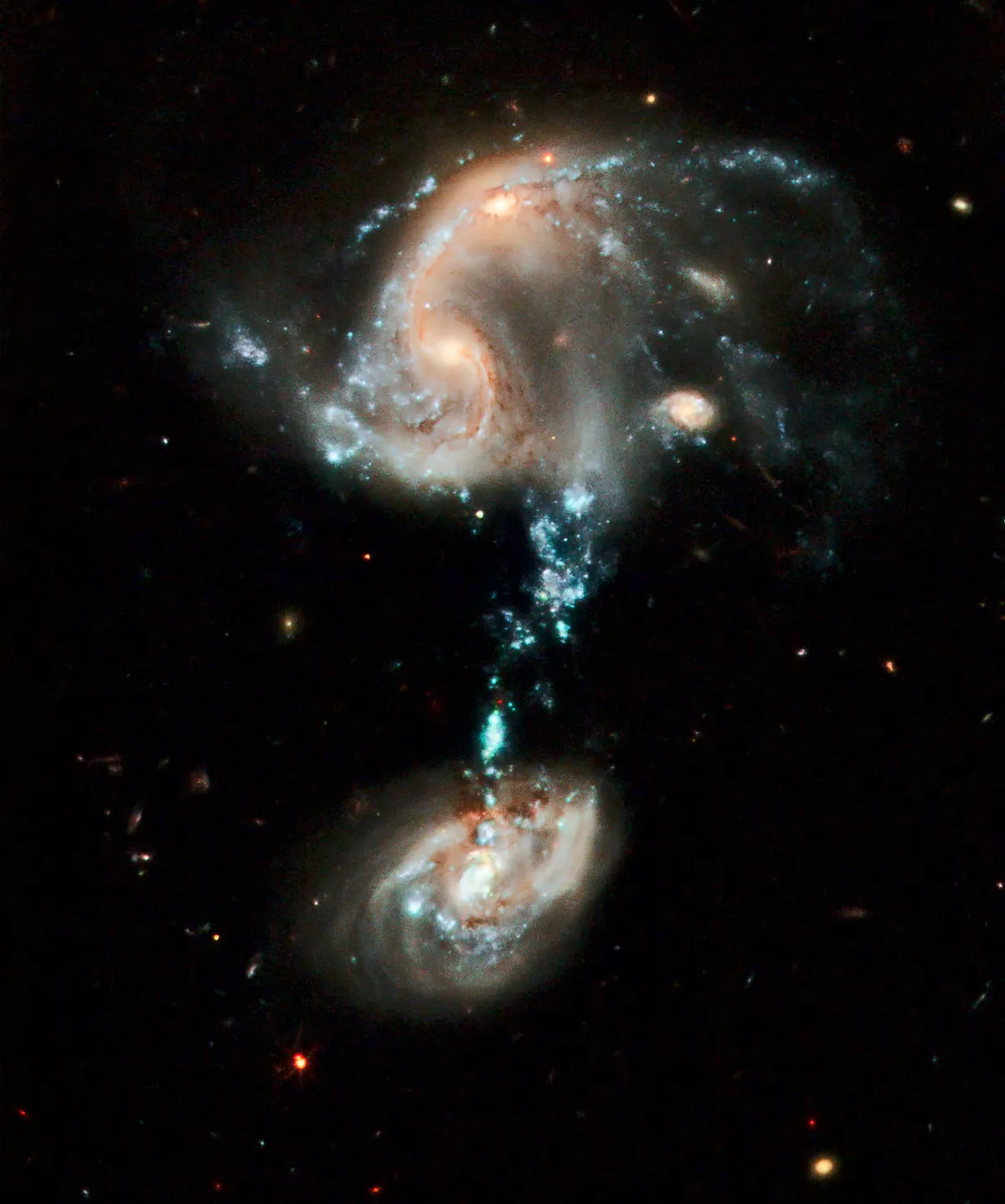
The blue "fountain" is the most remarkable element of this grouping and contains super star clusters that can have up to a dozen star clusters in them. The gravitational forces involved in a galactic interaction can promote star formation in the merging systems. This stream of material is a stretched spiral arm, packed with new blue stars.
Arp 194, located in the constellation Cepheus, resides 600 million light-years from Earth. The observations were taken in January of this year with the Wide Field Planetary Camera 2. The image was taken to celebrate the 19th anniversary of Hubble's launch aboard Discovery in 1990.
In almost two decades, this instrument has been able to perform 880,000 observations of 29,000 celestial objects.
In this time, the telescope has made more than 100,000 trips around our planet and produced 39 terabytes of data. Each month, the orbital observatory generates more than 80 gigabytes of data. Astronomers who used Hubble published more than 7,500 scientific reports, making it the most productive scientific instrument. Last year, nearly 700 press articles were published about the data from this very famous space telescope.
Sources and related links
- SpaceTelescope:Hubble celebrates 19th anniversary with fountain of youth
- HubbleSite:Hubble Celebrates Its 19th Anniversary with a "Fountain of Youth"
About the images
Credit:NASA, ESA and the Hubble Heritage Team (STScI/AURA)