Thanks to a series of films released on Friday by NASA, the U.S. Department of Energy, and the Fermi Space Telescope, we can enjoy the frenzy of gamma rays in the sky.
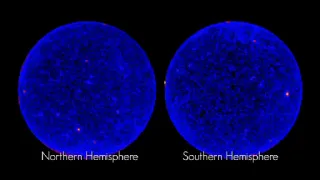
The films, which were made public during the live webcast as part of "100 Hours of Astronomy," comprise the first 87 days of Fermi's science data in almost 4 minutes. On this time scale, the sky is flooded with flickering sources of gamma rays. The all-sky movie shows a count of gamma rays with energies above 300 million electron-volts from August 4 to October 30, 2008, detected by the Large Area Telescope (LAT) of the Fermi Gamma-ray Observatory. Brighter colors indicate brighter gamma-ray sources as well. The blue circles represent the galactic north and south skies, with their edges along the plane of our galaxy.
Since this is an unusual view of the sky, the films cover the stars and establish the locations of well-known constellations: Ursa Major (Ursa Major), Boötes (Boötes), and Virgo in the northern galactic map; the whale (Cetus), Aries, and Pegasus (Pegasus), in the southern map. Notable gamma-ray sources include the Sun (moving across the northern sky), the gamma-ray pulsar PSR J1836+5925, and a number of blazars (active galaxies), among which 3C 273, AO 0235+164, and PKS 1502+106 stand out.
Our star is included because cosmic rays circulating through the universe continuously collide with starlight and gas and produce gamma rays.
"The movie shows a count of gamma rays seen by Fermi's LAT and each frame shows the gamma rays collected in one day," said Elizabeth Hays, an astrophysicist on the Fermi team.
"One of the first things to notice in the movie is the source crossing the northern galactic sky. It is the Sun moving along the plane of the ecliptic. The Sun appears to move across the sky because the Earth orbits it. It is the same reason why constellations progress across the sky during the year," added Hays.
Another aspect to highlight in the movie is that, even away from the brightest gamma-ray sources, the sky is not dark. "We see a general background of gamma rays across the entire sky. Although we don't know exactly where all these gamma rays come from, we know that some of them must be radiation from galaxies we are not detecting directly," explained Hays.
One galactic source lies sufficiently far from the plane of the Milky Way to stand out. "It is PSR J1836+5925, a new class of pulsar discovered by Fermi. It appears still in the movie because we have to add gamma rays from many rotations to see the pulses," added Hays.
The video can be seen on YouTube at:
http://www.youtube.com/watch?v=lAOR-tzprSc
Most of the other bright sources in the movie are actually distant galaxies. Each of these active galaxies, called blazars, hosts a central black hole with a mass of a million suns. Somehow, the black hole produces jets of matter moving at extreme speeds. "The large variations in brightness seen during the movie tell us that something in these jets has changed," commented the scientist.
An example is the blazar AO 0235+164, located 7.5 billion light-years away in the constellation Aries. "The eruptions we are seeing occurred when the universe was half its current age. The LAT sees a very strong eruption. The gamma rays increase 30 to 40 times in one day. On that day, AO 0235 was one of the brightest gamma-ray sources in the sky," said Hays.
The films can be downloaded, in different formats at:
Fermi All-sky Movie Shows Flaring, Fading Blazars
Sources and related links
- NASA:Active Galaxies Flare and Fade in Fermi Telescope All-Sky Movie
- Fermi All-sky Movie Shows Flaring, Fading Blazars
- Ciencia Kanija:The best view of the most extreme energy in the universe
About the images
The images belong to: NASA/DOE/Fermi LAT Collaboration