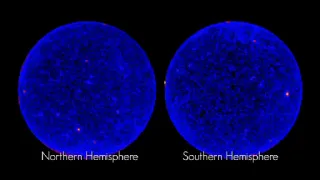
The first gamma-ray burst seen in high resolution by NASA's Fermi Gamma-ray Space Telescope is one for the record books. The burst has the highest total energy, the fastest motions, and the highest-energy initial emissions ever seen.
"This was the one we were waiting for. Burst emissions at these energies are still poorly understood, and Fermi is giving us the tools to understand them," said Peter Michelson, principal investigator for Fermi at Stanford University.
Gamma-ray bursts (GRB, for its acronym in English) are the most luminous explosions in the universe. Astronomers believe most occur when massive stars run out of nuclear fuel. As the core collapses into a black hole, jets of material—powered by processes not yet fully understood—are ejected at speeds close to that of light. The jets are expelled into space where they interact with gas previously expelled by the star and generate a bright afterglow that fades over time.
The explosion, designated GRB 080916C, occurred at 7:13 p.m. EDT on September 15, in the constellation Carina. Fermi's monitor recorded the event simultaneously. Together, the two instruments provide a view of the initial burst of gamma-ray emissions with energies from 3,000 to more than 5 billion times that of visible light.
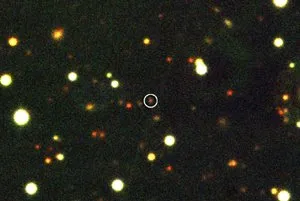
Nearly 32 hours after the burst, Jochen Greiner of the Max Planck Institute in Germany led a group that searched for the afterglow. The team captured the field simultaneously in seven wavelengths using the instrument GROND, at ESO's La Silla Observatory. In some colors, the brightness of the distant object shows a characteristic drop caused by intervening gas clouds. The farther away the object, the redder the wavelength where the drop occurs. This gives astronomers a quick estimate of the object's distance. The team's observations established that the explosion took place 12.2 billion light-years away.
With the distance in hand, the Fermi team showed that the burst exceeded the energy of approximately 9,000 ordinary supernovae, if the energy was emitted equally in all directions. This is a standard way for astronomers to compare events, although GRBs emit most of their energy in tight jets.
Along with Fermi's measurements, the distance also helps astronomers determine the minimum possible speed for the material in the initial burst. In this burst's jet, the gas must have been moving at 99.9999 percent of the speed of light. Its tremendous energy and speed make it the most extreme recorded so far.
A curious aspect of the burst is a five-second delay that separates the highest-energy emissions from the lower ones. That time separation has been clearly seen in only one previous burst.
"It means that the highest-energy emissions come from different parts of the jet or were created through a different mechanism," said Michelson.
The results appear in the online edition of Science.
Sources and related links
- NASA's Fermi Telescope Sees Most Extreme Gamma-ray Blast Yet
- Science@NASA: Extreme Gamma-ray Burst
- SLAC: Most Extreme Gamma-Ray Blast Ever, Seen by Fermi Gamma-ray Space Telescope
- Fermi Observations of High-Energy Gamma-Ray Emission from GRB 080916C
Various authors
Science Express Online February 19, 2009
Science DOI: 10.1126/science.1169101
About the images
On September 17, 31.7 hours after the explosion of GRB 080916C, the GROND instrument on ESO's 2.2m Max Planck telescope, La Silla, Chile, began acquiring images of the burst's afterglow (in circle)
Image courtesy of MPE/GROND.
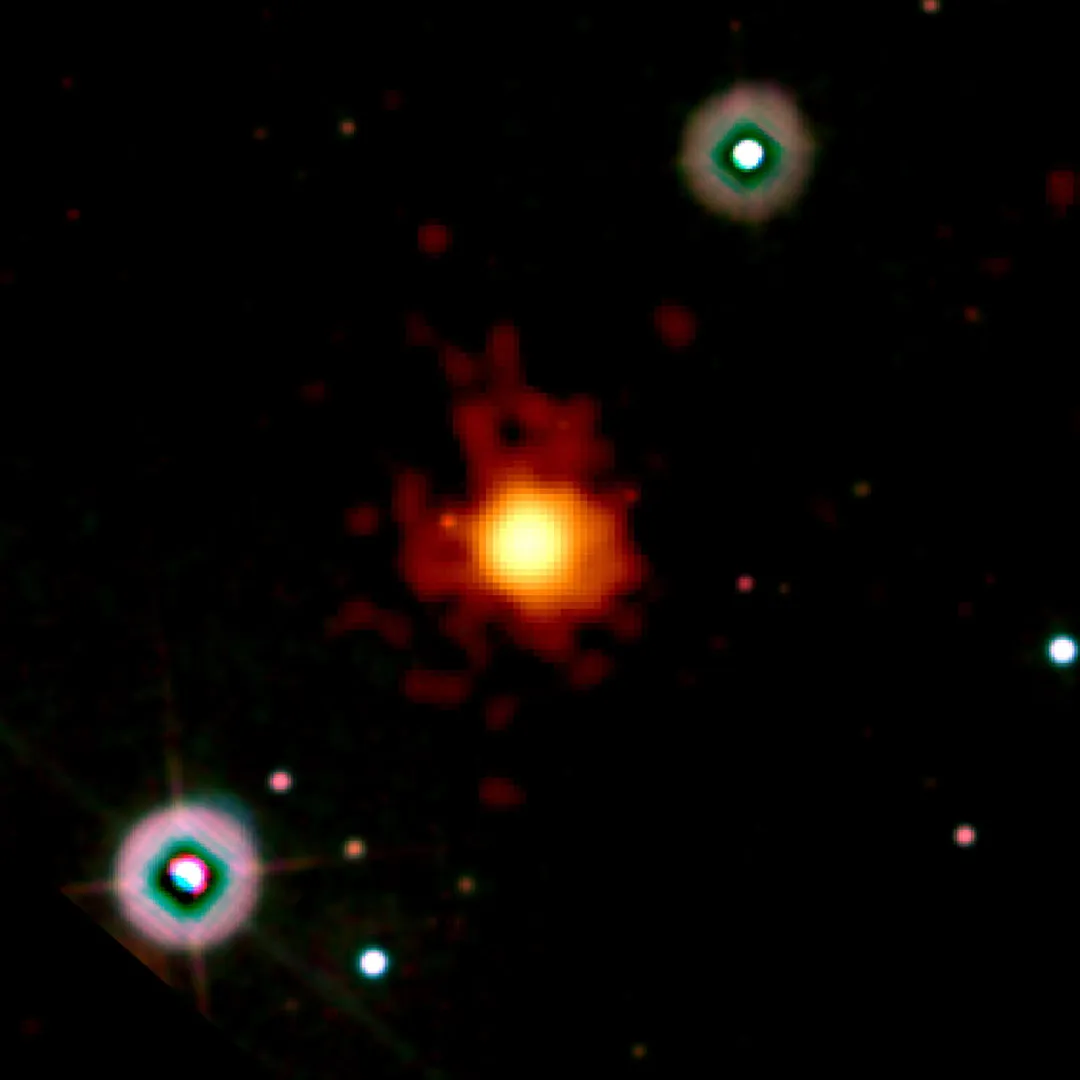
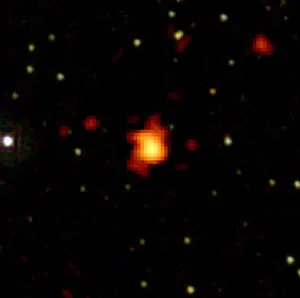
The X-ray afterglow of GRB 080916C appears orange and yellow in this image combining shots from Swift's optical/ultraviolet and X-ray telescopes.
Image courtesy of NASA/Swift/Stefan Immler.