Astronomers have witnessed the transformation or "recycling" of a slowly rotating pulsar into an object that rotates 592 times per second.

The discovery was made during a large radio survey of the sky by an international team of astrophysicists from McGill, British Columbia, West Virginia, NRAO Universities and other institutions in the USA, the Netherlands and Australia.
The sky survey used the Robert C. Byrd radio telescope in Green Bank to observe almost one third of the celestial sphere. The study found several new pulsars, but this one is truly special.
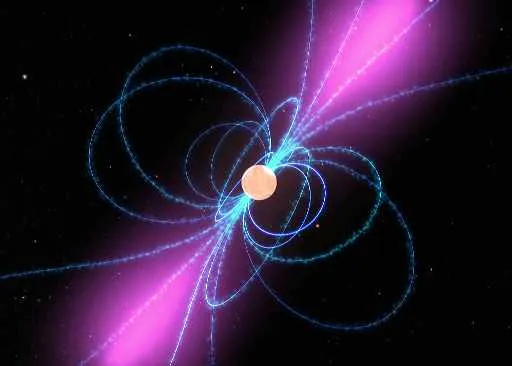
Pulsars are neutron stars that rotate very rapidly. Neutron stars are massive stars that have exploded as supernovae, leaving behind extremely dense objects. These rotating neutron stars, or pulsars, emit beams of radio waves as they spin. Some do so relatively slowly, ten times per second or less, and their magnetic fields usually slow them down further over time. But there are also ultra-fast pulsars, which rotate hundreds of times per second, so they are called "millisecond pulsars" (MSP).
"We know that pulsars typically pulse in the radio spectrum for one million to ten million years, but eventually they slow down," explained Prof. Victoria Kaspi of the McGill University Pulsar Group. "But some of these old pulsars are 'recycled' into millisecond pulsars. They end up rotating extremely fast and can then pulse forever," she continued.
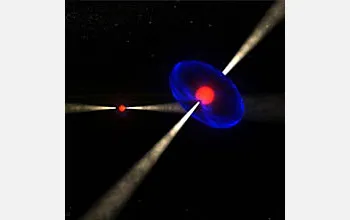
MSPs are thought to be created in binary star systems when matter from the companion star falls into the pulsar's gravitational well and thus increases its rotation speed, but, until now, the process had not been directly observed.
Animation by Bill Saxton, (NRAO/AUI/NSF) of a binary system composed of a neutron star with an accretion disk (white) that is taking material from a companion star (orange) until the slow pulsar begins to rotate very rapidly.
PhD student Anne Archibald of McGill pointed out that "we have seen systems speeding up their rotation, because when matter falls into them the stars are really bright in X-rays and are easy to observe. But we had never seen radio pulsations from these stars during that process. At last we have found a true radio source that shows direct evidence of having been recently recycled".
The MSP is located in the system called J1023 that lies 4,000 light-years from Earth. Astronomers later found that the object had been identified by the VLA radio telescope in a survey conducted in 1998 and was observed in visible light by the Sloan Digital Sky Survey in 1999, revealing a star similar to our Sun.
When observed again in 2000, the object had changed dramatically, showing evidence of a rotating disk of matter, or accretion disk, but by May 2002, the evidence of this disk had disappeared.
"No other MSP has shown evidence of an accretion disk. We know that another type of binary star, called low-mass X-ray binaries (LMXB), also contain a rapidly rotating neutron star and an accretion disk, but these do not emit radio waves. We have thought that LMXBs are probably in the process of being spun up and will emit radio waves as a pulsar. This object appears to be the 'missing link' connecting the two types of systems," explained Archibald.
Sources and related links
- A Radio Pulsar/X-ray Binary Link
Anne M. Archibald et al.
Published Online Science Express May 21, 2009
DOI:10.1126/science.1172740 - The cosmos is green: Researchers catch nature in the act of “recycling” a star
- "Missing Link" Revealing Fast-Spinning Pulsar Mysteries
- CSIRO:Astronomers catch a star being revved-up
About the images
Neutron star with accretion disk (left) taking material from a companion star (right)
CREDIT:Bill Saxton, NRAO/AUI/NSF