The world's largest volunteer computing project, SETI@Home, celebrates its decade this month with 140,000 participants and 235,000 computers powering the search for intelligent signs in space.

No extraterrestrials have been found yet. But the project continues to inspire the public and spurred the development of dozens of similar volunteer projects.
Launched on May 17, 1999, SETI@Home uses personal computers to process radio data acquired by the Arecibo Observatory in Puerto Rico. It is the search for a needle in a huge haystack: a unique signal showing signs that reveal an intelligent source, hidden in the relentless electromagnetic noise coming from space. The project quickly attracted followers all over the world: Three months after its debut, 1 million people signed up in 233 countries, running the screensaver software on their personal computers or at their jobs, classrooms, universities and even government offices.
The Planetary Society was there from the very beginning. Back in 1997, when the project's founders were desperately looking for sponsors to turn their concept into reality, the Society stepped forward with a grant that made it all possible. In the years that followed, the Society worked closely with SETI@home, supporting its growth and spreading the word about the project to the general public.
In the past decade, more than 5 million people have subscribed and today, despite more than 80 competing volunteer projects, SETI@home continues to have the largest core of dedicated users. "The number of members has gone up and down," says project director David Anderson, "but we have more computing power than ever, thanks to the steady increase in processor power"
The challenge, according to chief scientist Dan Werthimer, is to scan all frequencies, all areas of the sky, and all possible patterns of signals from extraterrestrial intelligence. During its 10 years of operation, SETI@home has continuously improved the capture of radio signals from the Arecibo radio telescope and subsequent signal analysis. Today, more signals are covered and more points in the sky are scanned simultaneously.
SETI@home was conceived in 1995 when David Gedye, a software engineer, now at Microsoft Live Labs, thought about harnessing the immense, unused computing power of desktop computers around the world. He proposed it to University of Washington astronomer Woody Sullivan, who suggested contacting Werthimer, whose SERENDIP project was already doing SETI at Arecibo.
Gedye also called on the expertise of Anderson, a specialist in distributed computing. Together, the four developed a way to link desktop computers across the internet into a virtual supercomputer capable of performing complex signal analysis on Arecibo data.
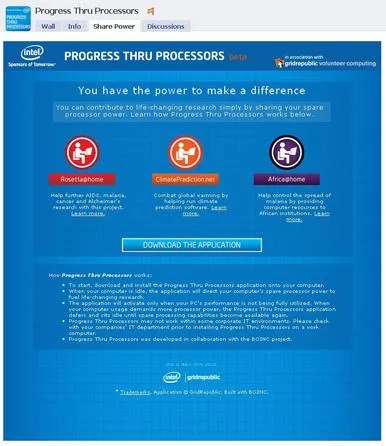
Since its launch in 1999, a group led by Anderson has developed the program called BOINC that allows scientists anywhere to create projects like SETI@home and allows volunteers to use several of these projects on their PCs. SETI@home moved to BOINC in 2005; other projects are using BOINC to study proteins (Rosetta@home), search for gravitational waves (Einstein@home) and predict the planet's climate (ClimatePrediction.net). It is also possible to join the Large Hadron Collider and do particle physics at home.
As for the radio data that feeds SETI@home, it began collecting data two years ago from a new receiver at Arecibo that now provides 14 times more data than the previous receiver with much greater sensitivity, all of that now feeding the processing of SETI@home computers.
SETI@home was and remains a low-cost operation. It started with only $100,000 from The Planetary Society and Paramount Pictures, and although companies like Sun Microsystems and Intel supplied servers, it is now funded exclusively by volunteer donations, said Werthimer. But he and Anderson intend to keep it running, as long as there is interest.
"We're in this for the long term," said Werthimer.
To get started with SETI@home
To start using BOINC you need to download the program. If you use a Windows operating system, the minimum requirements are:
Windows 98 or later, Windows 2000 with Service Pack 4
Pentium 233 MHz (Recommended: Pentium 500 MHz or more)
64 MB RAM (Recommended: 128 MB RAM or more)
20 MB of disk space and have administrator privilege to install BOINC.
Once BOINC is installed, we can join the projects we want.
Sources and related links
Commemorative logo for the 10 years of SETI@home (contributed by user Johnney Guinness in the SETI@home forum)
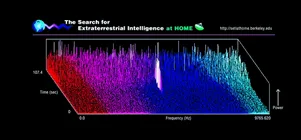
Image of the classic screensaver
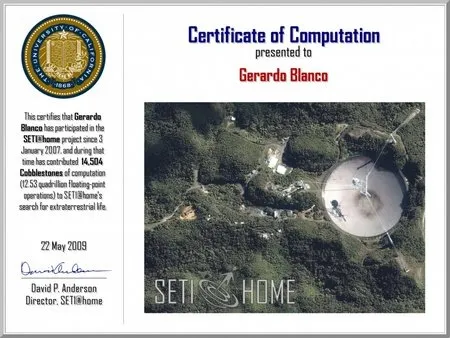
My participation certificate.
About the images