Astronomy is a journey into the past. When we look at a distant star, since its light travels at a finite speed and the space between it and Earth is vast, we see it as it was when its light left it, millions or billions of years ago. But astronomers are doing something more. They are looking at images of stars taken years ago. Here are two examples of the power of astronomical image archives.
Digitizing variables
Researchers at Harvard University are undertaking an effort to digitize 525,000 photographic plates taken at observatories around the world between the years 1880 and 1980.
The collection, the largest of its kind in the world, contains a hidden treasure of generally unexamined data, according to astronomy professor Jonathan Grindlay, who leads the digitization project.
According to the professor, each plate was examined for one or a few objects of interest by specific astronomers. Considering that each plate contains about 100,000 objects and that each one was photographed between 50 and 3,000 times over the years, the potential knowledge about the changing universe hidden in the Harvard Observatory plates is enormous.
The project is called DASCH, an acronym for Digital Access to a Sky Century at Harvard, and began in 2004 with funding from the U.S. National Science Foundation. After two years developing a specific scanner for the plates and an initial version of the software, the first scans began in 2006. Since then, the work has focused on creating programs to make sense of the immense amount of data the plates contain.
"DASCH will look at every object on the plate with specially developed software and measure its brightness," explained Grindlay.
By searching for brightness variation in objects, the scanning and recognition of the plates is ideal for identifying different classes of variable stars. Although only 1% of the collection has been scanned so far, the effort is already bearing fruit, with the discovery of thousands of variables.
The collection is the result of work that began in the 1880s by the director of the Harvard Observatory, Edward C. Pickering. He understood the potential of photography as a way not only to collect astronomical data, but to freeze a moment in time for celestial positions and their brightness and preserve that data for future astronomers.
At that time, a systematic survey of the sky was rare, and even more so for variable stars, since the physics involved in them began to be understood only from the 1920s onward.
Most plates are 20x25 centimeters in size, although there are about 25,000 that are larger (around 35x43) and another 2,000 are circular, coated with a photographic emulsion on one side.
The idea was conceived by Grindlay in the late 1980s when computers and digitization processes began to supplant traditional photographic observation. But he realized that the amount of data - which he estimates at 1.5 petabytes - was too large to handle at that time.
This has changed, and in 2003 he realized it was a project that could be done. So, together with other colleagues, they applied for a grant and DASCH was born.
Despite having scanned more than 5,500 plates, the project is still in the development stage. The first years were spent creating and building a scanner capable of handling the plates physically and detecting the small changes in luminosity.
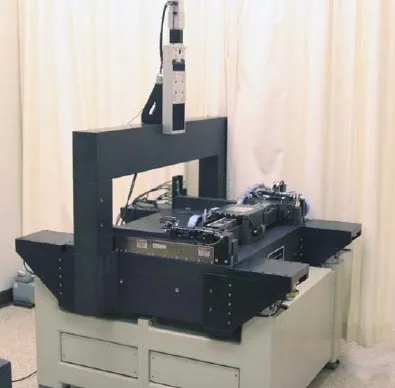
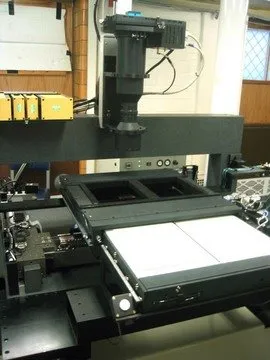
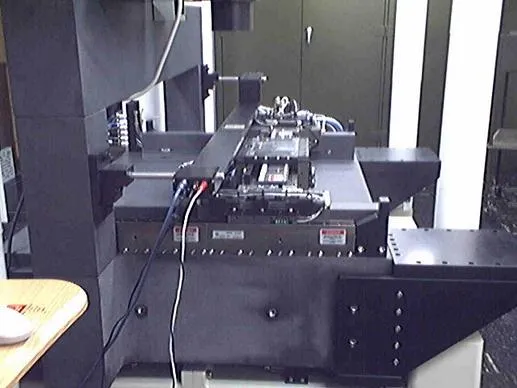
The scanner table is magnetically driven and can handle two plates at a time. It is designed to measure the position of an exposure with great accuracy. The plates are scanned in a dark room and illuminated from below with a series of red LED flashes. The scanner takes 60 images of each plate, captured through a fixed lens and a CCD camera. The image is then processed with software in a process that in total takes only 90 seconds for two plates.
The program also assigns a numerical value to the brightness and position of each object in the image and can detect brightness variations of up to 5 to 10 percent.
There are also manually written records of how the plates were taken. These meta-data, as Grindlay calls them, are preserved in 1,200 logbooks that will also be digitized.
The project is ambitious and includes creating an interface to allow access to the data for free use. But the hardest part is the scanning itself. The group performs the work for about 160 plates a week and needs funds to accelerate the process. The machine was designed to perform scanning of up to 400 plates per day, which would allow the entire collection to be digitized in a few years.
"The idea is to put this incredible hidden treasure online so that astronomers and the public can have it," commented Grindlay.
The supernova archive
An international team of astronomers has found a better way to examine the origins and evolution of galaxies.
"We have devised a technique to discover supernova explosions at greater distances than previously known," said Ray Carlberg of the University of Toronto.
The idea was to review images acquired by the CFHT Telescope survey. "Our trick was to combine six months of images to create a very deep image of the sky. This allows us to search for objects that changed in brightness over a long period of time," explained Carlberg.
With this technique they say they have discovered an ultra-distant supernova. After identifying four potential supernovae, the astronomers used the spectrograph on the Keck I Telescope (LRIS) and on Keck II (DEIMOS) to analyze the light spectrum of each object and thus determine its composition and distance.
According to Jeff Cooke, from the University of California and author of the report published in Nature, although the new explosions could be the most distant supernovae of any type found to date, the innovative method developed could make it possible to identify even more distant events.
"It's like in photography when you open the shutter for a long time. You'll collect more light with a long exposure," explained Cooke about the image stacking method.
The study sought very distant Type IIn supernovae (with a redshift z~2). Of the four candidates, three have already been confirmed.
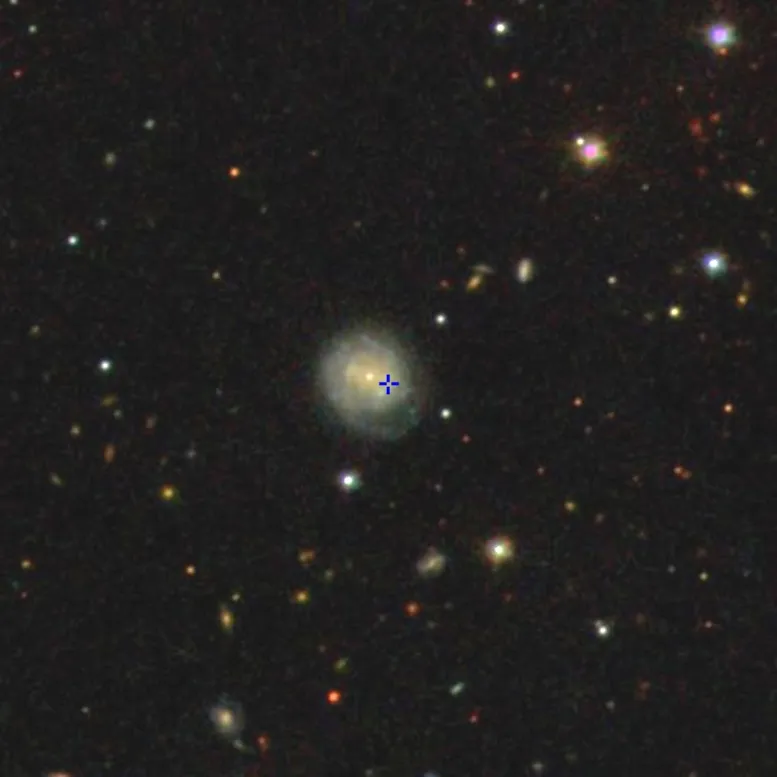
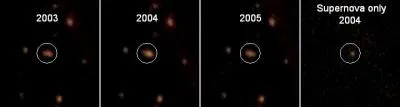
This type of supernova occurs in massive stars (50 to 100 solar masses) that expel a large part of their mass into space before exploding. When the unstable cores collapse, the expanding shock wave hits the previously ejected material and creates a flash of ultraviolet light that takes months to fade. The team estimates that 90% of the supernovae detectable at this distance are of this type. The images illustrate the method used. Each frame is the same small section centered on a galaxy that was discovered to host a Type IIn supernova in the year 2004. Each frame is an entire year of images, with three consecutive years shown. Below these images is another one in which the constant light from the galaxy is subtracted, revealing the supernova. The three confirmed supernovae are very distant (z = 0.81, z = 2.01, and z = 2.36), one of which would have occurred 11 billion years ago!
Sources and related links
- Physorg: Building a stellar time machine and HarvardScience
- DASCH: Digital Access to a Sky Century @ Harvard
- An ultrahigh-speed digitizer for the Harvard College Observatory astronomical plates
R.J. Simcoe, J.E. Grindlay, E.J. Los, A.Doane, S.G. Laycock, D.J.Mink, G. Champine, A.Sliski
arXiv:astro-ph/0610351v1 - Type IIn supernovae at redshift z approximately 2 from archival data
Jeff Cooke, Mark Sullivan, Elizabeth J. Barton, James S. Bullock, Ray G. Carlberg, Avishay Gal-Yam & Erik Tollerud
Nature 460, 237-239 (July 9, 2009)
DOI:10.1038/nature08082 - Univ. of California: Giant supernovae farthest ever detected
- Keck: New Method Finds Most Distant Supernovae
About the images
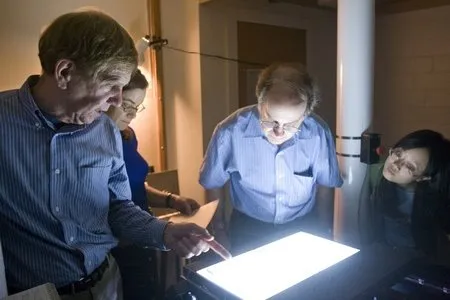
Jonathan Grindlay (from the left), Alison Doane, Edward Los, and Sumin Tang, are part of the DASCH project.
Credit: Kris Snibbe/Harvard News Office
Images of the DASCH scanner.
Credit: Harvard
Images of Type IIn Supernovae in the CFHT Survey
Credit: University of Toronto