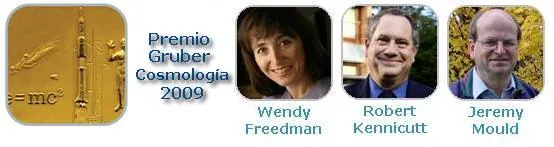
The Gruber Foundation awarded the 2009 Cosmology Prize to Wendy Freedman of the Carnegie Observatories, Robert Kennicutt of the Institute of Astronomy at the University of Cambridge, and Jeremy Mould of the University of Melbourne for their work in defining the Hubble constant, the rate at which the universe is expanding.
The three researchers led a team of astronomers from the Hubble Space Telescope (HST Key Project) to provide an improved measurement of the Hubble constant. This value is needed to determine the age of the universe and also underpins other basic cosmological measurements.
One of the most important implications of the research is its contribution to the understanding of dark energy, the force that is accelerating the rate of expansion of the universe.
The prize consists of a gold medal and $500,000. At the same time, Dr. M.B.N. Kouwenhoven, a young researcher at the University of Sheffield in the United Kingdom, will be recognized with a $50,000 fellowship.
The precise value of the Hubble constant was hotly debated since its discovery in 1929 by astronomer Edwin Hubble, who calculated it at a speed of 500 (km/s)/Mpc. Working with a team of twelve astronomers from 13 different institutions around the world, the three awardees determined that the best value for the constant is 72 km/s/Mpc, with an uncertainty of 10 percent. This discovery, which was published in final form in 2001, means that the universe is about 13.7 billion years old, which coincides with the estimated age of the oldest stars.
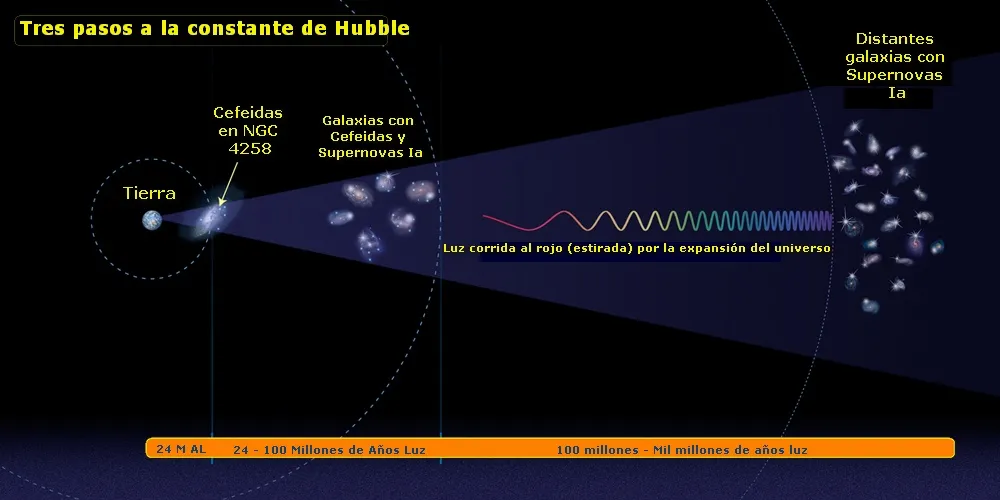
To make these measurements, astronomers use Cepheid variable stars, which vary in brightness in proportion to their absolute brightness: the more luminous the star, the longer it takes to pulsate. By measuring this pulsation, its true brightness can be estimated and thus its distance obtained. However, these stars are not so good to use if the distances to be measured are very large. For this, astronomers use another "rung" on this distance ladder: Type I supernovae, since they think that these stellar explosions are similar enough to be used to obtain their absolute brightness and distance. These two tools can be applied at the same time, if distant galaxies that have Cepheid variables and supernovae are observed, such as galaxy NGC 3021.
The symbols of the Cosmology medal
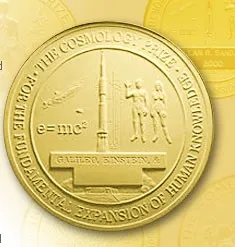
The design of the first medal, for the Cosmology prize, originated in a brainstorming session between Peter and Patricia Gruber and Dr. Larry Tise. Peter suggested that the medal should reflect everything the prize was intended to reflect, including paradigmatic discoveries (E=MC2), space exploration (a rocket launching), and the fruits of exploration (the Andromeda galaxy, the first to be identified). But they also agreed that the prize, at its core, is about universal peace and understanding, so they decided to include the human figures used by NASA on the Pioneer 10 probe. Peace, discovery, and exploration: those were the ideas they hoped to capture in the Cosmology medal and the symbols that ultimately came together in the representation developed by Dr. Tise and the medal designer.
The value of the constant has three parameters: kilometers per second per megaparsec. A parsec is 3.26 light-years. A kiloparsec is a thousand parsecs (3260 light-years). A megaparsec is one million parsecs (3.26 million light-years). The value of 72 km/s/Mpc therefore means that for every megaparsec, the universe increases its speed by 72 km/sec. A galaxy 10 Mpc away will be moving away from us at 720 km/sec.
Recently, this value was measured again by the SHOES team (Supernova H0 for the Equation of State) led by Adam Ries of the Space Telescope Science Institute. His team observed 240 Cepheid variables in seven galaxies at near-infrared wavelengths using the same telescope to more precisely calibrate the luminosity of the objects taken as parameters. The value obtained by the team is H0 74.2 (+/-3.6), which coincides with the 72+/-8 km/s/Mpc measured previously.
The Gruber Prize honors contemporary individuals in the fields of cosmology, genetics, justice, and women's rights, whose work provides new models that inspire and enable fundamental changes in knowledge and culture. The official citation states:
The Peter and Patricia Gruber Foundation proudly presents the 2009 Cosmology Prize to Wendy Freedman, Robert Kennicutt, and Jeremy Mould for the definitive measurement of the expansion rate of the Universe, the Hubble constant. This parameter effectively determines the age of the universe at the present time and determines the other basic cosmological measurements. An accurate measurement of the expansion rate was one of the three great goals of the Hubble Space Telescope when it was launched in 1990. From meticulous measurements of a particular class of variable stars, the Cepheids, Freedman, Kennicutt, and Mould achieved the goal, resolving one of the longest debates in the history of modern cosmology.

Freedman was chosen as the scientific leader of the Key Project for her years of developing innovative techniques and technologies and her management style. She refined measurements of pulsating stars, known as Cepheid variables, used as "standard candles" to measure extragalactic distances. She developed schemes to determine distances to Cepheids, correcting the obscuring effects of interstellar dust.
In addition to directing the Carnegie Observatories, Freedman chairs the board of the Giant Magellan Telescope, which is designing and building a 25-meter optical telescope. She will receive the prize at the annual meeting of the International Astronomical Union to be held on August 4 in Rio de Janeiro.

Robert C. Kennicutt was from 1999 to 2006 editor-in-chief of The Astrophysical Journal. He is currently a professor of astronomy at the University of Cambridge and director of the Institute of Astronomy at that institution. His work focused on the physical processes behind star formation and galactic evolution. A large part of his research focused on calibrating standards for galactic measurements. In addition, he leads the Spitzer Infrared Nearby Galaxies Survey.

Jeremy Mould earned his doctorate at the Australian National University. In 2001 he was director of NOAO until 2007. He is currently an honorary professor at the University of Melbourne. His research focused on stellar populations. He was recently a co-author of a series of papers showing that when using red giant stars as standard candles, the value of the Hubble constant is the same as when using Cepheids.
Sources and related links
- Freedman, Kennicutt and Mould share $500,000 Gruber Cosmology Prize
- Refined Hubble Constant Narrows Possible Explanations for Dark Energy
- 2009 Gruber Cosmology Prize
About the images
Images of the laureates. Gruber Prize.