From remote observations in Tibet to the suburbs of Shanghai, Chinese researchers will conduct a bold experiment. To test a controversial theory: the possibility that gravity changes during a total eclipse.
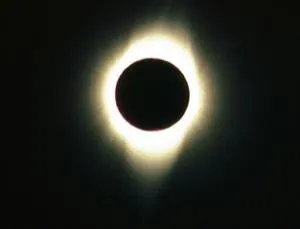
Geophysicists from the Chinese Academy of Sciences are preparing a set of instruments at six sites across the country to take gravity readings during the upcoming total solar eclipse that will occur tomorrow. The results could confirm once and for all whether the fluctuating anomalies observed in past eclipses are real.
"I am not really convinced that the anomaly exists, but it would be revolutionary if it were true," said Chris Duif of Delft University in Holland.
The first sign that gravity fluctuates during an eclipse was in 1954. French physicist Maurice Allais noticed erratic behavior in an oscillating pendulum when an eclipse passed over Paris.
Pendulums typically swing back and forth as a result of gravity and the Earth's rotation. At the start of the eclipse, however, the pendulum's swing direction changed violently, suggesting a sudden change in the gravitational pull.
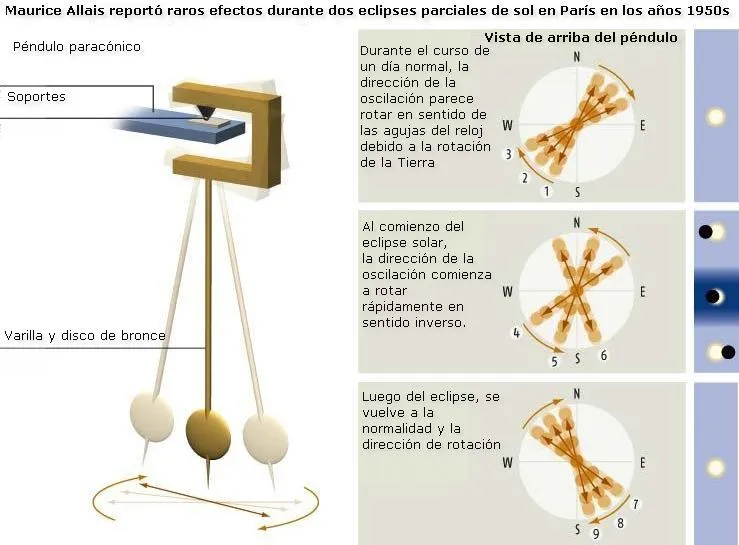
Fluctuations like that have been measured during about 20 total solar eclipses, but the results remain inconclusive.
Most physicists doubt the existence of this anomaly because it would challenge our ideas about how gravity works.
As a result, a number of conventional explanations have been suggested. "There could be different reasons: atmospheric changes in temperature or air pressure, people suddenly moving or not moving, or other sudden changes," said C.S. Unnikrishnan of the Tata Institute in India.
However, in 2004, Duif posted a theory online concluding that none of the suggested external factors could account for the magnitude of the anomalies.
(www.arxiv.org/abs/0408023).
For tomorrow's total solar eclipse, the Chinese scientists prepared eight gravimeters and two pendulums scattered across six monitoring sites. The team hopes that the large distance between the farthest sites (about 300 kilometers), as well as the number and diversity of instruments used, will eliminate the possibility of instrumental error or local atmospheric disturbances.
"If our equipment operates correctly, I think we have a chance to say whether the anomaly is true beyond all doubt," commented Tang Keyun, a geophysicist at the Chinese Academy of Sciences.
The opportunity will not arise again soon. Lasting 5 minutes, the event will be the longest total solar eclipse of the century. Furthermore, the event will occur when the Sun is high in the sky, a time when, according to Tang, any gravitational anomaly should be greater.
The eclipse, live, on the web
The eclipse will be broadcast live via the Internet by the "Expedición a China Eclipse Solar 2009" from the Chinese city of Chongqing. Totality at this point will last 5:30 and will begin at 1:13 UTC.
The expedition is co-organized by Shelios Expediciones Científicas, the Junta de Extremadura and by the Cíclope group of the Facultad de Informática de Madrid.
On the web:http://www.eclipsesolar.es/
Sources and related links
- NewScientist:July eclipse is best chance to look for gravity anomaly, by Phil McKenna
- The mysterious Allais effect in solar eclipses, by swing states
- Decrypting the Eclipse
About the images
- Solar eclipse: Sean Mahoney/Rex Features
- Diagram: The Allais anomaly