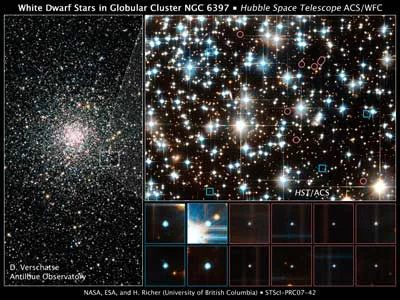
24 unusual stars, 18 of which were newly discovered, have been observed in images from the Hubble Space Telescope. They are unusual white dwarfs because they are made of helium, instead of carbon and oxygen.
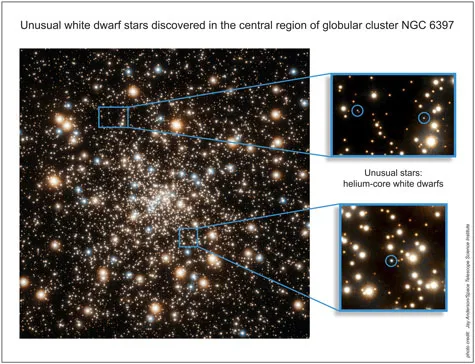
A study, accepted for publication in Astrophysical Journal, suggests that these helium-core white dwarfs had their lives shortened by their orbital dance around a companion star.
"Helium-core white dwarfs have only half the mass of typical white dwarfs, but they are concentrated in the center of a cluster," said Adrienne Cool, from the University of San Francisco, co-author of the study. "With so little mass, helium-core white dwarfs should be floating around the cluster, according to theory. The fact that we find them only in the central regions suggests they have heavier companions that drag them to the center," she explained.
Being coupled with companions would also explain the atypical chemical composition of the stars. White dwarfs are stars that reached the end of their lives and "ran out of fuel." Most stars burn their fuel leaving a dense ball of carbon and oxygen, but these white dwarfs are made of helium (He WD). The scientist suggests that these unusual stars must have a close companion, and so when the star became a red giant and expanded, its outer layers were spilled onto the companion. Thus, the star never had the chance to reach maturity and burn helium into carbon and oxygen, turning into a helium-core white dwarf.
According to the report, the companions cannot be main sequence stars, but, most likely, "normal" carbon and oxygen white dwarfs, which are heavier (CO WD).
He WDs are commonly found in binary systems, typically in ultracompact X-ray binaries. In globular clusters, 8 have been found, in addition to those found in NGC 6397. Three are in ultracompact binaries in NGC 6712, NGC 6624, and M15. Three are companions to millisecond pulsars (MSPs) in 47 Tuc, NGC 6752, and M4. In M4, a second He WD has been found as a companion to an intermediate (or sub-) dwarf, and in 47 Tuc a second one was recently identified in a study of blue stars.
The study focuses on the star cluster NGC 6397, one of the globular clusters closest to Earth, about 7,200 light-years away. Six helium-core white dwarfs had previously been observed in this cluster. The same scientist and colleagues discovered the first three in 1998.
Being the second closest globular cluster to the Sun, NGC 6397 is particularly favorable for the study of white dwarfs. The cluster has a dense core that appears to be the origin of exotic astronomical objects. This includes numerous "blue stragglers", cataclysmic variables, an inactive low-mass X-ray binary, and a pulsar.
"This is the first time helium-core white dwarfs have been discovered with other white dwarfs in a globular cluster. This large sample allows us to answer questions about the mass and nature of the companion stars and the prevalence of this type of binary in the globular cluster," commented Cool.
Binary stars play an important role in the evolution of star clusters. Their continuous dance around each other provides energy to the cluster that astronomers believe may help prevent the formation of black holes. From the data, Cool and her team are able to infer that 1 to 5 percent of the stars in this globular cluster will end their lives as helium-core white dwarfs with companion stars, a discovery that will help improve theoretical models of cluster dynamics. "It may not sound like much, but you don't need many binaries to stir things up," noted Cool.
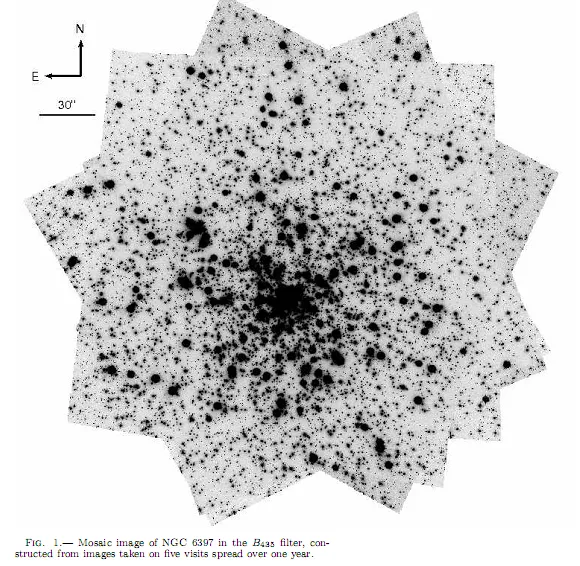
The images were obtained using Hubble's ACS/WFC cameras in ten visits over the course of a year, beginning in 2004.
Sources and related links
- Largest collection of anomalous white dwarfs observed in new Hubble images
- Oddball stars discovered in new Hubble images
- Helium-Core White Dwarfs in the Globular Cluster NGC 6397
R. R. Strickler, A. C. Cool, J. Anderson, H. N. Cohn, P. M. Lugger, A. M. Serenelli
arXiv:0904.3496v1
About the images
Image of NGC 6397, indicating the region of the unusual white dwarfs:Credit:Jay Anderson / Space Telescope Science Institute
Mosaic of images of NGC 6397:Rachel R. Strickler et al.