The creation of a microblogging service, in the style of Twitter, but focused on astronomy, has been proposed. To answer: "What are you observing now?" in 140 characters.
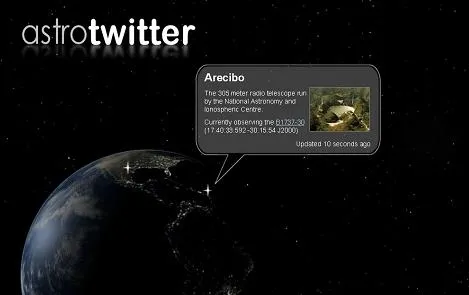
The project is led by Stuart Lowe, from the Jodrell Bank Centre for Astrophysics in the United Kingdom. Lowe has an extensive resume: He completed his doctorate in radio astronomy in 2005 and is now an associate researcher working for ESA's Planck spacecraft, recently launched. Furthermore, when he is not conducting research, he likes to contribute to the dissemination of astronomy and science. Among various tasks, he maintains the Jodrell Bank Twitter profiles and the Astronomical Picture of the Day. He collaborates with Jodcast, the Jodrell Bank podcast, and is a member of the New Media Task Group for the International Year of Astronomy (IYA2009).
At the recent 214th Meeting of the American Astronomical Society, in California, sessions were held on new media in the International Year of Astronomy.
The presentations were by Nancy Atkinson ("Is Your Telescope Tweeting?"); Michael Parrish ("Google Sky as an Interactive Content Delivery System"); Adrienne J. Gauthier ("IYA2009 in Second Life") and Pamela Gay ("Linking in IYA New Media"), in addition to Stuart R. Lowe ("Astrotwitter"). Atkinson's presentation revolved around new media. Half the world was born after the Apollo mission moon landings. The best way to reach this generation and excite them with current space exploration and astronomy news and events is through online social media, which are technologies that allow everyone to communicate with everyone, as her presentation states. And it continues by saying that Twitter is a growing social tool that telescopes and spacecraft are using to reach the general public, with status updates for each mission, which in some way makes the public feel they are part of the missions.
Other tools that the IYA New Media Group addressed were Google Sky, in Parrish's presentation. The first 6 months of the IYA2009 island in the virtual world Second Life were also highlighted.
Ultimately, this group seeks to provide an online astronomical experience to learn and play by creating content that brings the public closer to this science using a set of technologies on multiple platforms.
The same topic was also addressed in the latest issue (June) of CAP Journal, a magazine that attempts to communicate astronomy with the public, aimed at journalists. There it is also indicated that in this "internet era," the time between news generation and its consumption has shortened dramatically. Now, through tools like blogs, microblogging services, and podcasts, which do not require large infrastructure, but on the contrary are accessible and relatively simple to manage, it is possible to provide content quickly, interactively, and synergistically (it is possible to use several of these tools simultaneously).
The idea is for these tools to be increasingly used by scientific institutions, in order to reach the public more quickly, bringing interesting, educational, and attractive content.
Here we have commented on the Twitter or Facebook channels of some astronauts and space missions (See: "Socializing Mars", "Interview with astronaut Mike Massimino").
To learn about some of the missions and observatories that have a channel on Twitter, it is possible to view who I follow on my channel.
A proposal that goes beyond the mere use of existing web services is "AstroTwitter." It is an initiative of the IYA2009 New Media Group, led by Lowe. In his presentation at AAS 214, he tells us that the Jodrell Bank telescopes were among the first users of Twitter. Since then, many other astronomers, engineers, and communicators have joined, allowing them to use the service to ask or answer questions, for example: "Does anyone know if Mercury will be visible on September 9? I'm having trouble determining it."[1]
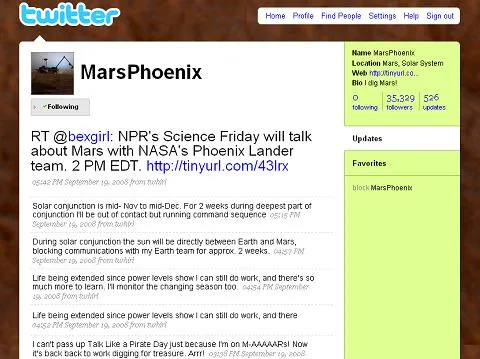
The most successful Twitter channel is that of Mars Phoenix, from NASA, initially created for those working on the project to stay in touch. As the mission gained media notoriety, the number of "followers" has been increasing. To date, it has over 45,000 followers. The success seems to be linked to two reasons: the Mars Phoenix team writes in the first person, which besides saving characters ("I," instead of "Mars Phoenix") personalizes the communication and encourages interaction. Furthermore, instead of ignoring the comments and questions received, the team has actively responded to its followers.
There are already several missions and observatories that use this channel, which allows transmitting information before, during, and after each mission in just 140 characters.
But Lowe goes further. He indicates that Twitter, despite being a great service, is far from perfect. Users have seen on several occasions the "whale" that illustrates the messages when the service is not working properly. Lowe also indicates that the generic nature of the service is also a limitation for astronomical applications, as it is difficult to efficiently communicate everything required to define an observation and then do other, more interesting things, when you only have 140 characters.
An AstroTwitter, as a dedicated microblogging service, would try to make it easier to answer "What are you observing now?" for many telescopes around the world, consistently.
In practice, each observatory or telescope (amateur or professional) would create its own account and would be able to define several details like those currently allowed by Twitter (username, image, location, short biography). With the appropriate APIs, it would be simple for those telescopes to send their data to the service in the most appropriate way for them. Being dedicated to astronomy would allow this data to be distributed in a variety of formats: web page, RSS feeds, widgets, links, etc.
To Tweet or Not to Tweet
The barriers to implementing the idea would mainly be due to each observatory's technology: it might not be simple to access observations online to determine coordinates or for telescopes not to be connected to the internet. To join AstroTwitter, an initial effort would be required from each observatory to implement it, although it would require little maintenance once automated.
On the other hand, Lowe points out that there should be the possibility for observatories to stop sending data online, so that discoveries are not leaked before desired, for example.
An obvious application, as Lowe comments in his paper, is displaying the data in applications like Google Sky, Microsoft WWT, or Stellarium, which would allow the public to see, in real time, an image of what telescopes around the world are observing. In this way, with AstroTwitter it might be possible to see telescopes hunting gamma-ray burst alerts, follow long-baseline interferometry observations, etc. With an archive, a sky map could be generated showing the areas covered by observations, as well as those not receiving attention. If extracting information from the systems were simple (key in this project), many more interesting and innovative applications would emerge over time.
I think we could finally ask ourselves (using fewer than 140 characters):
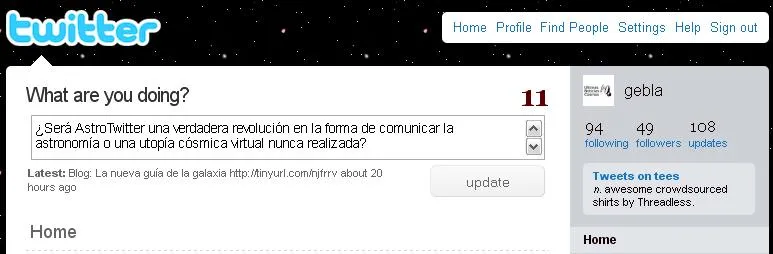
"Will AstroTwitter be a true revolution in the way astronomy is communicated or a never-realized virtual cosmic utopia?"
Sources and related links
- "AstroTwitter"
Lowe, S.R.
American Astronomical Society, AAS Meeting #214, #238.02;
Bulletin of the American Astronomical Society, Vol. 41, p.741
arXiv:0907.0193v1 - Is Your Telescope Tweeting?
Atkinson, Nancy
American Astronomical Society, AAS Meeting #214, #238.01; Bulletin of the American Astronomical Society, Vol. 41, p.741 - Google Sky as an Interactive Content Delivery System
Parrish, Michael
American Astronomical Society, AAS Meeting #214, #238.03; Bulletin of the American Astronomical Society, Vol. 41, p.741 - [1]:ignom Tweet
- IYA2009 in Second Life
Gauthier, A.; Gay, P. L.
Preparing for the 2009 International Year of Astronomy: A Hands-On Symposium ASP Conference Series, Vol. 400, proceedings of the conference held 1-5 June, 2008, in St. Louis, Missouri, USA, in Conjunction with the 212th Meeting of the American Astronomical Society. Edited by Michael G. Gibbs, Jonathan Barnes, James G. Manning, and Bruce Partridge.
Astronomical Society of the Pacific, 2008., p.354 - Live Casting: Bringing Astronomy to the Masses in Real Time
CAPjournal, No. 6, June 2009
Pages 26-29
Pamela L. Gay, Fraser Cain, Phil Plait, Emily Lakdawalla, Jordan Raddick - AstroTwitter in IYA2009
- Astronomy Blog: Where is it looking?
About the images
Screenshots of Twitter channels and Twittearth.com