The University of Colorado at Boulder is working with NASA to develop a new communications technology being tested on the International Space Station (ISS), which will extend the internet to outer space.
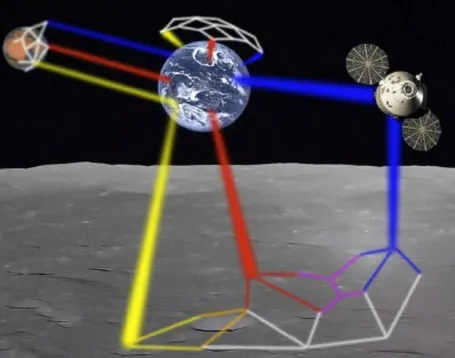
Called Disruption Tolerant Networking, or DTN, the new technology will allow the U.S. space agency and other space agencies to communicate better with their spacecraft.
"Communications between spacecraft and ground stations have traditionally been point-to-point links, similar to walkie-talkies," said Kevin Gifford, a Colorado researcher. "Currently, space operations teams must manually schedule each link and generate appropriate commands to specify where data should be sent, the time, and its destination. As the number of spacecraft, links, and the need to communicate among multiple vehicles increases, these manual operations become cumbersome and costly," he explained.
As Gifford continued to explain, highly automated communication capabilities will be required in the future. But existing internet protocols, where servers and computers are always connected, do not work well for many space environments, where intermittent connection operations are common.
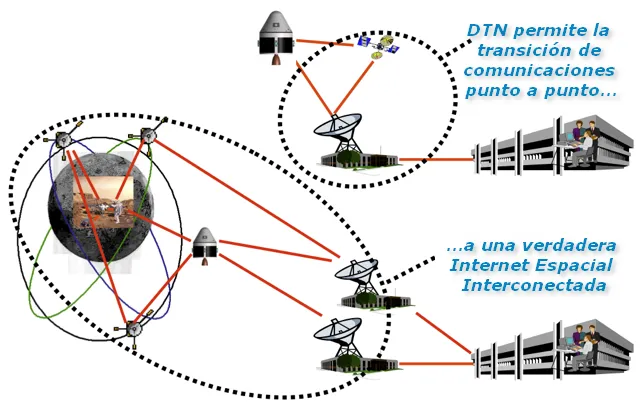
The new protocols were installed on a payload (known as Commercial Generic Bioprocessing Apparatus, or CGBA) on the ISS in May to send DTN messages known as 'bundles'. The tests will send these 'bundles' from the ISS to the Marshall center and the University of Colorado's Bioserve mission control center.
The new protocol was developed by the group known as Internet Research Task Force based on work started more than a decade ago jointly by NASA and Vint Cerf, who holds the title of vice president and chief evangelist at Google, and is also known as one of the fathers of the web.
Cerf stated that "while conventional internet protocols work well for highly connected environments with short delays on Earth, they degrade rapidly with long delays and wireless communication scenarios."
Cerf's counterpart at NASA's Space Communications and Navigation office is Adrian Hooke, a veteran of the Apollo 11 launch team, who leads the DTN project and is a pioneer in the development of international space intercommunication standards.
Hooke explained that "with the new system, delays caused by spacecraft moving behind planets or solar storms disrupting communications are not a problem because data packets are not discarded when an interruption occurs, but are stored as long as necessary until an opportunity arises to allow their transmission." This store-and-forward method is similar to a basketball player passing the ball to other players near the basket who have a better chance of scoring, as Hooke illustrated.
Gifford also noted "There are intriguing applications of DTN technology on Earth. They include tracking livestock and wildlife, enhancing connectivity in remote rural areas in third world countries, and tactical support operations for the military."
In November 2008 JPL tested the DTN protocols by transmitting dozens of images from the EPOXI spacecraft, located more than 30 million kilometers from Earth, to NASA.
The new series of tests are a further step in the development and evolution toward an interplanetary internet, involving many NASA centers, such as Marshall, Johnson, Glenn, Goddard, JPL (Jet Propulsion Laboratory). NASA and the University of Colorado are exploring ways to extend the experiments on the ISS to include the space agencies of Europe and Japan.
Sources and related links
- CU-Boulder, NASA test new 'space Internet' system on International Space Station
- NASA Spacecomm: Disruption Tolerant Networking (DTN)
- NASA Spacecomm: NASA and University Test New "Space Internet" Protocols
- Technology Review: A Better Network for Outer Space by Brittany Sauser
About the images
Testing DTN
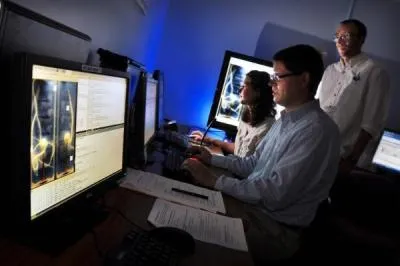
University of Boulder operators Emily Pilinski (left), Andrew Jenkins (center), and Sebastian Kusminski, all from BioServe Space Technologies in the aerospace science department, receiving data packets from the ISS.
Credit: Glenn Asakawa/University of Colorado
DTN graphics: Credit Bioserve/NASA