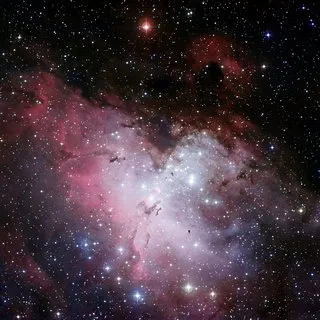
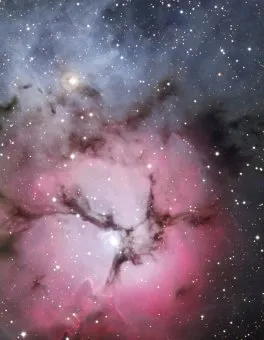
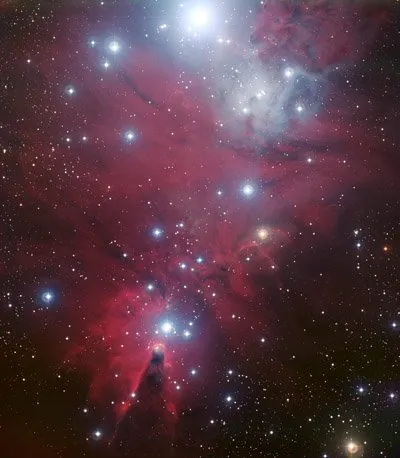
The stellar nursery where newborn stars illuminate and sculpt pastel-colored shapes is revealed in all its glory by a new image from ESO.
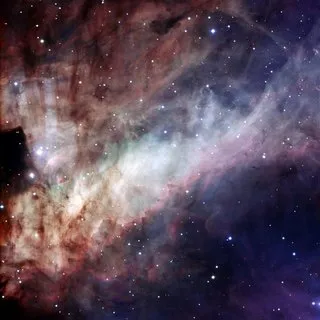
The Omega Nebula, sometimes called the Swan Nebula, is a dazzling stellar nursery, located 5,500 light-years away in the constellation Sagittarius. The active star-forming region of gas and dust about 15 light-years in diameter recently spawned a cluster of massive, hot stars. The intense light and strong winds from these powerful newborns have carved out the gas and dust that generate them, creating strange shapes in view.
When viewed through a small telescope, the nebula has a shape that reminds some observers of the last letter of the Greek alphabet, Omega, while others seem to see a swan with its distinctive long, curved neck. The nebula is also evoked as "Horseshoe" and "Lobster".
Swiss astronomer Jean-Philippe Loys de Chéseaux discovered it around 1745. French comet hunter Charles Messier independently rediscovered it 20 years later and included it as number 17 in his famous catalog. In a small telescope, the Omega Nebula appears as an enigmatic bar of light set against the field of stars of the Milky Way. Early observers were unsure whether it was a true cloud of gas or a remote cluster of stars too faint to resolve. In 1866, William Huggins settled the debate when he confirmed it was a glowing gas cloud.
In recent years, astronomers discovered that the Omega Nebula is one of the youngest and most massive star-forming regions in our galaxy. Active star birth began a few million years ago and continues today. The bright gas shown in the image comes from the remnants of massive hot stars that ended their lives and ejected material into space.
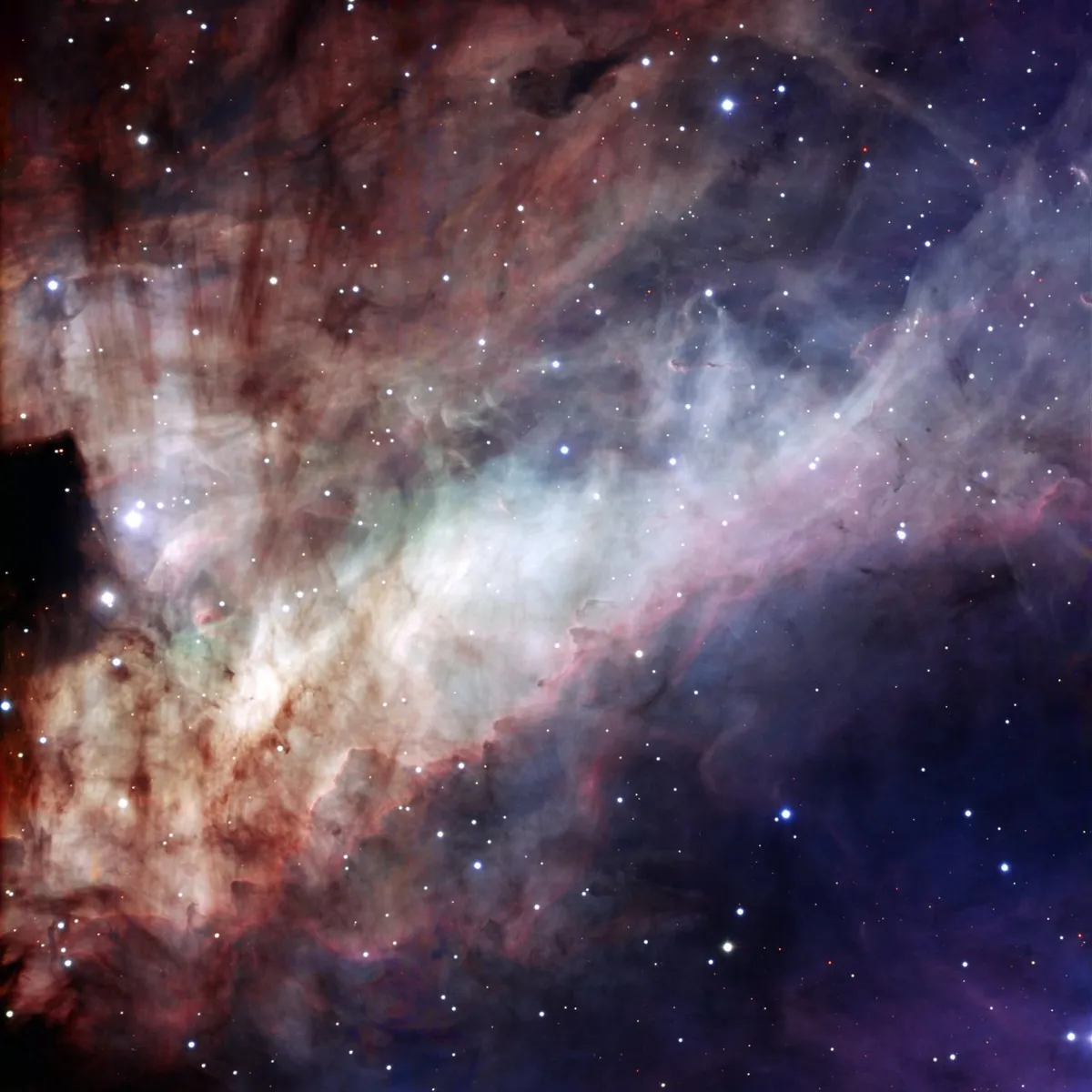
The new image, obtained with the EMMI instrument on the 3.58-meter NTT telescope at the La Silla Observatory, Chile, shows the central region of the Omega Nebula in exquisite detail. In the year 2000, another instrument on the NTT telescope, called SOFI, captured another incredible image of the M17 Nebula in the near-infrared, giving astronomers a penetrating view through the dark gas and clearly showing previously hidden stars. The Hubble Space Telescope also photographed some parts of the nebula.
To the left of the image, a huge dust cloud with a strange box-like shape covers the glowing gas. The fascinating palette of subtle colors in the image comes from the presence of different gases (mainly hydrogen, but also oxygen, nitrogen, and sulfur) that are glowing under the fierce ultraviolet light of the hot young stars.
Sources and related links
- ESO: New portrait of Omega Nebula's glistening watercolours
About the images
Three-color composite of the Omega Nebula (Messier 17), based on images from the EMMI instrument on the New Technology Telescope at the La Silla Observatory.
Credit: ESO
Animation: Panorama of the Omega Nebula
Credit: ESO. Music by John Dyson from the CD darklight.
Animation: Zoom into the Omega Nebula
Credit: ESO, Digitized Sky Survey 2, Panther Observatory, R. Gendler and A. Fujii. Music by dogstar.