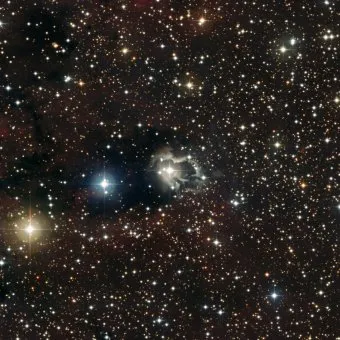
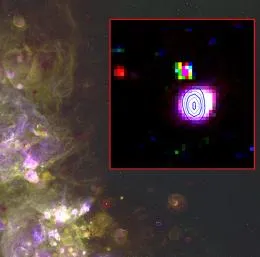
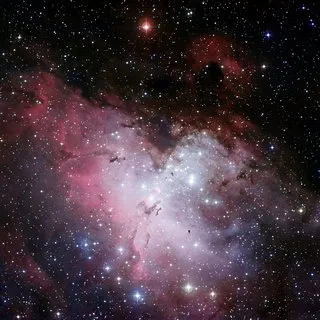
A supernova explosion is sometimes symmetrical. But when it is not, the result can be spectacular. An example is the incredible Guitar Nebula.
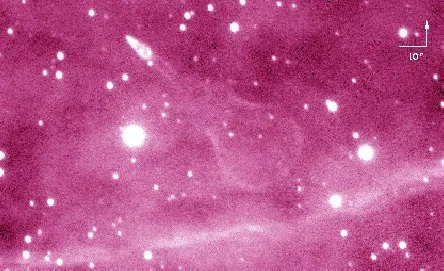
In 1992 a group of researchers from Cornell University used the Hale Telescope at Palomar Observatory and discovered a nebula associated with a rapidly rotating neutron star, also called a pulsar, with the designation PSR 2224 + 65. This pulsar is flying through a cloud of gas and producing shock waves in the gas, like the wake of a ship moving through water.
The pulsar's speed is incredible: 850 km/s, fast enough to escape our galaxy. The speed of its motion allows it to be observed in just a few years. For example, the Hubble Space Telescope observed the "Guitar" in 1994 and in 2001, as shown below.
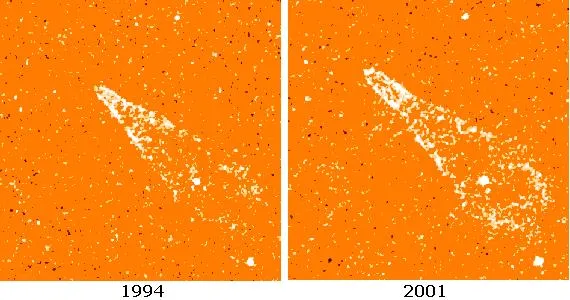
Given the distance of the Nebula (about 6,500 light-years, in the constellation Cepheus) and its apparent size in the sky, astronomers estimate that the neutron star has been traveling for about 300 years.
Sources and related links
- The Guitar nebula: a bow shock from a slow-spin, high-velocity neutron star
James M. Cordes, Roger W. Romani & Scott C. Lundgren
Nature 362, 133-135 (March 11, 1993)
DOI:10.1038/362133a0 - Bow Shocks from Neutron Stars: Scaling Laws and HST Observations of the Guitar Nebula
S. Chatterjee, J. M. Cordes (Cornell Univ.)
arXiv:astro-ph/0201062v2 - The Guitar Nebula
- Palomar Skies: Guitar Hero
About the images
- Guitar Nebula observed by the Hale Telescope in 1995
Credit: Cordes et al, Palomar Observatory. - Images of the Guitar Nebula in 1994 and 2001
Credit:HST Planetary Camera