ESO has presented a new and incredible image of a star field toward the constellation Carina. In the image, crowded with stars of all colors and brightnesses, a rare star with a dusty companion stands out in the center.
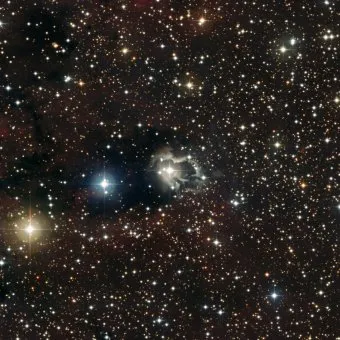
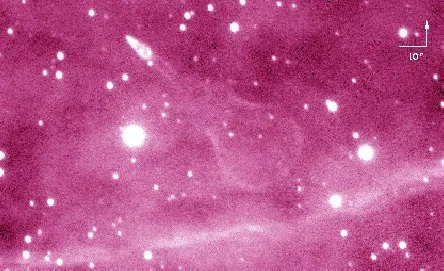
The new image shows a rich star field toward the Carina Arm of the Milky Way, centered on the star HD 87643, a star of an exotic class: the B[e] stars. B[e] stars are of spectral type B, with emission lines in their spectra, usually surrounded by a large amount of dust.
The image was obtained with the WFI instrument on the 2.2-meter MPG/ESO Telescope at the La Silla Observatory, Chile. The image beautifully shows the extensive nebula of gas and dust (RCW 47) that reflects the star's light. The winds from the central star appear to have sculpted the nebula, leaving ragged trails of gas and dust. A careful investigation of these features seems to indicate that they are regular ejections of matter from the star every 15 to 50 years.
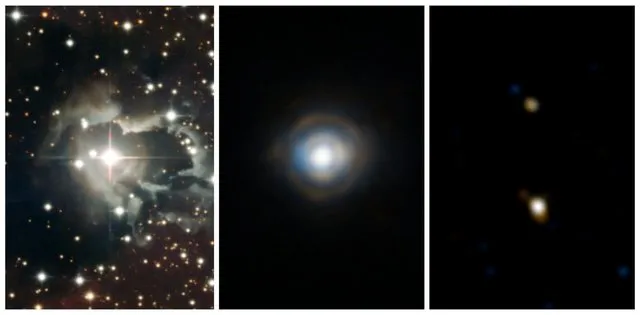
A team of astronomers, led by Florentin Millour, studied the star HD 87643 in great detail, using several telescopes of the European Southern Organization. In addition to the WFI, the team also used the Very Large Telescope (VLT) at Paranal.
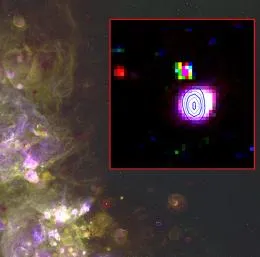
At the VLT, the astronomers used the NACO adaptive optics instrument, allowing them to obtain an image of the star free from the effects of the atmosphere. To investigate the object further, the team then obtained an image with the VLTI interferometer.
The astronomers found that the star has a companion located at about 50 times the distance from Earth to the Sun and is embedded in a compact shell of dust. The two stars probably orbit each other in a period between 20 and 50 years. A dust disk could also be surrounding both stars.
The presence of a companion could be an explanation for the regular ejections of matter from the star and the formation of the nebula: as the companion moves in a very elliptical orbit, it would regularly come very close to HD 87643, triggering the ejections.
Sources and related links
- A binary engine fueling HD 87643’s complex circumstellar environment using AMBER/VLTI imaging
F. Millour et al.
PDF
To be published in: Astronomy and Astrophysics - ESO: Double Engine for a Nebula
About the images
- RCW47 Nebula around HD 87643
Credit: ESO/F. Millour et al. - In the first image the star HD 87643 is at the center of an extensive cloud of gas and dust, with the WFI at La Silla. In the middle, a close-up of the star with NACO on the VLT. The third image zooms in further, showing an image obtained with the AMBER instrument using three VLTI telescopes.
Credit: ESO/F. Millour et al.