The first group of 64 meteor showers will receive their official names at the XXVII General Assembly of the IAU, following a vote by the members of Commission 22 at its meeting on Friday, August 7. Astronomers are celebrating because, until now, there was much confusion about which showers were real and how to name them.
This is how German astronomer Peter Jenniskens tells it, who belongs to the Carl Sagan Center of the SETI Institute and NASA's Ames Research Center, an expert on meteor showers and a member of the IAU Meteor Shower Nomenclature Task Group.
Comets leave behind debris of material in space. When Earth crosses these remnants in its orbit, meteor showers occur, which repeat annually. The name of the constellation from which these showers appear to radiate was generally adopted.
To create order in the chaos, at the previous meeting (three years ago, in Prague), a task group on meteor shower nomenclature was formed to formulate a list of showers that were well-known enough to deserve official names. The Task Group started with a list of showers and nomenclature rules. Then they thought of ways to add showers to that preliminary list and decided, based on the results of recent surveys, which showers were indisputable.
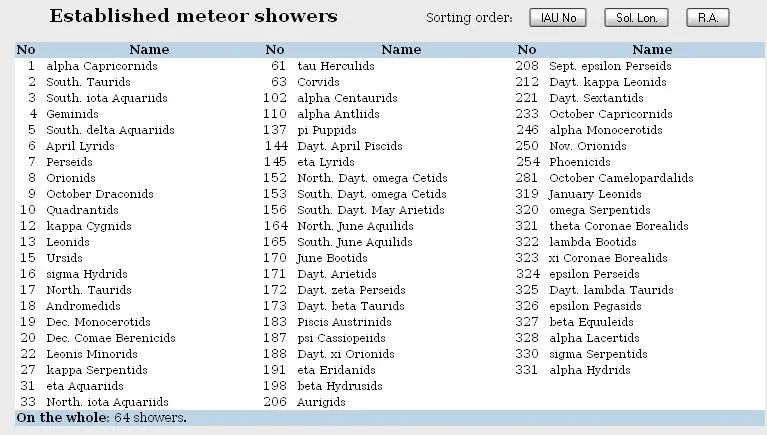
The IAU Meteor Data Center (IAU Meteor Data Center) maintains a database of known and suspected showers that gradually grows as more observations become available. Before being published, new showers must be reported to the Data Center, which will verify any name conflicts with existing showers and assign a unique number and a three-letter code to each new shower.
Those showers that are confirmed by others are considered established. Each established shower can then be studied to find its parent body and study the past activity of the comet.
Now, nature is providing us with a couple of cosmic fireworks: a rich Perseid shower in the Northern Hemisphere and the Alpha Capricornids in the South.
Nomenclature rules for meteor showers
The general rule is that a meteor shower should be named after the constellation that contains the radiant (the point from which they appear to come), using the possessive form in Latin. Thus the name of the constellations must end in one of the seven declensions:
ae (Lyrae); is (Leonis); i (Ophiuchi); us (Doradus); ei (Equulei); ium (Piscium); ourm (Geminorum).
If greater precision is needed, the shower is named after its nearest star (or the brightest one) with a Greek letter. Following existing custom, the name of the month should be added to distinguish showers from the same constellation. For daytime showers, it is customary to add the term "Daytime".
More in the Meteor Shower Nomenclature Rules.
Sources and related links
- Celebrating the naming of meteor showers
Peter Jenniskens
Estrela D'Alba, No. 5, p. 4 - IAU Meteor Data Center
- Meteors Showers online
- Sur astronómico: Meteor shower
- IAU Commission 22: Meteors, meteorites and interplanetary dust
About the images
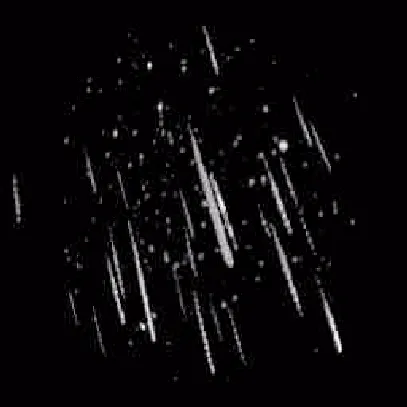
- Perseid shower
Credit: Sirko Molau, IMO, Archenhold-Sternwarte
Image of the day for 8/9/96 - List of established meteor showers from the IAU Data Center