The gas giant captured a comet in the mid-twentieth century for 12 years, astronomers reported today.
The data were presented at the European Planetary Science Congress in Potsdam, Germany.
It is comet 147P/Kushida-Muramatsu, which would have been captured by the planet between 1949 and 1961, according to the researchers' calculations. It is not the first, but the fifth time a captured comet has been identified. The best known of these brief companions was Shoemaker-Levy 9, which crashed into the planet in 1994.
The discovery allows for a better understanding of how Jupiter interferes with objects of the so-called "Hilda Group", named after the asteroid of the same name, which are asteroids and comets that have orbits related to those of the giant.
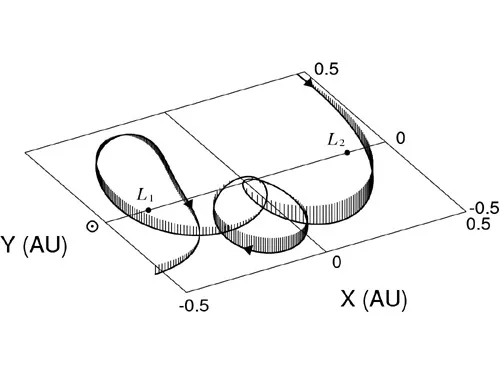
The calculations, led by Katsuhito Ohtsuka of the Tokyo Meteor Network, indicate that the comet made two complete revolutions around Jupiter, in an irregular orbit, before becoming free again.
The researchers used observations from the comet's discovery in 1993 and its return in 2001 to calculate its orbit during the previous century.
Their model shows that the comet entered Jupiter's vicinity from the outer solar system in 1949. The uncertainties in their observations make it impossible to determine the orbit exactly, so the astronomers performed 200 simulations, slightly varying the shape of the orbit, but all showed that the comet orbited the giant for a dozen years.
The simulations were not limited to this particular comet, but the study attempted to know the trajectories of 18 comets from the Hilda Group. Many of them were not captured. And the astronomers add a prediction: Jupiter will have another future moon. Comet 111P/Helin-Roman-Crockett will complete six laps around Jupiter between 2068 and 2086.
"Our results suggest that impacts and temporary satellite captures on Jupiter could occur more frequently than we previously thought," said David Asher of Armagh Observatory, who presented the data in Potsdam.
Sources and related links
- 147P/Kushida-Muramatsu and temporary satellite capture
K. Ohtsuka et al.
EPSC2009-10 - Cosmos:Captured comet becomes moon of Jupiter
- Physorg:Jupiter had temporary moon for 12 years
- New Scientist: Jupiter had brief encounter with icy companion
About the images
- The graphic illustrates one of the possible orbits of the comet around Jupiter (at the center of the axes). Credit: Ohtsuka/Asher
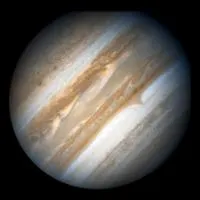
- Image of Jupiter. Credit: NASA