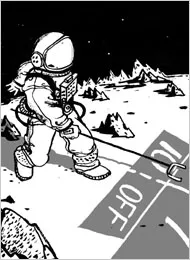
A successful flight test demonstrated how a spacecraft returning to Earth can use an inflatable heat shield to slow down and protect itself while entering the atmosphere at hypersonic speeds.
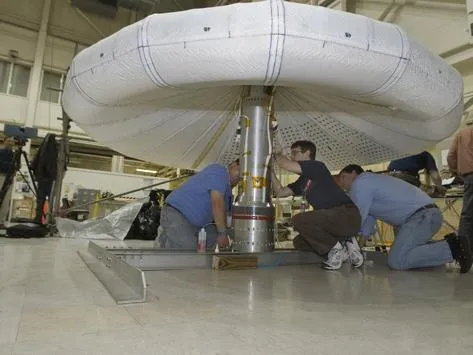
The Inflatable Re-entry Vehicle Experiment (IRVE) has the shape of a giant mushroom that was vacuum-packed inside a cylinder about 40 centimeters in diameter, but which, when opened and filled with nitrogen, deployed its nearly 3-meter span.
The "giant umbrella" is made of several layers of industrial silicone and was tested from the Wallops Flight Facility on the namesake island on the east coast of Virginia, USA.
The Black Brant 9 sounding rocket lifted off today at 8:52 a.m. EDT and took approximately 4 minutes to carry the experiment to an altitude of 210 kilometers. Less than a minute later, the cover was released and inflation began, a process that lasted 90 seconds.
"We are excited today because this is the first time anyone has successfully flown an inflatable re-entry vehicle," said Neil Cheatwood, principal investigator for IRVE and chief scientist at Langley Research Center.
According to the onboard cameras and sensors, the shield expanded to its full size and then fell freely at high speed. The key part of the research came six and a half minutes into the flight, at an altitude of 80 km, when it re-entered the atmosphere and experienced a peak of heat and pressure for 30 seconds.
The onboard telemetry system captured data from the instruments during the test and transmitted the information to engineers on the ground in real time. The experiment sank into the Atlantic Ocean 144 km east of the island.
"This was a small-scale demonstration. Now that we have proven the concept, we want to build a more advanced aeroshell capable of handling higher heat rates," said Mary Beth Wusk, IRVE project manager.
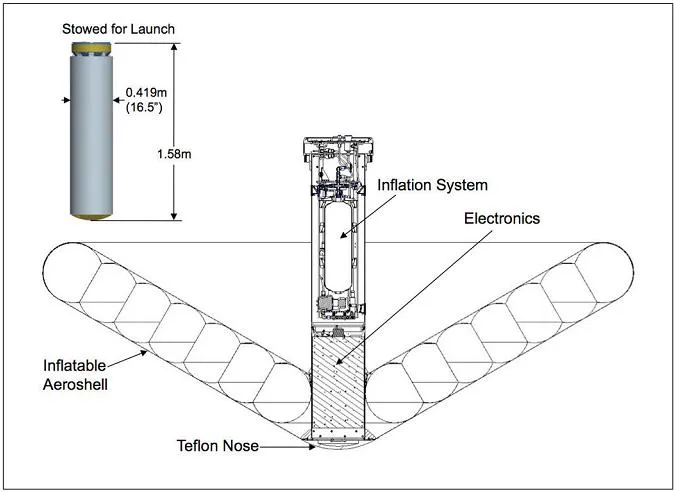
The concept had been tested before the flight through computer models, wind tunnel tests, and engineers thought it should work. But, aside from the schematics and calculations, they had to test its actual operation.
IRVE weighs 635 kilograms (1400 pounds) and carries nitrogen gas inside some pockets (or bladders) made of Kevlar fiber covered with silicone. The Kevlar gives those pockets their structure and the silicone allows them to hold pressure.
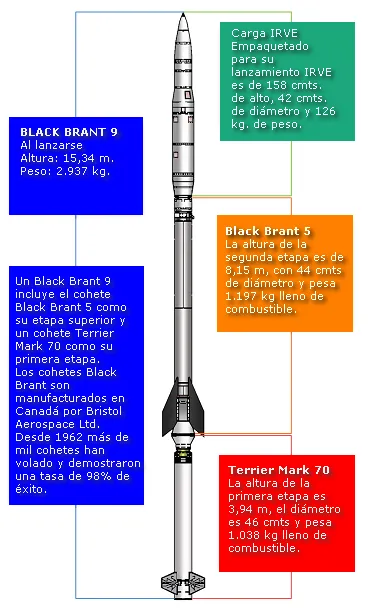
These inflatable shields could be a promise for future space missions, according to researchers. To bring more mass to Mars, for example, mission planners need to maximize the payload. Currently, the size of a rigid heat shield for any mission is limited by the size and weight available for cargo transport, the number of science instruments, and mission productivity. An inflatable shield would occupy less space and weight, allowing for greater mission payload capacity.
Sources and related links
- NASA: Rocket to Launch Inflatable Re-entry Capsule
- NASA Launches New Technology: An Inflatable Heat Shield
- Inflatables for space
About the images
- Image of workers preparing IRVE at Wallops Flight Facility
Credit: NASA/Sean Smith - IRVE diagram and Launch rocket diagram
Credit: NASA