In March we presented the first part of the transcription of a podcast developed by cosmology specialists Alan Guth (who formulated the idea of inflationary universe); Lawrence Krauss, a prominent physicist, author of several popular publications and contributor to Scientific American; John Carlstrom, leader of the South Pole Telescope, studies the background radiation; and Scott Dodelson, a cosmologist at Fermilab. Here is its continuation.
What follows is the transcription of the second part of the conference given by the specialists at the Annual Meeting of the American Association for the Advancement of Science, in Chicago. In this second part, the researchers answer questions from the press.
The first part can be found at "The future of cosmology".
Before moving on to the translation of the podcast transcription, some clarifying notes:
Since it is an informal chat among colleagues and aimed at the press, the language used is colloquial and messy. It is not an elaborate speech that each one gives, but rather they develop the ideas at the same time as expressing them. As in a chat among friends where we tend to go off on tangents and then pick up again and leave sentences unfinished. That is why the sentences may lack all the necessary elements to give them the greatest linguistic coherence. Also, voices often overlap in different passages and the transcription loses fidelity there.
In this part, the reporters (who are not identified, unfortunately) address some interesting issues and others not so much.
The cosmologists revisit certain ideas expressed in their previous talk and that they have commented on on other occasions: the anthropic principle, multiverses, the idea of the universe with zero total energy ("free lunch"), gravitational waves, the hypothesis of cosmic inflation, its acceleration, the "dark" universe, and the possibilities of finding (or not) answers in the Large Hadron Collider (LHC).
I would like to highlight the ideas related to the methodology of science and its objective, when asked about the connection between these topics and everyday life or when talking about NOT finding what is expected at the LHC, as well as the notion of falsifiability.
I must say, finally, that the first part had been published in March of this year and that this second part was available some time later, but we had not done the translation until now. We must thank the reader "Cuantín" (that's how he identified himself) for requesting this second part. And as a promise is a debt, we are settling accounts. Here it goes:
Reporter: Do you think the idea of inflation will be well confirmed enough to complete the demands of physics and in that case, which probe do you think will most likely give those results?
Krauss: I think the incredible thing about inflation is that it is completely consistent with what we see, and the key question, certainly, is: Will consistency finally be enough to convince everyone that it is absolutely true? Many people think -and Scott can expand on this (as can John) -that what has been called a smoking gun, inflation's gravitational waves is a prediction of inflation that is ubiquitous. In fact, it is a generic feature of inflation, more generic than many other things. I have said for 20 years that it is the most general feature we should look for. So, if these waves are discovered -and both Scott and I have been part of a group that has tried to be able, as we will be in the next satellites, to search for this, and John has been a leader in thinking about creating experiments to search for them-, if we detect gravitational waves from inflation, there is a real possibility of determining them sufficiently to convince all physicists that inflation occurred. There are significant obstacles and, inflation, at the same time, is unfortunately so robust that it can be consistent with almost any observation we make, and that is a problem. But if we detect gravitational waves, I think we will be much closer to Alan having a free ride.
[NOTE: The last sentence refers to the idea of the "free lunch". It is taken up more clearly in subsequent paragraphs]
Reporter: And which probe will that be?
Krauss: Which will be what?
Reporter: Which probe is trying to answer that question?
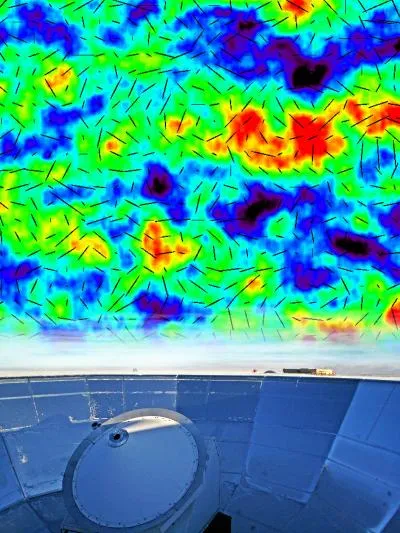
Carlstrom: Looking for the signs of these inflationary gravitational waves in the polarization of the cosmic microwave background radiation...
Dodelson: There are a number of different experiments including John's that are sensitive to this. For example, in Europe, Planck is about to be launched in April, and it will be much more sensitive (by a factor of 10) than the WMAP satellite and there are about a dozen experiments looking for this signature of polarization. These are very complicated experiments with dozens of people working on each one.
Carlstrom: I think we will know in 10 years, we will know whether we can detect gravitational waves from inflation or not, but it doesn't mean we will detect them.
Krauss: And, in fact, the unfortunate thing is that the absence of gravitational waves is also consistent with inflation, in the sense that there are two fundamentally different theoretical ideas, one of which suggests that gravitational waves should be large enough to be seen in the next generation of experiments. The other, based loosely on the idea of extra dimensions, suggests that the gravitational wave signature should be small. And this is really important, we will learn something profoundly useful, but, of course, if we don't see them, what we learn will rule out one set of models and leave another viable, but we wouldn't confirm them and confirming is always better than ruling out, I think.
Reporter 2: Can I ask, to help us, how small can a gravitational wave be?
Krauss: Oh! That's important. We don't say small in terms of wavelength. These gravitational waves would be the size of the visible universe, but they would produce signs, temperature -in this case, the polarization of the cosmic microwave background radiation- signatures that are at a next-generation level, the best we can imagine is having a 1 percent gravitational wave signal compared to the temperature fluctuation signal we can measure in the universe. And 1 percent would be a kind of holy grail, in a sense because it's probably the best we can do experimentally; and Scott might want to talk more about that, but it also distinguishes the class of scale, if it's greater than 1 percent, one set of inflationary theories are probably correct. If it's smaller, another set would be, but then he tries to add, as I often do, and muddy the waters a bit: we have also argued recently that, unfortunately, there are other mechanisms in the early universe that can also produce the gravitational wave signal that would mimic those due to inflation. And that's wonderfully exciting because it means that if you discover them you'll have a great test of the early universe, but it wouldn't be a unique test of inflation.
Steve: How long will it take to return to the 19th-century vision due to data availability?
Krauss: Oh, it's really soon, it will be within between 100 billion and a trillion years; it may seem like a very long time to you (maybe not so much) compared to this press conference, but the interesting thing is that the universe will look big, I mean, the local universe will look just as big at a point. The longest-lived stars are older than that, so there will be stars like ours and planets around them and civilizations powered by solar energy, so it's perfectly reasonable to expect that those civilizations won't be so different from ours, but they will live in an empty and dark universe. And, in fact, what we said somewhat humorously when we pointed this out is that we live in a very interesting time, the only time in which we can empirically verify that we live in an interesting time.
[Note: this idea will be taken up later, more clearly]

Dodelson: Can I add something? In reference to this dark energy today, there are two possibilities that lead to being optimistic and one is that the current dark energy might not be vacuum energy, it could be something completely different; and a good piece of evidence is that inflation itself requires dark energy, so it makes sense to think: "Well, we had an early epoch of dark energy which is something we are trying to understand; perhaps currently there is also a new kind of dark energy different from vacuum energy, which would lead to a less pessimistic view of the future. The other potentially exciting thing about dark energy is that it could be connected to very small particles called neutrinos. The mass scale is almost the same, so there are theories in which dark energy is connected to neutrinos. And if that's true, there is a huge amount of research currently being done on neutrino physics. The idea of connecting that primitive dark energy with something current is exciting and would open new vistas in our understanding.
Krauss: And let me add to what Scott said. He is right, of course, and we could be lucky and I hope so; what Alan said is, I want to emphasize something about the negative features of what Alan said, which is that if vacuum energy is dark energy, we wouldn't be able to prove it. Our experiments will narrow the uncertainty on these dark energy parameters, but the closer we get, the less we would be able to distinguish between vacuum energy and something that looks like it. And the unfortunate thing is that the only way to answer is with theory and the theory should be guided by things like the LHC and that's the really exciting thing about cosmology and particle physics working together. But we could be unlucky and, for example, in particle physics we have this wonderful standard model that has survived the tests of all experiments, unfortunately, for the last 30 years without really telling us what the fundamental physics is and we hope the Large Hadron Collider (LHC) will tell us. But cosmology could be in a similar situation when these fundamental parameters are determined, so we need new theoretical ideas. We don't know, and the good thing is not to know, because that's how you do experiments and see.
Reporter 2: I'd like to follow up on what Scott said, about the connection with neutrinos, what does it mean?
Dodelson: Those particles in fields responsible for dark energy are also responsible for the mass of neutrinos. The problem is that I think part of the pessimism -and there was some pessimism in the field- is that we are inventing things; we observe this acceleration and say, "Ok, that's dark energy". I mean, you can play tennis without a net only for a while, until you need to go to the net. So if we can connect this dark energy to something we know exists, like neutrinos and connect, for example, a field that gives mass to neutrinos and somehow generates the dark energy, I think I'll sleep much easier tonight.
Reporter 2: Would that be an entirely new field or an existing one manifesting in a new way?
Carlstrom: Is it new physics?
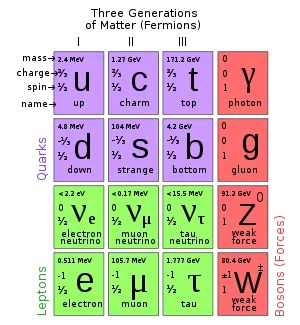
Dodelson: It definitely should be. You know the charts that describe the standard model of particles and Lawrence is right that we don't have any experiment yet that moves us from that chart, except in cosmology: so dark energy, dark matter, inflation, all require physics beyond the standard model. So this new field would have to lie beyond the chart and would definitely be new physics.
Krauss: New physics and it could be probable in particle accelerators and that's key, because you would have something new and it's what we really need.
Reporter 3: Do you fear that dark energy is a modern phlogiston theory?
[NOTE: The phlogiston theory dates from the mid-17th century. Johan Becher, a German alchemist, postulated the existence of an element called "phlogiston" contained in combustible bodies and released during combustion. It was an attempt to explain oxidation processes, until Lavoisier dedicated himself to its study and explained it by the presence of oxygen. The theory is known in Spanish as the teoría del flogisto.]
Krauss: I hope so. I mean, I think one of the biggest misconceptions about science is that we want to be right. In a way we want to be wrong, because that...
Reporter 3:...will lead you to the correct answer.
Krauss: Yes, what was more interesting is that many basic ideas we have today were wrong, because it means there is a lot of work left for theorists and I think the point is that we don't have a theory of dark energy. That is key. It is the most mysterious discovery from a fundamental theory perspective that has happened in a long time, and we have vague ideas; and vacuum energy is a good explanation except that when we try to explain it we get the wrong answer. It is the worst prediction in all of physics. That's why it's very exciting from a theoretical perspective because it means there is something profoundly important we need to understand and we don't know. And unfortunately Alan is right that now the best answer is that we have many universes and that it is what it is because it is the way it is, but boy, isn't that a horrible explanation?
[NOTE: I understand he is referring to the argumento antrópico.]
Reporter 4: Are there bigger or more powerful machines if the LHC doesn't find it?
[Note: Asking about the Higgs boson?]
Krauss: The physics community has been thinking, these machines take decades, at least a decade or two to design and build, if you have the political and economic will. And the scientific community is coming together around the International Linear Collider (ILC)[...]
But, currently, I would say it's possible that in the lifetime of the people in this room, the LHC will be the biggest accelerator, unless there is the political and economic will and international collaboration to do it [...] These machines are expensive. They could cost $10 billion spread over a decade and I would say that if we, as a civilization, don't have the money to ask and answer fundamental questions, it's really a sad reflection on our civilization.
Reporter 2: Can I ask, Alan, the latest ideas on whether there is any chance of detecting those other universes, if they interact with ours in a measurable way or if they are purely theoretical?
Guth: There are people doing research on what it would be like if we collided with another bubble. It is possible in principle for bubble universes to collide with each other. There's no doubt about that. My own guess is that when the dust settles it would be something incredibly rare to expect to detect other universes in that way, that's what I think, but it's worth exploring and work is being done on it, I could be wrong there, what I express are just hunches.
Krauss: But it doesn't mean it will be metaphysics. I want to point that out. I want to show my optimism. People say 'If there are other universes, and you can't detect them, then, what's the difference with metaphysics?' And the answer is that we might be lucky enough to have a theory that explains what we see, explains why the proton is 2,000 times heavier than an electron, explains why there are three generations of elementary particles, explains how the forces could have been unified, and therefore it is testable in a whole domain of ways, but one of its auxiliary predictions might be that it produces inflation which would produce these other universes. And then you should say, well, if I measured 95 predictions of this theory and it explains everything and also something we can't see, we are willing to accept that which we don't see. And the same has been true in physics. Many times there have been theories that have explained what we can see but make predictions we don't see, from the existence of atoms onward. And so we get to a point where at least we have strong scientific ways of testing a theory that predicts strange universes.
Reporter 5: Something that comes to our newsroom often is that these things are divorced from people's everyday reality. When trying to explain it to people who don't work in this field, what basic things would you say about how this connects to daily life?
Krauss: Well, I just came from Paris for the International Year of Astronomy in honor of Galileo's discovery. And if you look back with a historical perspective and think about how astronomy has changed our cultural perspective and understanding of ourselves, it is profound. It was Galileo's discovery of the moons of Jupiter that told us the universe had a beginning. And I think that while these questions are cosmic in a real and metaphorical sense, the fact of our perception of where we come from, the fundamental questions that everyone asks about themselves is inevitably determined by these discoveries. And, certainly, there is no practical meaning to that, except understanding our perspective of our place in the universe, but I would say the same is true for art, literature and music. And we never ask why we do that. The only reason to ask ourselves these questions is because we want to understand ourselves at a certain level and cosmology gives us a profound level. It is true that when you ask fundamental questions from an experimental perspective, the techniques you develop will produce economic benefits and that has happened, from the internet to other things, but I think, my own feeling is that you should never justify asking fundamental questions by their ancillary benefits. They will affect our economy, they will produce the things that will change our generation, but the questions themselves are worthwhile.
[Note: The best answer of all. Forceful.]
Reporter 6: If I understood correctly, is it dark energy that will make the universe less falseable in the future?
Krauss: yes, it will change the picture of the future more than anything and yes, dark energy is the culprit that has changed our thinking in almost every way.
Reporter 6: What is the mechanism?
Krauss: it's very simple. Dark energy is gravitationally repulsive and causes the accelerated expansion of the universe and distant objects will accelerate and finally move away from us faster than the speed of light, which sounds like it's not allowed by Einstein, but we lied. Nothing can move through space faster than the speed of light, but space itself can do whatever it pleases as far as we know and can expand faster than the speed of light.
Even without dark energy, there are regions of the universe that are moving away from us now faster than light and what happens in that case is that it carries objects in them, like a surfer on a wave, and the light from those objects will not be able to reach us, so the universe will finally disappear from our eyes in that sense.
[Note: this clearly picks up the previous question, regarding that in the future (billions of years), future living beings will see a universe similar to the one we saw in the 19th Century because it will appear static. There will be no way to know that other galaxies exist and that they are moving away from us (and that the universe is expanding). Other galaxies will not be seen, it will be a dark, cold and empty universe to future observers. That makes "this" time very particular, because we are in a position to realize all of the above. Amusingly it is said that it is a very particular moment because we can realize that it is a very particular moment...]
Reporter 2: Can I ask something that has been worrying me? If the universe inflated from [borrowed] energy and then continued expanding indefinitely, even faster, we end up with what sounds like a contradiction for an economist, that we have a war that was never executed (like a mortgage).

Krauss: Well, Alan said it well. I'll let him say it, it's the last free lunch, do you want?
Guth: Yes, my slogan is the last free lunch, it's not a mortgage. Even if inflation is not correct, the universe itself given that we observe it as it is at least very closely, if it is not at the exact point where the total energy is zero, where all the galaxies and stars and so on -which are positive energy- is balanced with the negative contribution of energy. Energies are not always positive. The negative contribution comes from the gravitational fields that fill the universe and as long as the universe is near the border between being open and being closed, the total energy is very close or exactly zero.
[Note: the idea of the "free ride" mentioned earlier, is precisely the same idea as the "free lunch", just expressed differently: we have a universe with total zero energy. As if to say we have a universe full of things, for which nothing was spent, it's "free".]
Reporter 4: I'm struggling with the concept of "something near zero". It seems like a huge difference between zero and...
Guth:...near zero. Well, yes, certainly. I say that observationally we can say near zero. Theoretically, I think, it is very attractive for it to be exactly zero.
Krauss: And that is one of the wonderful things about inflation. It predicts a natural mechanism for the energy to be essentially equal to zero, and Alan's observation of a free lunch is profound because it really means that (and I wrote about it) that the universe could begin from nothing. People say you can't have nothing for something, that has been the main argument for God for certain people. And the answer is that it is perfectly simple to start with nothing because if the total energy of the universe is zero now, it was zero before and fluctuations and other things could easily create it. I would say that science has a mechanism that is perfectly rational and natural to create a universe from nothing, in fact Alan's mechanism in some sense is the most natural.
Reporter 7: What is the probability that some assumptions or hypotheses are leading us into a dead end?
Krauss: The probability is that most ideas in physics are wrong, if they weren't, anyone could do it. I mean, the probability is that much of what we are saying about theoretical speculations will have to be revised. That is the general case and...
Dodelson: I think it's true, people want to be wrong about all this. The problem is that there is dark energy, dark matter, inflation and a large number of different observations pointing to the same new thing, so it's hard, I mean, people try to have alternative models, but there are always observations that constrain them. So it is possible that we are on the wrong path and must rethink everything, but there are so many observations that it is hard to think how we will be able to rule these things out.
Krauss: Yes, and it's true that all the observations in cosmology, from the CMB measurements to the large-scale structure measurements, to the dark energy measurements, the amount of mass in the universe, everything seems to converge on the same picture. The problem is that all aspects of the picture cannot be understood on fundamental bases, but I would say that one of the great virtues of inflation is that it has explained many of those features and allows an explanation of many of the features of the picture for which, otherwise there would be no explanation.
Reporter 3: (the question in the podcast is not heard well at the beginning) [...] if we take the dark energy particles or use supersymmetry particles, for example, neutralinos and axions, to help solve the dark energy problem too.
Krauss: Well, yes and no, I mean, we used to think that the biggest problem was dark matter, it is fundamentally important to measure that and the fact that we might see it at the LHC, or indirectly by seeing the annihilation of dark matter particles in the galaxy, is profoundly important. What will happen, if we discover dark matter particles, is to tell us that a number of theoretical ideas in particle physics are on the right track. For example, supersymmetry - if we discover supersymmetry particles, it will tell us something that is a profoundly important idea that will affect the direction of theory, and supersymmetry is at the basis of a lot of ideas including string theory. It is not true, and I emphasize, that if we measure supersymmetry in some way, we will have evidence for string theory, but it will direct our theoretical ideas in ways that could be important for finally answering the question.
Dodelson: I think another possibility is if we detect at the LHC evidence of extra dimensions. Then that would point to a different framework for understanding the dark energy potential.
Krauss: Absolutely, not likely, but absolutely. I mean, that's why you have to keep looking. You don't know where the answer will come from and you have to keep looking and in a healthy world, you look in all possible directions.
Guth: Let me add another thing that could be seen at the LHC, which I think would make us less happy if detected, but we could see evidence of a finer tuning in nature than already seen, in the cosmological constant and that would be taken as evidence for this anthropic picture of the multiverse where the laws of physics are not determined by fundamental principles but by a variety of things happening[...]
Krauss: And what we might see at the LHC - this should be very sad - but we should see something, right? But I think and want to emphasize and journalists should emphasize that seeing nothing is sometimes important. I mean, I worry that if we see nothing at the LHC it would be an argument for people to say "We shouldn't build the next one because after all these guys are just saying they will continue finding things", but seeing nothing would be profoundly important. It has happened before, the Michelson-Morley experiment, in which seeing nothing led to laying the foundations of special relativity, so it will give us, no matter what happens, it will profoundly affect our picture of fundamental physics in a vitally important way.
Reporter 8: Can you categorize what it means for the LHC to find nothing?
Krauss: I mean, nothing new. It is looking for, for example, everyone knows that one of the things it was designed for is to look for the so-called Higgs particle, which is a vital part of the standard model. And all the indirect arguments suggest, which is a reason why it was built, we are not building it because we have money, but physics tells us that we will probably find something. But due to possible tunings in nature, which Alan referred to, it is possible that [...] the Higgs is not observable. And if that is the case, Alan is right, the only explanation is that, given all the evidence suggests that unless you find those tunings, the Higgs should be observable at the LHC or a similar machine, then it would tell us that there are other fine tunings in nature that would strongly suggest that the universe we see is not generic and is very special. And that would give us evidence that we are in the periphery and so there would be more universes.
Guth: Let me say that, what Lawrence said is probably true, but I am not absolutely sure. What is also true is that finding the Higgs and nothing else...
Krauss: Yes, that's another possibility.
Guth: Most of us call that nothing. We are pretty sure the Higgs is there and finding it and nothing else, in terms of physics would have consequences similar to what Lawrence was talking about.
That would require a greater tuning, those ideas like supersymmetry are promoted as being able to explain why the Higgs is so light. If you find the Higgs and not supersymmetry and nothing like it, that would generate an alternative explanation for why the Higgs is so light, then that lightness of the particle becomes a problem like the cosmological constant. It is very far from what we expect. And a plausible explanation, and the only one that would remain under this hypothesis, would be that there are many other universes and life only forms when the Higgs field is light.
Carlstrom: My own hope is that we don't see at the LHC any of the above and that the world is much more exciting than thought.
Reporter 9: If you see something, if you find the Higgs particle, it's good. If you don't find it, it's good. Is there anything you could see at the LHC or in another dreamed-of accelerator that you would say would be something definitely right or wrong, for example, whether inflation is or isn't?
[Note: What a great question!]
Krauss: Wow! That would be inflation. I mean, look where we have managed to look, thinking about the universe on scales that are much more different than what we can measure now, than what you can understand, it is the greatest extrapolation probably in the history of physics.
Carlstrom: The energy scale, at which we think inflation could have occurred is far beyond what we can reach with the LHC (or the ILC) or any other collider that can be built on Earth.
Krauss: So we must take small steps, and there is always a chance of being lucky, but what we need are empirical tests of ideas that are leading us in the direction. So the discovery of supersymmetry, for example, if it is discovered, will definitely direct our understanding of fundamental physics and suggest ideas about the scale at which inflation could have occurred, which will restrict things tremendously. So we will have new things, but that's what's interesting. Experiments and observations in cosmology have been so successful that we are seriously trying to answer questions about scales that have been previously unimaginable, and so it might take a while before we get definitive experimental answers and we must recognize that possibility.
Carlstrom: I think the way to falsify inflation is to keep making observations, finding things and then a new theory will replace inflation and make predictions that we could test, it is probably the only way inflation will go away.
About that I can't think who knows what we'll find in the next 10, 20, 30 years.
Krauss: There is a possibility that the fluctuations seen in the cosmic microwave background radiation that are called Gaussian and it means a kind [of fluctuations] as random as they can be and if you investigate deeper you find that there were some fundamental Gaussians, that would be something that would lead us in a different direction, do you agree?
Guth: Well, it would lead us toward certain types of inflationary models.
Krauss: That is, probably, that even then it could be falsifiable. Perhaps we should give it up as a fundamental principle at a certain level and that doesn't mean that science will end at a fundamental scale, it means that the kind of questions we can ask will be restricted.
End of the Science Talk podcast.
Sources and related links
About the images
- Chart of the three generations of elementary particles.
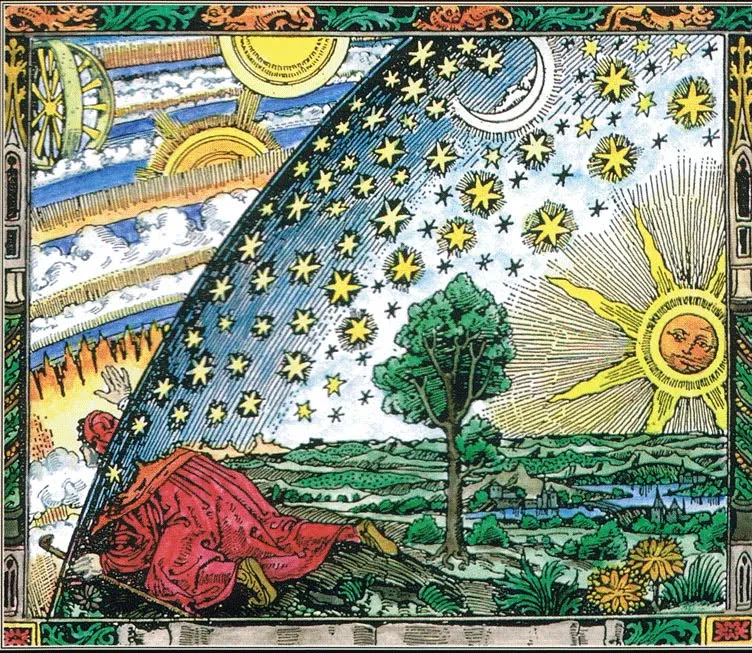
Credit: Wikipedia - Camille Flammarion L'Atmosphere: Météorologie Populaire
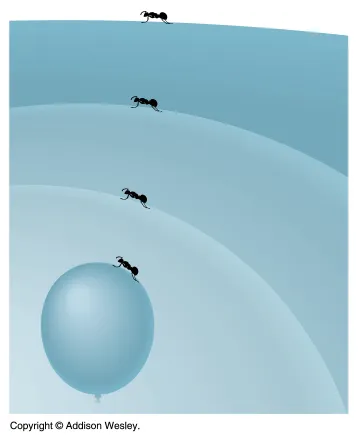
- Expansion of the universe. Credit: Addison Wesley
- Cosmic composition of the universe today. Credit: Gerardo Blanco
- Menu: Free Universe. Credit: Gerardo Blanco