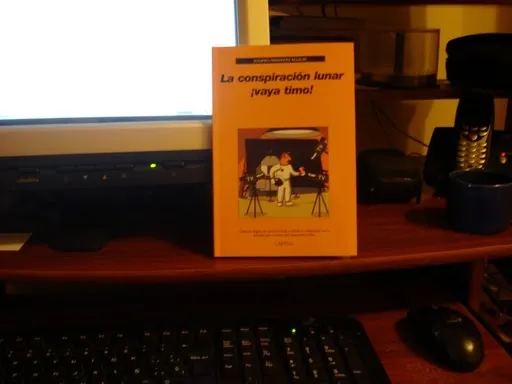
And it arrived in Buenos Aires. The book "La conspiración lunar ¡vaya timo!" traveled from Pamplona to 34º South latitude and here we comment on the content of a work that sheds light on the conspiratorial doubts about the Apollo space missions.
I have been following Eugenio Fernández Aguilar's posts on "Ciencia en el XXI", his blog about astronomy, physics, mathematics and related sciences, for a long time. So it was a joy to learn about the publication of a book that, as if that weren't enough, deals with the lunar conspiracies.
Eugenio's work is meticulous and direct. If anyone doubts the human arrival on the Moon, it is mandatory reading. And if the hypotheses of the conspiracy theorists bother you, it is too, as it provides solid arguments against them. Without too much beating around the bush, the multiple "arguments" that cast doubt on the success of the Apollo missions are dismantled. And, as if that weren't enough, Eugenio does not use hermetic language. Of course, the explanations necessarily involve appealing to physics, but the author develops the answers in a simple and clear way.
First of all, we find a magnificent introduction about the ease of creating -and believing- fake news, like the child who corrects NASA (which we commented on here in "NASA: the student's story is a fiasco") or the apocryphal greeting from Neil Armstrong to his neighbor's husband.
Immediately after, there is a very brief history of the missions in question, to know the context.
The second chapter introduces us to who the conspiracy theorists are and how they weave their hypotheses with a list of the 50 assumptions about the lunar landings that in the next chapter will be dismantled one by one.
Those of us interested in these topics already know many of the fallacies that abound on the subject and we also know where the falsity of the reasoning used lies. The truth is that when I have come across someone who cheerfully doubts the veracity of the historic trips to the Moon, I usually ask my interlocutor how many times -he believes- man reached our natural satellite. And generally the answer is: "One", after which it is easy to dismantle anything else he says, due to his enormous ignorance.
This false idea of a single trip is addressed in hypothesis 43.
Other ideas can be more difficult to answer. The most "rational" one seemed to me number 26: Why are there no telescope photographs showing the landing site with the remains of the Apollo missions?
Recently I received a similar comment in the blog's email inbox. The commentator's (Franco) idea was that the conspiratorial hypotheses would cease to make sense if the rover on the lunar surface were identified with a telescope. My response to the reader appealed to the fact that if that were possible it would solve nothing. Simply because they could quickly say that a current NASA mission "dropped" the rover there. And it wouldn't be far-fetched, given that there are other lunar cars on the Moon, not American ones. Russia has the Lunokhod there. There are also NASA's rovers on Mars. And, so far, man has not managed to set foot on the Red Planet.
But Eugenio responds to the concern more directly. The impossibility is given by the necessary resolution. If we want to photograph an object of about 10 meters at approximately 356,000 km (the minimum distance between Earth and the Moon), it would be necessary to have an instrument with a resolution angle much better than Hubble's.
Other hypotheses I was unaware of, such as the one about the rock with the "letter C" or the one that attributes to an astronomer at the Royal Observatory of Greenwich words that she herself denies.
The fourth chapter of the work contains a more critical, more epistemological look at what we believe and what we base it on, along with a decalogue of reasonings that overflow with common sense.
The fifth part is very interesting: it brings us the accounts of well-known personalities (from Spain) linked to astronomy, physics, journalism about how they experienced the moon landing. I particularly liked those of Rosa María Ros and Jorge Wagensberg, which convey the emotions of the time. It's no wonder that around here someone proposed July 20 as friendship day.
Finally, Eugenio shares a conclusion and a compilation of interesting resources: books, websites, blogs, movies.
La conspiración lunar (Promotion video)
http://www.youtube.com/watch?v=JpgmC-aViK8
But that's not all. From "Ciencia en el XXI", Eugenio has been adding audiovisual material to his printed work, which enriches this formidable work. And more also on his personal page.
The Collection
"La conspiración lunar..." is part of the ¡vaya timo! Collection from Editorial Laetoli. The titles that compose it are all very attractive and address ideas that are well worth reviewing: creationism, UFOs, parapsychology, abductions, and more. The collection is directed by Javier Armentia and published in collaboration with the Sociedad para el Avance del Pensamiento Crítico (http://www.escepticos.org/).
To them also, congratulations for this work in particular and for the other titles in the set. And I would particularly like to emphasize the importance of this editorial adventure of scientific outreach, thanking the effort to Serafín Senosiáin, director of Laetoli. I cannot fail to mention that "La conspiración..." came into my hands thanks to the publisher sending it to me, at Eugenio's suggestion, as it has done with other bloggers and journalists.
And in this case the effort is greater, for having made the pages travel across the Atlantic. And it didn't take long, as I "devoured" the 166 pages in a few hours, taking advantage of an internet "outage" that has been going on for a couple of days and continues... (¡¡Fibertel!!).
To all those who in one way or another manage to carry this magnificent collection forward, my most sincere congratulations and enormous gratitude. And to Eugenio, for getting us out of the caves of myths by shedding light where there are shadows and helping us to learn, through this beautiful work and his blog.
PS: The photos are for your collection on Flickr!
Book data
"La conspiración lunar ¡vaya timo!"
Eugenio Fernández Aguilar
Editorial Laetoli
Colección ¡vaya timo! directed by J. Armentia
1st edition, July 2009, Spain
176 pages
ISBN: 978-84-92422-14-2
€ 15 At Casa del Libro
Sources and related links
- Interview with Eugenio in "Desde el Sur"
- Ciencia en el XXI
- Editorial Laetoli
About the images
- "The Lunar Conspiracy..." on screen.
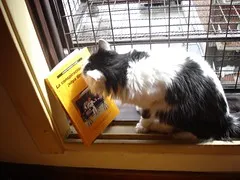
- "The Lunar Conspiracy..." and Marget (my skeptical cat)
- "The Lunar Conspiracy..." among my astronomy and related books.
Photo credit: Gerardo Blanco