Why do skeptics tend to reject new claims more often than accept them? Don't ideas have a 50-50 chance of being true or not? Here we won't be cynical, but we will take the opportunity to greet cartoonists, though we believe none will read us.
Massimo Pigliucci is a professor of ecology and evolution at the University of New York and head of the philosophy department at Lehman College. What follows is based on his article "Null Hypothesis And The Logic Of Skepticism" published today in Scientific Blogging.
Being a skeptic is a rather lonely art. People often confuse you with a cynic, and I'm not using the term in the classical philosophical sense, of course.
In ancient Greece, the cynics were people who wished to live in harmony with nature, rejecting material goods. The origin of the name (which comes from the Greek word kyon, "dog") seems to arise from the derogatory way they were called due to their frugal life. They were "dogs," among them Diogenes of Sinope. The character was immortalized in the characters of Diogenes and the tramp that Jorge Guinzburg and Carlos Abrevaya knew how to write masterfully and which continues to be published on the back page of Diario Clarín through its longtime cartoonist, Tabaré.
The skeptics, on the other hand, were philosophers who said that since nothing could be taken for certain, the only thing to do was to suspend judgment. As everything is subjective, it is only possible to give opinions.
A skeptic, in the modern sense of the term, let's say from Hume onward, is someone who thinks that X must be proportional to the amount of evidence in favor of X. Or, in Carl Sagan's famous popularization of the same principle, extraordinary claims require extraordinary evidence. In that sense, then, what I will call positive skeptics do not automatically reject new claims, but weigh them according to the evidence.
And, of course, we are not cynics in the modern sense of the term either, that is, we do not follow Groucho Marx in his song "Whatever It Is, I'm Against It".
One might think that few people would object to the simple idea that our thoughts should be adjusted to the available evidence. It is also conceivable that, since evidence changes continuously and our evaluations are always imperfect, one should not subscribe to absolute beliefs of any kind.
On the one hand, the skeptic considers a given claim that he is not in a position to (provisionally) reject as positive more often (in fact, much more often) than (provisionally) accepting it. Why? Shouldn't the possibility that something is true be a priori 50%?
Let's go to statistical inference, which is a part of the latter that comprises the procedures for inferring the properties of a population from a sample. One methodology is significance testing or hypothesis testing. A specific hypothesis is considered, called the null hypothesis, and an alternative to determine which is true. The null hypothesis is also called neutral and represents what we will maintain unless the data indicate otherwise. It is said that the null hypothesis cannot be proven, but it can be ruled out by the data.
In research studies, two types of errors can occur, called type I and type II (or alpha and beta). Although with names that seem far-fetched, we are surely familiar with them through other expressions like "false positive" or "false negative." The HIV virus and the need to get tested for it led a large part of society to become aware that results not consistent with reality can appear. A false positive occurs when we are diagnosed with the virus, even though it is not true. That is why it is strongly recommended to have more than one test. In this case, the doctor would be rejecting the neutral hypothesis (being healthy), based on the test results, indicating that the test was positive (that there is HIV), although in reality we are healthy.
The type II error is the inverse: it occurs when the null hypothesis is accepted, which is actually false. Following the same example, the doctor concludes that we are healthy (negative result, virus not found), but we do have the virus.
These types of errors do not only occur in medicine. In computing, false positives and negatives are also discussed, for example, in diagnosing viruses on a PC.
It is also often said, jokingly, that there is a third type of error: not remembering which is type I error and which is type II...
What does this have to do with skepticism? When confronting a new claim, it is reasonable to think that the null hypothesis is that the claim is false. That is, the default position is skeptical. Now, the difficult part is that these types of errors are inversely proportional: if we lower the threshold for one, the threshold for the other automatically increases. To get out of the dilemma, it is necessary to take the hard work of collecting more data.
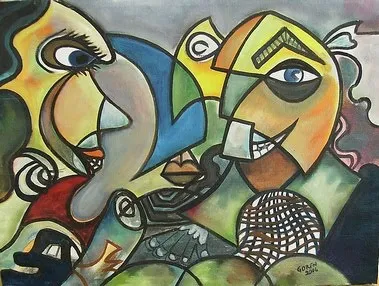
Therefore, if we decide to be conservative (not in the political sense, but statistically speaking), we will raise the bar for evidence, decreasing the chances of rejecting the null hypothesis and accepting the new belief when it is not in fact true. Unfortunately, we will simultaneously be increasing the chances of accepting the neutral one and rejecting the new belief, when the latter is true.
Thus, we humans are destined to navigate the dangerous waters between Scylla and Charybdis, between being too skeptical and too naive. And the two monsters are not equally strong: if we accept the assumption that there is only one reality out there, then the number of false hypotheses must be overwhelmingly larger than the number of correct ones. In other words, there must be many more ways to be wrong. Take the discovery that DNA is a double helix (the true answer, as far as we know). It could have been a single helix (like RNA) or a triple one (as Linus Pauling suggested before Watson and Crick hit the nail on the head). Or it could have been a much more complex molecule, with 20 or 50 helices. Or not be helical and so on.
Thus, when we try to navigate the course between skepticism and naivety, it makes sense to stay closer to the Scylla of skepticism than to steer the ship of beliefs into the threatening and much longer reaches of the naive Charybdis. The net result of this prudent policy, however, is that positive skepticism will lead us to reject many beliefs.
It would be easier to accept the hypothesis that the United States faked the trips to the Moon (note the plural), that they have an alien locked up in some desert hangar, that the First Lady of Japan travels to Venus, that a child cries blood...
But what happens to us is that, a priori, we reject them.
As said, it is a lonely art, but with the satisfaction of being right more often. Of course, we won't be very popular, nor will it lead us to be surrounded by blonde mireyas...
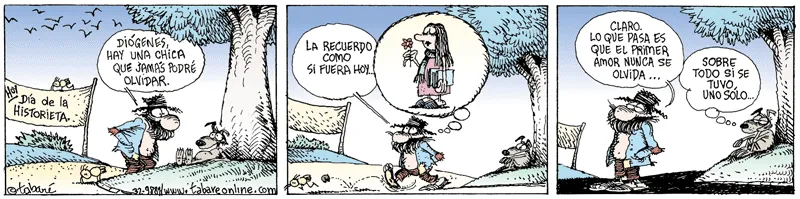
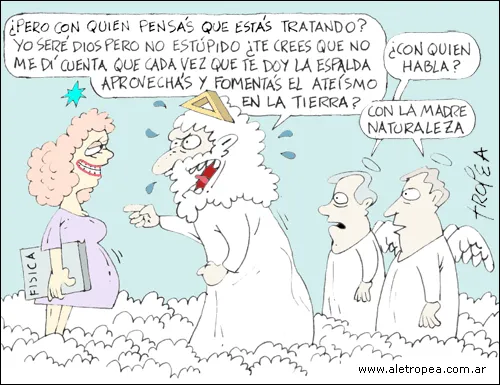
The work of the cartoonist is also somewhat lonely and often combines a mix of cynicism (or sarcasm) and skepticism. To all of them, creators of Mafalda y Compañía, our skeptical greeting. On the day of historieta argentina, we extend a hug to those who are no longer with us, like Fontanarrosa; to those who always stole a smile from us, like Altuna, García Ferré, Quino, Dante Quinterno, Trillo, Caloi, Sendra. And to the new generation, among whom I highlight the brilliant Tute and, why not, friend Ale Tropea, whose production fits like a glove to everything said: ciencia y humor.
Will any of them read this post? The null hypothesis is yes, so we reject it, hoping to be wrong, once again...
Sources and related links
- "Null Hypothesis And The Logic Of Skepticism", Massimo Pigliucci, Scientific Blogging.
About the images
- Scylla and Charybdis. Painting by Harim Gorem
- Diogenes and the linyera. Credit: Tabaré
- God and Nature. Credit: Ale Tropea