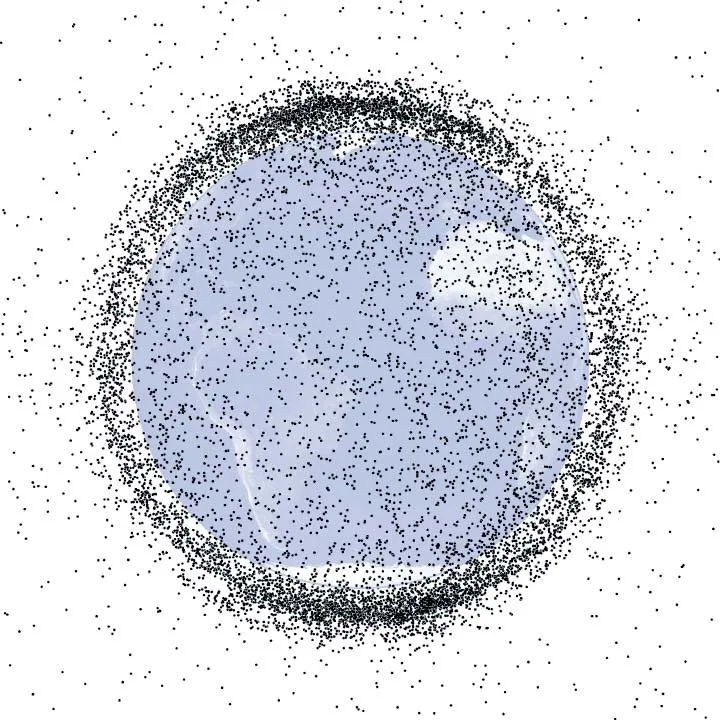
New images describe the objects larger than 10 centimeters, made by humans, orbiting our planet. There are about 19 thousand!
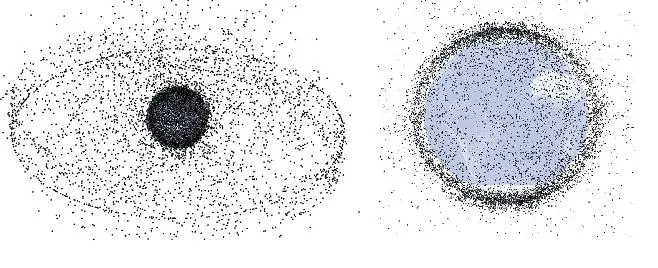
NASA published a graphic representation of space debris today, based on the latest data and analysis from the U.S. Space Surveillance Network and the Orbital Debris Program.
As in previous descriptions, it looks like a disaster. Let's recall our note "Space debris: the problem in images" with data from the European Space Agency.
But NASA stated that it is not as terrible as it seems, although human debris is added to space every year, according to the Space.com site.
"The dots are not to scale and space is a very big place," declares NASA. "Collisions between large objects are quite rare. The orbit of each piece is well known. If any debris gets in the way of an operational NASA satellite, flight controllers will maneuver the satellite."
Just this week, the shuttle Discovery had to dodge an orbital debris while the astronauts prepared to return. Also this week, a piece of a Chinese satellite was expected to pass near the Space Station on Wednesday, although it did not happen.
And these are the latest cases, but there have been many more.
"The threat of orbital debris to space operation systems will continue to grow, unless the sources of space debris are brought under control," said Nicholas Johnson, NASA's chief of orbital debris, to a subcommittee in Washington in April.
Each dot represents a piece of known space debris at least 10 cm orbiting the Earth. Note the outer ring, known as geostationary orbit, where weather and communications satellites orbit at the same time as the Earth, allowing them to remain over the same point. The concentration of dots darkening the Earth in the center of the image represents the debris in low Earth orbit. In total, about 19,000 human-made objects orbit the planet, counted as of July this year. But there are also countless smaller objects.
Credit: NASA/Orbital Debris Program Office.
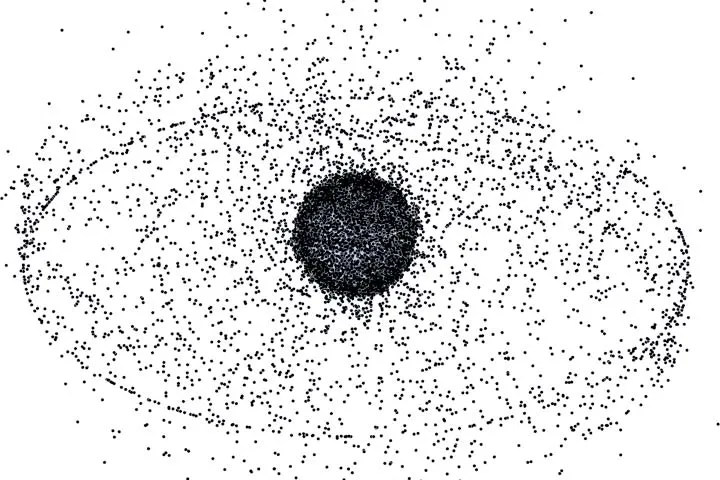
More images at Orbital Debris Graphics.
Sources and related links
About the images
- Images from NASA