Two researchers propose how to reduce the computational cost in very large antenna arrays by transforming them into omniscopes.
Astronomers want larger and better telescopes every day. But in the world of radio telescopes, greater sensitivity requires a larger surface area and costs grow exponentially.
That is why astronomers are interested in a less onerous approach: connecting many smaller antennas to form an interferometer. Such an antenna array can be as large as we want.
The best-known very large arrays are those of the NRAO VLA, which consists of 27 antennas of 25 meters each arranged in a "Y" shape.
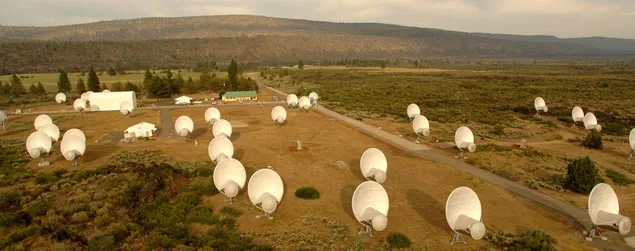
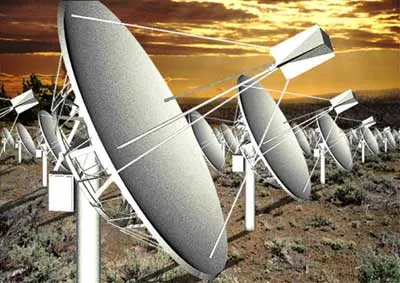
The Allen Telescope Array, which currently has 42 antennas, when completed, will have 350.
The ESO Very Large Telescope Array or VLT is a system of four telescopes in Chile.
The problem is that in interferometry, the signals from each antenna must be correlated with the others and the computational cost is proportional to the square of the number of antennas.
So it quickly becomes prohibitive. But Max Tegmark of MIT and the Argentine Matías Zaldarriaga, at the Institute for Advanced Study in Princeton, propose two measures to reduce costs.
The first is to divide the antenna array into groups, each considered as an element. This reduces the correlation cost from N2 to (N/M)2, at the price of reducing sky coverage by a factor M. In other words, the savings come from discarding available sky information and thus not computing it.
The second measure is to reconfigure the antennas into a rectangular grid that can be correlated using an efficient algorithm called "Fast Fourier Transform". This algorithm is used in signal processing, statistics, image processing, noise reduction, etc.
This again reduces the computational cost from N2 to N log2 N at the price of lower resolution.
In a new scientific paper, the researchers ask what type of antenna design allows for low-cost signal processing without discarding any information. And they show that this class can be incredibly large, not just rectangular grids, but a wide variety of combinations.
"This opens the possibility of getting the best of both worlds, combining affordable signal processing with coverage tailored to specific scientific needs."
In the paper, they illustrate the possibilities with some examples. For that, they gave a name to each design: 3-level, Plank, Strips, Blocks.
And they made comparisons between the proposed designs and designs of the Murchison Widefield Array (MWA). MWA is a low-frequency radio telescope, under construction, which will consist of 512 antennas divided into 32 arrays (tiles) of 16 antennas each arranged in a square shape (4x4).
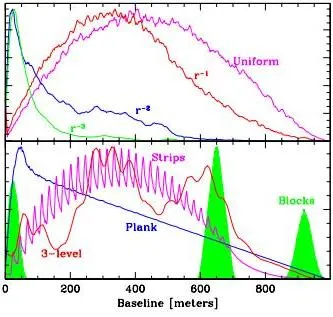
The image shows a comparison between the distribution of four MWA designs with cost N2 (top) with distributions of four hierarchical grids with computational costs of N Log N (bottom).
Zaldarriaga and Tegmark use the term omniscope since, they say, the arrays they propose would be omnidirectional and omni-chromatic and not focusing on a specific distant object.
About Matías Zaldarriaga
The young Doctor in physics studied at the University of Buenos Aires and has lived in the United States for a decade. He received the "genius" grant from the MacArthur Foundation in 2006. He was born in Argentina in 1971, graduated with a degree in physical sciences in 1994 and obtained his doctorate in 1998 at MIT.
About Max Tegmark
Max Tegmark was born in 1967. He is a Swedish-American cosmologist, a professor at MIT. He worked on data analysis for the Sloan Digital Sky Survey. He formulated the mathematical universe hypothesis.
Sources and related links
- Omniscopes: Large Area Telescope Arrays with only N log N Computational Cost
Max Tegmark (MIT), Matias Zaldarriaga (IAS)
arXiv:0909.0001v1 - Technology Review:Astronomers Turn To Omniscopes For Low Cost Observation
About the images
- Illustration of the Allen Telescope Array
Credit: SETI Institute - Comparative graph of design distribution. Credit: Zaldarriaga, Tegmark